
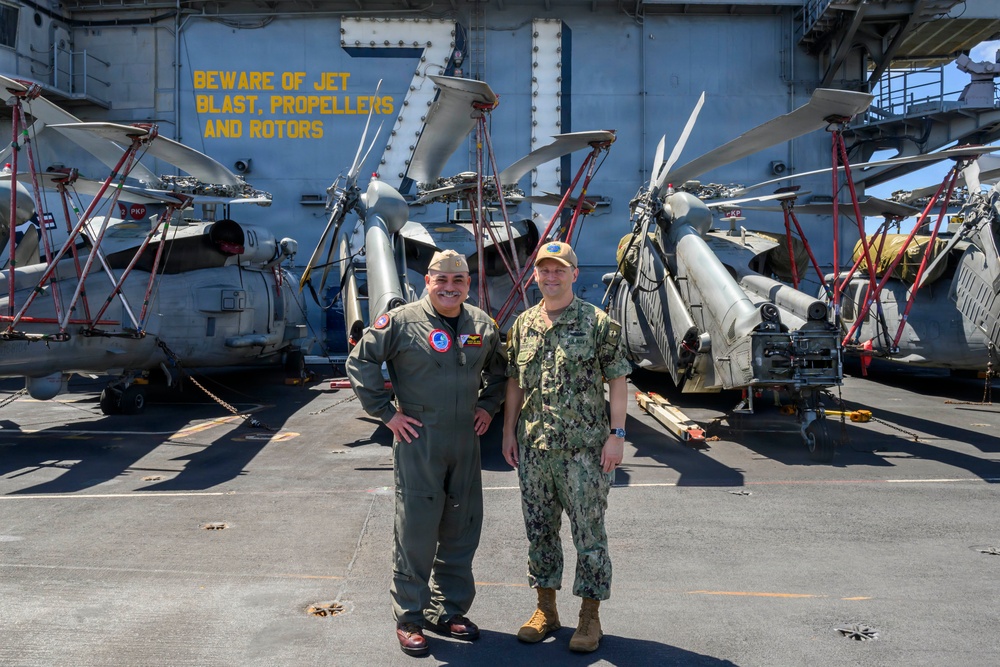
Photo By Petty Officer 2nd Class Ryan Holloway | Rear Adm. Marcos Jasso, commander, Carrier Strike Group (CSG) 9, left, poses for a...... read more read more
 Subscribe
Following the conclusion of the at-sea phase of the biennial Rim of the Pacific (RIMPAC) 2026 exercise, U.S. Navy Rear Adm. Chris Cavanaugh, commander, Submarine Force, U.S. Pacific Fleet, visited Nimitz-class aircraft carrier USS Theodore Roosevelt (CVN 71), the lead U.S. Navy ship for RIMPAC 26, July 30. During the visit, Cavanaugh met with U.S. Navy Rear Adm. Marcos Jasso, commander, Carrier Strike Group (CSG) 9.
The engagement focused on the strategic alignment of subsurface and surface fleet operations, with the stealth, speed, and capabilities of SUBPAC’s nuclear-powered submarines enabling unparalleled access for carrier strike groups and the greater Joint Force. Cavanaugh and Jasso discussed several topics, including the possibility of expanding options for integrating unmanned undersea vehicles (UUVs) into carrier strike group operations.
“The operational environment in the Pacific continues to evolve with the rapid development of technological advancements in the undersea domain,” said Cavanaugh. “The Pacific Submarine Force is heavily investing in unmanned capabilities to augment our manned submarines and preserve our undersea advantage across the full spectrum of submarine operations.”
Cavanaugh and Jasso explored how future UUVs, building on foundational successes, can operate as seamless, highly flexible tactical extensions of the carrier strike group, due to the unprecedented operational flexibility of these advanced autonomous systems. RIMPAC 2026 provided an ideal and timely backdrop for these discussions, with a multinational force of like-minded maritime partners demonstrating the necessity of seamless interoperability across all warfighting domains.
Additionally, the leaders explored the logistical advantages of unmanned systems, specifically focusing on utilizing UUVs to transfer critical parts and components between submarines and aircraft carriers. By leveraging these intra-group/intra-ship transfers, submarines would be able to deploy and retrieve unmanned platforms while remaining entirely submerged, ensuring stealth, operational security, and the rapid flow of critical assets without requiring the submarine to surface or return to port.
A recent noteworthy milestone for U.S. Navy’s UUV tactical development and integration included the Yellow Moray UUV system operational testing in 2025. Virginia-class fast-attack submarine USS Delaware (SSN 791) completed the first-ever, forward-deployed, submarine torpedo tube launch and recovery of a UUV to complete a tactical objective.
While conducting operations near Norway, Delaware and Yellow Moray successfully completed three tactical sorties, all launched and recovered through standard torpedo tubes, without the assistance of divers. An additional accomplishment for U.S. Navy UUV development occurred July 2026 in the Pacific, when an Orca extra-large UUV completed a transit of over 1,000 nautical miles for the first time.
The U.S. Pacific Fleet Submarine Force provides strategic deterrence, anti-submarine warfare, anti-surface warfare, precision land strike, intelligence, surveillance, reconnaissance, and early warning, and special warfare capabilities around the globe.
| Date Taken: | 08.13.2026 |
| Date Posted: | 08.13.2026 16:41 |
| Story ID: | 572379 |
| Location: | JOINT BASE PEARL HARBOR-HICKAM, HAWAII, US |
| Web Views: | 19 |
| Downloads: | 0 |

This work, Pacific Submarine Force Commander visits USS Theodore Roosevelt as RIMPAC 26 Concludes, must comply with the restrictions shown on https://www.dvidshub.net/about/copyright.

No keywords found.




