
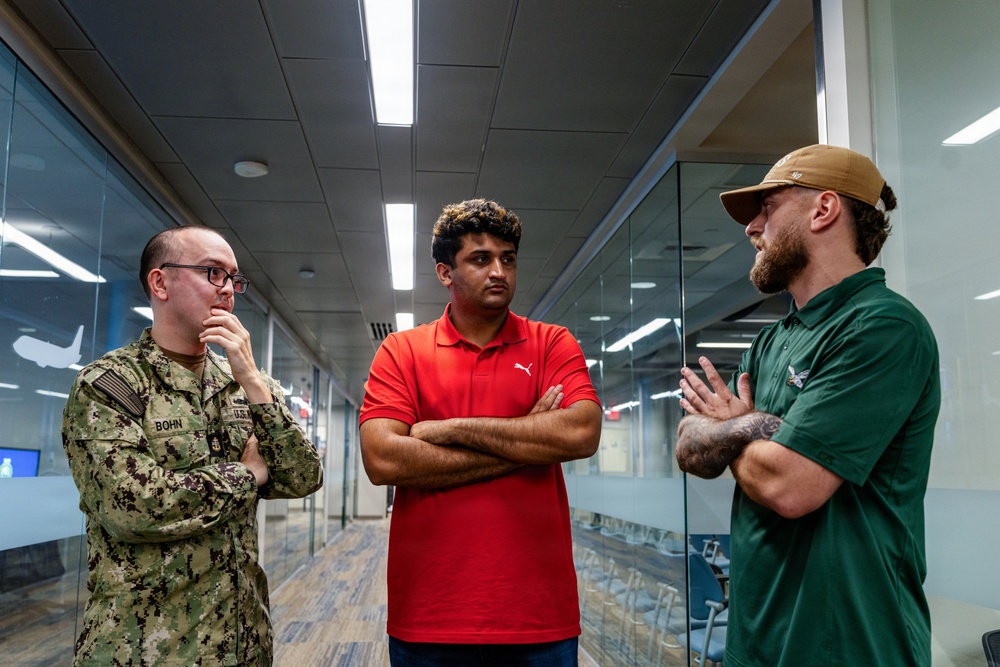
Photo By alexzander johnson | For Naval Supply Systems Command Weapon Systems Support (NAVSUP WSS) employees,...... read more read more
NORFOLK, Va. — For Naval Supply Systems Command Weapon Systems Support (NAVSUP WSS) employees, supporting fleet readiness often begins hundreds of miles away from the ships, aircraft and Sailors who depend on the parts they manage.
During a Meet the Fleet visit to Norfolk, NAVSUP WSS military and civilian personnel had an opportunity to close that distance by seeing firsthand how their work contributes to maintaining mission-ready aircraft and ships.
The visit connected employees from NAVSUP WSS sites in Philadelphia and Mechanicsburg, Pennsylvania with fleet personnel and provided participants an opportunity to see how supply support, maintenance and communication come together to support the warfighter.
Chief Logistics Specialist Alex Bohn, assigned to NAVSUP WSS Philadelphia and working at the Maintenance Operations Center (MOC), serves as a liaison between NAVSUP WSS and personnel supporting fleet maintenance operations.
Bohn said having NAVSUP WSS representation physically present at the MOC helps reduce the time required to resolve supply questions.
“If there are any real-time questions that come up that need to be answered, I’m able to push those up to the Philly team if I can’t answer it right away,” Bohn said. “Or, if I can, I just provide real-time support instead of them having to wait for emails or make phone calls.”
Bohn primarily works within the Fleet Readiness Center cell, where he and other personnel monitor maintenance discussions and identify issues requiring NAVSUP WSS support.
At its core, Bohn said the mission comes down to ensuring maintainers have the material they need to keep aircraft operational.
“That’s our job — procurement,” Bohn said. “How do we get the parts that the squadrons and the FRCs need to fix their components to get the jets flying?”
For NAVSUP WSS employees who normally perform that mission from an office, Meet the Fleet provided an opportunity to see the other side of the supply chain.
Bohn said email and telephone communication are essential, but they cannot always provide employees with the complete picture of what happens at the fleet level.
“If you only communicate via email, you don’t really see the whole picture,” Bohn said. “That goes both ways from the people here at the MOC who may not understand what goes on up in Philly, and then vice versa.”
Seeing the MOC in operation allows employees to better understand the volume and pace of fleet maintenance activities while also helping fleet personnel understand the work NAVSUP WSS employees perform to resolve supply challenges.
“When you can come face to face and meet those people and see that they are pushing just as hard as you’re pushing on your end, that really brings everybody together better,” Bohn said. Physically experiencing what was only a notion, Sean Cohen, a logistics management specialist, had his entire perspective transformed.
“The MOC, to me, previously was just spreadsheets and calls,” Cohen said. “Now I come to the building and physically see all the cells and all the work that goes into it, and all the dashboards we’re building and the innovation that we’re pushing forward. It’s inspiring to me.”
Cohen said the visit also reinforced that supporting the warfighter extends beyond ships, aircraft and equipment.
“When you go to see the warfighter, you realize that it’s more than just the ships and the aircraft. It’s the people as well,” Cohen said. “When you come face to face with civilian and military counterparts, you recognize that we are all doing different jobs, but the same mission.”
That face-to-face interaction provided participants an opportunity to see how separate responsibilities throughout NAVSUP WSS ultimately contribute to the same readiness mission.
“We’re all pulling in the same direction, and ultimately that’s supporting the warfighter and mission readiness,” Cohen said. “I think it’s really important for our civilian employees to be able to take this trip, come down and really see the impact that we make for both the people and the warfighter.”
Aman Mody, an inventory management specialist with NAVSUP WSS Mechanicsburg, said the visit allowed him to see equipment and capabilities connected directly to the material he manages.
Mody works within an expeditionary integrated weapons support team IWST that includes underwater unmanned vehicles and construction vehicles. Seeing fleet equipment firsthand helped connect his day-to-day inventory management responsibilities to their operational purpose. Seeing fleet equipment firsthand helped connect his day-to-day inventory management responsibilities to their operational purpose.
“One thing I can say about being interactive with the warfighter and seeing it in person and also being able to see what we’re doing to make an impact, was really exciting,” Mody said.
Mody said the experience helped him better understand how the parts and equipment managed by NAVSUP WSS contribute to the Navy’s ability to maintain combat-ready ships and systems.
“Seeing what we were doing to make an impact to have the carriers be combat ready was really exciting to see,” Mody said. “Our main goal is to be combat ready and support fleet readiness.”
For Mody, seeing equipment he had previously known primarily through his work as an inventory management specialist made the connection between supply support and fleet operations more tangible.
“Seeing exactly the parts that I managed and seeing it in real life was actually amazing,” Mody said.
The experience demonstrated how work performed behind a computer screen in Philadelphia or Mechanicsburg can ultimately affect equipment operating aboard ships, at maintenance facilities and throughout the fleet.
Bohn said that connection is increasingly important as NAVSUP WSS personnel work to provide the parts necessary to sustain mission-ready aircraft.
“It’s more vital than ever that we get the parts that the aircraft need,” Bohn said.
For Meet the Fleet participants, the visit provided more than a tour. It offered an opportunity to follow the mission from the office to the fleet, meet the people on the other side of emails, phone calls and spreadsheets, and see how individual responsibilities contribute to a shared mission.
For Bohn, Cohen and Mody, the experience reinforced that military, and civilian personnel may perform different jobs in different locations, but their work ultimately converges at the same point: providing the support necessary for the warfighter to accomplish the mission.
NAVSUP WSS provides program and supply support for weapon systems used by the U.S. Navy, Marine Corps and allied forces to keep naval forces mission ready. With locations in Norfolk, Virginia; Philadelphia; Mechanicsburg, Pennsylvania; and Tucson, Arizona, NAVSUP WSS supports operational readiness for nearly 300 deployable ships, 92 submarines and 3,700 aircraft worldwide.
| Date Taken: | 08.13.2026 |
| Date Posted: | 08.13.2026 13:49 |
| Story ID: | 572344 |
| Location: | NORFOLK, VIRGINIA, US |
| Web Views: | 72 |
| Downloads: | 0 |

This work, Meet the Fleet connects NAVSUP WSS workforce to the warfighter, by alexzander johnson, identified by DVIDS, must comply with the restrictions shown on https://www.dvidshub.net/about/copyright.

No keywords found.





