Redstone Arsenal to gain first permanent ordnance destruction system
Photo By Charles Maib |
A group of engineers from the U.S. Army Engineering and Support Center, Huntsville......read moreread more
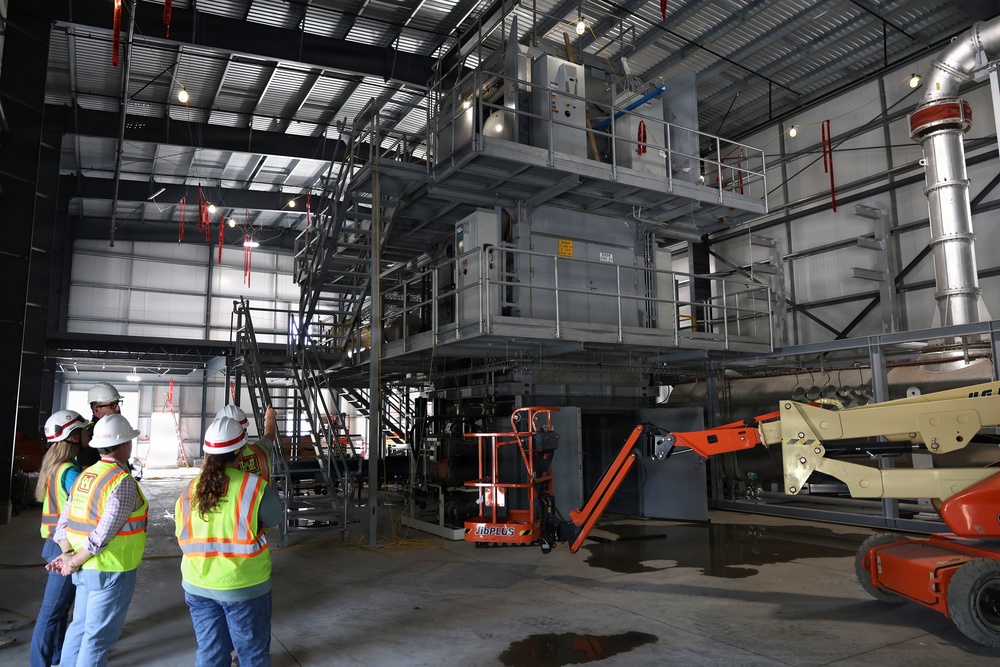
Photo By Charles Maib | A group of engineers from the U.S. Army Engineering and Support Center, Huntsville inspect the Prototype Recovered Ordnance Destruction System (PRODS) being constructed on Redstone Arsenal, Alabama. The system will allow for an up to 75% increase in the speed at which Redstone is cleared of ordnance, and a significant amount in tax dollar saving as well. This innovative technology comes via the experts at the Huntsville Support Center. see less
| View Image Page
Redstone Arsenal to gain first permanent ordnance destruction system
REDSTONE ARSENAL, Ala. — Redstone Arsenal is receiving its first permanent system for destroying recovered ordnance, a prototype facility designed to process munitions safely and at a rate that could keep long-term cleanup moving forward, minimize potential delays, and speed the clearing of munitions on the installation, thanks to the U.S. Army Engineering and Support Center, Huntsville.
Known as the Prototype Recovered Ordnance Destruction System (PRODS), the facility will integrate a static detonation chamber with an off-gas treatment system. Project documents prepared for the U.S. Army describe a system that will thermally destroy recovered munitions and related materials in a contained chamber, leaving scrap metal for disposal or recycling.
Redstone Arsenal officials have previously relied on smaller, portable disposal units that could process only limited quantities at a time. The permanent system is intended to match the pace of ordnance excavation, reducing the risk that recovered munitions could accumulate in storage and force excavation to halt, speeding operations by a potential 75% over current available disposal methods.
The Center is executing the project for the Arsenal and will continue to support the system during operations. According to the Corps of Engineers, the system was selected in part to destroy munitions and other materials that Redstone Arsenal's state-issued Resource Conservation and Recovery Act permit does not allow to be destroyed by open detonation.
Although PRODS is a prototype, much of the system is being built with proven equipment and technologies adapted for Redstone Arsenal. Huntsville Center civil engineers said the project is reusing critical components from a static detonation chamber system in Pueblo, Colorado, that would otherwise have been scrapped. The Redstone design also incorporates technology used at Blue Grass Army Depot.
Project estimates place the savings from reusing the Pueblo chamber at about $50 million, with time savings of around 456 days compared with purchasing a new unit. The Army also used an Other Transaction Authority agreement to begin the work and fund it incrementally. Project documents estimate that this approach saved an additional 12 to 24 months compared with a traditional Federal Acquisition Regulation-based acquisition, allowing the project to start more than two years sooner than under traditional procurement methods.
The Center’s project team is designing the system to achieve 99.9999% destruction and removal efficiency while meeting environmental requirements. The facility will also include a control room, backup power, fire protection, ventilation controls, and systems to contain waste streams and protect workers during destruction operations.
Huntsville Center project delivery personnel are also evaluating ways to improve ordnance recovery before ordnance reaches the chamber, including potential robotic or remote technologies. As of now, recovery technology has not yet been selected for the project.
Once construction is complete, the static detonation chamber will be transferred to Redstone Garrison's Directorate of Public Works. Huntsville Center will continue to provide technical support during the unit's systemization, testing, and operation.
For Redstone Arsenal, the permanent system represents a major change in how recovered ordnance is managed. Rather than relying on lower-capacity portable units or allowing disposal limitations to slow excavation, PRODS is intended to provide a dedicated, high-throughput capability on the installation and to support the arsenal's cleanup mission for years to come.