
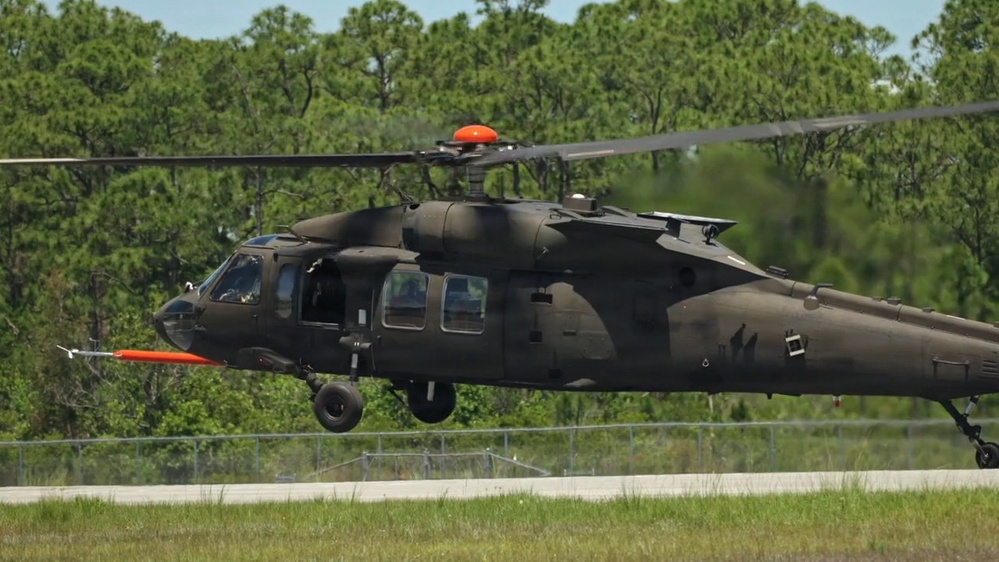
Courtesy Photo | Following successful forward flight testing aboard a UH-60M Black Hawk, the...... read more read more
 Subscribe
By Line: Ms. Gina Bublitz, supporting Capability Program Executive, Aviation and Ms. Carliss Spencer, Avion Solutions, Inc. supporting the Aviation Turbine Engines Project Office
Cleared for Takeoff: T901’s Historic Run to PFR The UH-60 Black Hawk continues to serve as a battle-hardened workhorse of Army Aviation. But the future demands more, more reach and more payload using less fuel. To power this next-generation warfighter, the Army launched the Improved Turbine Engine Program (ITEP). The mission was a formidable engineering challenge: deliver a staggering 3,000 shaft-horsepower engine - a 50 percent increase - while fitting seamlessly into the exact physical footprint as the current T700 engine.
On June 24, 2026, that future officially arrived. This next-generation powerplant cleared its most critical milestone by successfully concluding Preliminary Flight Rating (PFR) testing. More than just a technical feat, this milestone achieves a key airworthiness milestone, certifying the new powerplant is safe to continue qualification flight testing.
Breaking the Sequential Testing Mold In traditional military acquisitions, engine testing is a slow, step-by-step process. Engineers historically spend years testing prototypes in a sealed ground chamber, waiting for parts to fatigue, implementing redesigns, and only then clearing the engine for actual flight testing.
The T901 program changed the paradigm with simultaneous ground and flight testing. Running ground and flight trials in parallel allowed the team to rack up over 2,600 test cell hours and more than 90 hours of aircraft ground and flight test time.
This parallel approach created a rapid feedback loop between the ground and air. If test pilots detected a minor anomaly during a flight run, engineers in the ground test cell could immediately replicate the conditions, diagnose the issue, and push software or hardware refinement back to the flight line for the next day's mission.
The "Virtual Engine" That Flew First Before the physical T901 engine ever powered an aircraft and turned rotors, the engine had already flown thousands of simulated hours in a digital environment. To accelerate the Engineering and Manufacturing Development phase, the team built a digital twin of the engine. Using the Numerical Propulsion System Simulation, engineers ran thousands of digital iterations, constantly updating the models with real-world data from early altitude tests.
The combined test team, including members from Lockheed Martin, GE, and the US Army, also used advanced Computational Fluid Dynamics to model complex aerodynamic and thermal behaviors. By simulating heat transfer within the cramped confines of the helicopter's engine compartment before manufacturing any physical parts, the team mitigated integration risks and saved months of software and hardware redesigns.
Proving the "6k/95° " Power Promise The ultimate benchmark for the T901 is its high-and-hot operational rating: the ability to deliver full mission performance at 6,000 feet in 95-degree Fahrenheit conditions (6k/95°) where high density altitude severely degrades engine performance.
To prove the engine could handle these extreme operational envelopes, the program took a methodical, stepped approach. During recent testing, the T901 was able to conduct flights up to 17,000 feet and speeds of 160 knots. This successful flight testing validated the engine's performance models and set a solid foundation to push the envelope to the ultimate 6,000-foot requirement during the formal operational assessment planned for Fiscal Year 2028.
Momentum Toward the Future Achieving a Preliminary Flight Rating represents a key airworthiness milestone, demonstrating that the engine has attained the level of maturity and technical confidence necessary to support defined flight operations. The engine has proven it is safe, reliable, and fully capable of operating in the real world.
With PFR complete, the program is pivoting to its next major milestone: full airworthiness qualification testing for the engine, which will run in parallel with the UH-60M’s developmental testing. Flight Load Surveys and continued flight tests will demonstrate the added capabilities the T901 provides for the UH-60M at heavy, high, and hot conditions, with activities scheduled to kick off in the first quarter of Fiscal Year 2027.
The story of the T901 engine isn’t just a victory for DoW acquisition design and development, it is proof that when the military combines digital engineering with agile, parallel testing, we can deliver next-generation capability to the warfighter on an accelerated timeline.
| Date Taken: | 08.10.2026 |
| Date Posted: | 08.12.2026 13:39 |
| Story ID: | 572245 |
| Location: | ALABAMA, US |
| Web Views: | 16 |
| Downloads: | 0 |

This work, Cleared for Takeoff: T901’s Historic Run to PFR, by Belinda Bazinet, identified by DVIDS, must comply with the restrictions shown on https://www.dvidshub.net/about/copyright.


No keywords found.




