
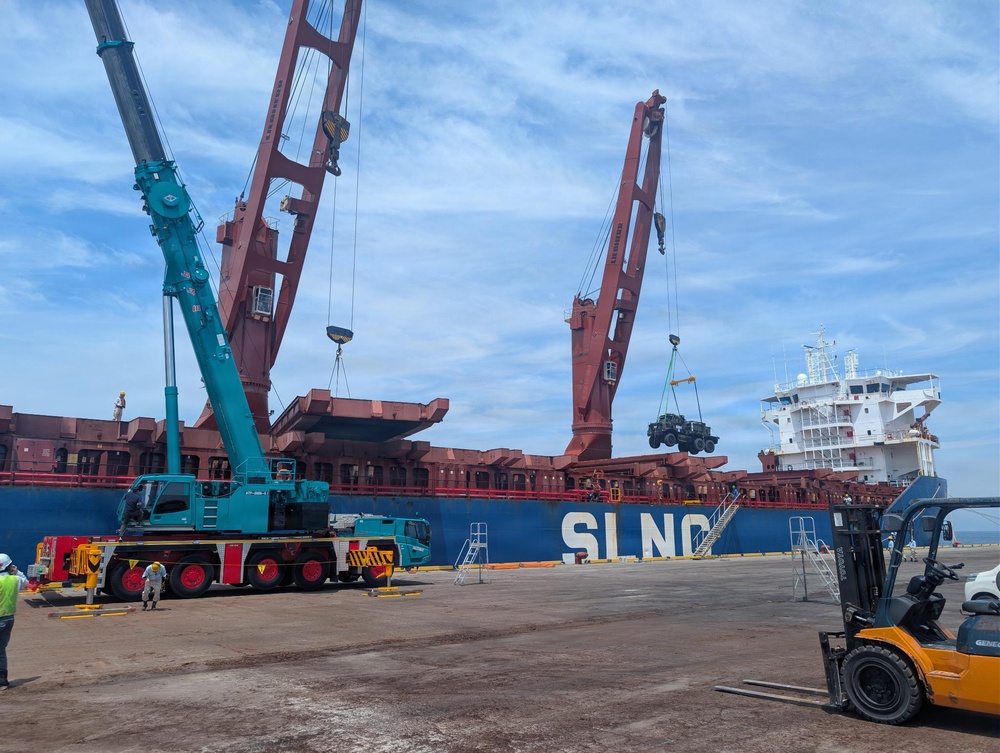
Courtesy Photo | Soldiers assigned to the 836th Transportation Battalion and 599th Transportation...... read more read more
 Subscribe
OITA, Japan — Before Soldiers and Marines could maneuver across training areas during Resolute Dragon 26, Soldiers assigned to the 599th Transportation Brigade and 836th Transportation Battalion executed terminal operations at Oita Port, ensuring the equipment needed to support the exercise arrived safely, efficiently and on time.
Resolute Dragon 26 is an annual bilateral exercise conducted across Japan that strengthens the command, control and multi-domain maneuver capabilities of III Marine Expeditionary Force and the Japan Ground Self-Defense Force's Western Army, with a focus on supporting and defending key maritime terrain. While much of the exercise highlights bilateral training and tactical operations, transportation Soldiers provide the critical link that enables those operations by moving equipment from strategic sealift to the units training throughout Japan.
For the 599th Transportation Brigade and 836th Transportation Battalion, that mission centered on serving as the Army's forward-stationed port operations unit in mainland Japan. Working alongside military and civilian partners, the battalion executed terminal operations that ensured military cargo moved through Japan's strategic ports and into the hands of the forces participating in the exercise.
"The primary mission objective for the 599th Transportation Brigade and the 836th Transportation Battalion is to serve as the Single Port Manager (SPM) to orchestrate the rapid, secure surface upload and download of cargo, reception, staging, and onward movement of joint force combat equipment across Japan's strategic ports,” said Lt. Col. Jason Scudamore, commander of the 836th Transportation Battalion. “During Resolute Dragon 26, the battalion's focus centers on executing synchronized seaport terminal operations; This links strategic sealift assets directly to the distributed operational nodes where Marine Littoral Regiments and JGSDF units are actively maneuvering."
Although cargo discharge operations at the port spanned only a few days, successfully executing them required months of preparation.
“Executing port operations during an exercise such as Resolute Dragon begins well before any vessel arrives in port,” said James Miller, transportation planning specialist with the 836th Transportation Battalion. “The planning and coordination process originates at the planning conferences, where requirements, participating organizations, and logistical parameters are identified and refined.
“As the Transportation Planner for the 836th Transportation Battalion, my role during these conferences is to identify the organizations intending to move cargo in support of the exercise, determine the designated Seaport of Debarkation (SPOD) and Seaport of Embarkation (SPOE) locations within Japan where cargo will be loaded or discharged, and confirm the types of support required to execute discharge operations,” continued Miller.
Once those requirements are identified, the information is used to build the port plans that set the conditions for execution.
“Once this information is consolidated, it is disseminated to the appropriate battalion elements ... to initiate the development of comprehensive port plans,” Miller said. “These plans address stevedoring requirements, cargo staging layouts, cargo movement routes, accountability procedures, and detailed discharge and upload operations. This deliberate planning process ensures that all stakeholders are synchronized ... and in accordance with established timelines.”
Once those plans moved from paper to the port, the battalion's Terminal Management Team took on oversight of the discharge and loading operations, coordinating the people and organizations involved throughout execution.
"Port operations play a critical role in enabling the successful execution of Resolute Dragon 26 by ensuring the safe, efficient, and timely movement of military cargo into and out of mainland Japan. The 836th Terminal Management Team (TMT) is responsible for providing oversight of all discharge and loading operations involving exercise-related equipment and materiel. This includes enforcing compliance with established safety standards, coordinating with port and local authorities, exercising stakeholders, and ensuring that all personnel involved in the operation adhere to the operations plan. Through deliberate planning, synchronized execution, and continuous communication with 3rd Marine Expeditionary Forces Mobility Team, the TMT ensures that cargo is received, processed, and onward-moved in a manner that supports the exercise timeline and overall mission objectives," Miller said.
For transportation Soldiers, that work represents far more than loading and unloading equipment. Every vehicle discharged, every piece of cargo accounted for and every movement synchronized directly supports the larger exercise, ensuring participating forces have the equipment necessary to train alongside allies and partners across Japan.
While transportation operations often take place behind the scenes, they are essential to projecting and sustaining combat power throughout the Indo-Pacific. Exercises like Resolute Dragon provide an opportunity to put those capabilities into practice, moving equipment from strategic sealift into the hands of the forces that need it.
For Soldiers assigned to the 599th Transportation Brigade and 836th Transportation Battalion, Resolute Dragon 26 demonstrated the work required to make that movement possible. Through months of planning, coordination and execution, transportation Soldiers helped set the logistical foundation for joint training across Japan, reinforcing the Army's role in enabling readiness and supporting the U.S.-Japan alliance.
| Date Taken: | 08.03.2026 |
| Date Posted: | 08.11.2026 20:59 |
| Story ID: | 572172 |
| Location: | US |
| Web Views: | 28 |
| Downloads: | 0 |

This work, Behind the movement: Transportation Soldiers enable Resolute Dragon 26, by SGT Deneisha Owens-McParland, identified by DVIDS, must comply with the restrictions shown on https://www.dvidshub.net/about/copyright.


No keywords found.




