
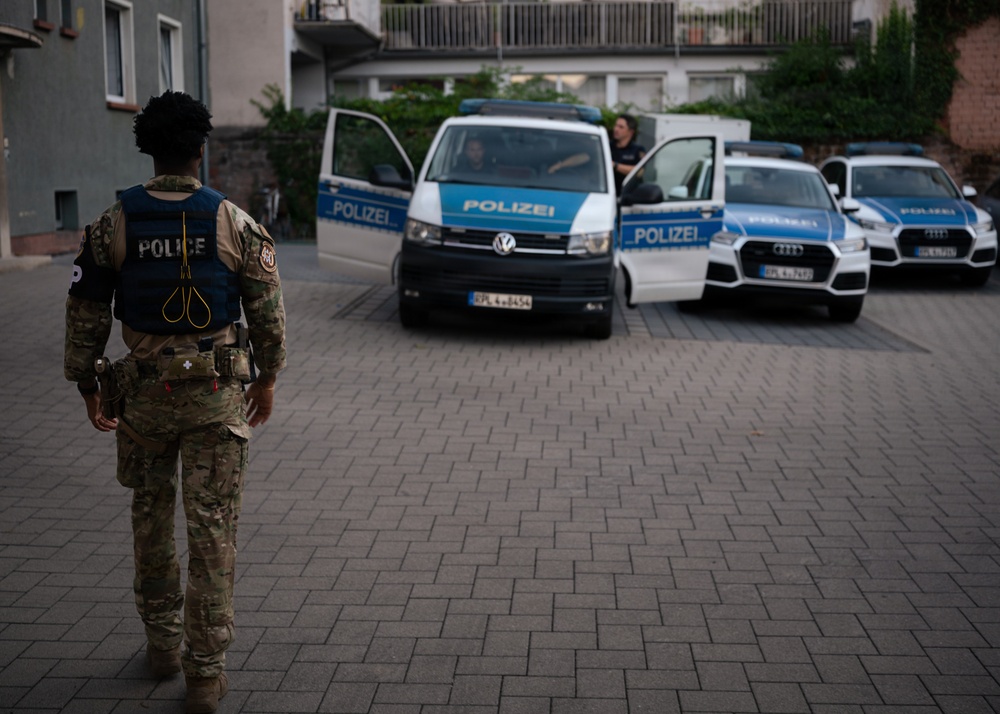
Photo By Senior Airman Edgar Grimaldo | U.S. Air Force Senior Airman Elijah Merritt, 569th U.S. Forces Police Squadron desk...... read more read more
 Subscribe
In the crowded streets of old town Kaiserslautern, Germany, U.S. Air Force defenders assigned to the 569th U.S. Forces Police Squadron and German police officers from Dienstgruppe Flex, a Kaiserslautern police unit responsible primarily for old town Kaiserslautern patrolled side-by-side Aug. 7-8, 2026.
The patrols paired Airmen assigned to the 569th USFPS with officers from DG Flex, a Kaiserslautern police unit responsible primarily for old town Kaiserslautern. Their partnership provides tailored support to a community where American and German residents live, work and socialize alongside one another.
“Because so many Americans live here, we need you and you need us,” said German Police Chief Inspector Max Weigerding, DG Flex shift supervisor.
Kaiserslautern’s large American population sets policing in the city apart from most of Germany. German officers regularly interact with U.S. service members and their families. These encounters can involve language barriers, different police procedures, and questions of jurisdiction, Making clear communication between German and U.S. police organizations essential to coordinating responses, sharing information, and resolving incidents effectively.
For U.S. Air Force Senior Airman Elijah Merritt, 569th U.S. Forces Police Squadron desk sergeant, the mission offers a law enforcement experience unavailable at most Air Force installations. Squadron personnel can patrol off base and support German police while operating within the legal authorities and policies of both organizations.
That different patrol settings with German polizei creates opportunities to learn. Weigerding, who has worked with the 569th USFPS through DG Flex since 2017, said the partnership similarly helps German officers understand what happens after they transfer a U.S. service member to military authorities, including how the Status of Forces Agreement and the Uniform Code of Military Justice apply after the German legal process.
Working with German police has helped Airmen develop patience, professionalism, awareness and how to read body language.
“Their ability to take control of a situation and maintain that control has impressed me most,” Merritt said. Both officers said a successful patrol begins before an incident. A visible police presence can discourage confrontations, while conversations with residents, business owners and bar security personnel help officers identify concerns before they become problems.
“It is not only about preventing bad behavior; it is also community policing,” Weigerding said. “We talk with residents, explain what we do, answer questions and have ordinary conversations with people.”
Those interactions build trust, and also help residents understand why U.S. and German officers patrol together. Community members sometimes approach the Airmen to ask about their mission, take photographs or offer food and candy as gestures of appreciation.
Regular patrols also build trust between members of the participating organizations. Officers learn one another's capabilities and know whom to contact when an incident requires additional personnel or specialized support.
“We know that we can count on one another if a situation gets out of hand,” Merritt said. “It is really about being able to rely on one another.”
Joint patrols also help correct misconceptions about police authority. When German and U.S. police respond together to off-base incidents involving U.S. service members, they can explain their respective responsibilities to those involved. German police retain jurisdiction off base, while service members may also face consequences under military law. Clarifying these roles during an incident demonstrates how the two organizations work toward a shared purpose.
“Our uniforms represented separate organizations, authorities and nations,” Merritt said. “I want residents to see beyond those differences to our shared purpose.”
“We would like for them to think, ‘These are the same people protecting us,’ regardless of the difference in our uniform or even citizenship,” Merritt said.
Each patrol puts that partnership into action, strengthening the trust, communication and mutual support U.S. and German police need to protect the community together.
| Date Taken: | 08.10.2026 |
| Date Posted: | 08.11.2026 10:50 |
| Story ID: | 572087 |
| Location: | DE |
| Web Views: | 24 |
| Downloads: | 0 |

This work, Joint patrols strengthen U.S.-German police partnership, by SrA Edgar Grimaldo, identified by DVIDS, must comply with the restrictions shown on https://www.dvidshub.net/about/copyright.


No keywords found.




