NORTH LITTLE ROCK, Ark. — For Army National Guard medical leaders, readiness can come down to something as routine as a dental appointment, a hearing test or a medical case that has lingered unresolved.
Though they may seem insignicant, Individual deficiencies can have much larger consequences. When Soldiers lack medical readiness, commanders have fewer personnel available to train, mobilize and deploy.
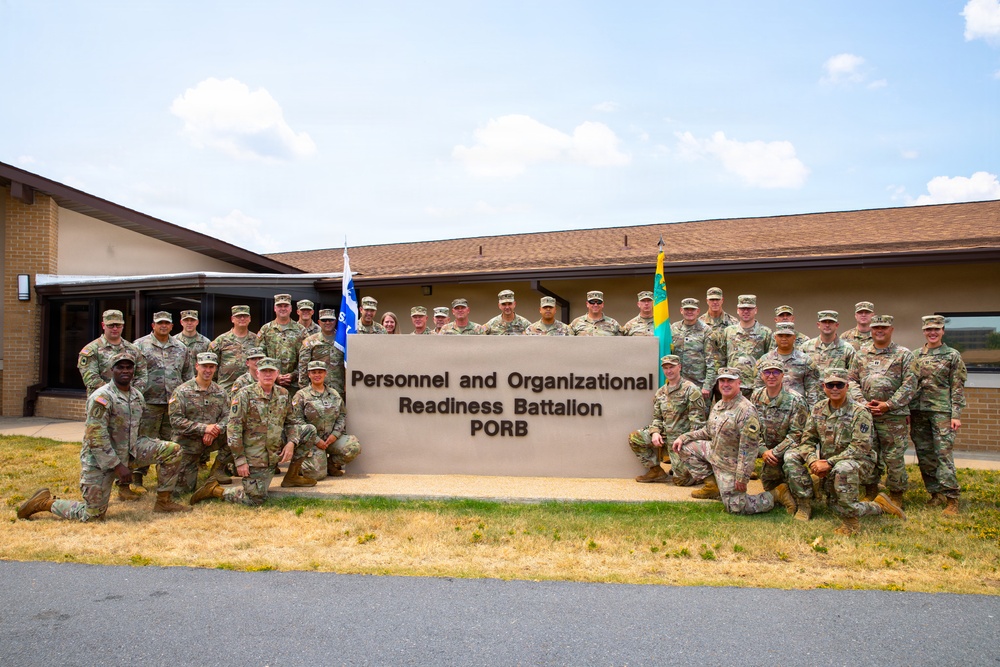
That bridge connecting medical administration and combat readiness exists at the center of the pilot State Surgeon and Deputy State Surgeon Orientation Course hosted by the Personnel and Organizational Readiness Battalion at the National Guard Professional Education Center.
This pilot course brought medical professionals and senior enlisted leaders from across the 54 together at PEC for the exchange best practices, receiving current program guidance and identificaiton of practical ways to improve medical readiness within their organizations.
For PORB and PEC, hosting the pilot represents more than another course on the training calendar. This is an opportunity to help shape a developing training model while placing practitioners from across the force in the same room to evaluate challenges, compare solutions and carry lessons back to their states.
That approach allows the course to evolve around the real-world problems medical leaders are currently facing.
Capt. Joel Penzo Gomez, deputy state surgeon administrative for the New Jersey Army National Guard, said the course's personnel management instruction provided an immediate look at how states can better manage their medical workforce.
“The personnel management portion of the course was very revealing,” Gomez said. “Knowing how many officers, medical service officers, providers and nurses we are authorized to have within the state, and then what we could do to better manage their careers in order to incentivize them to stay within the military.”
Retaining those professionals is itself a readiness issue. Medical officers, providers, nurses and enlisted medical personnel form the system responsible for identifying deficiencies, managing cases and returning Soldiers to a deployable status.
For Gomez, one of New Jersey's most persistent challenges is dental readiness, particularly getting dental class three Soldiers the treatment they need.
“A lot of the issues that we're having is with getting Soldiers their dental treatment in order to improve medical readiness,” Gomez said.
During the course, Gomez endeavored to learn how other states are using local contracting and other available resources to address dental deficiencies. He says he intents to examine their procedures and determine how similar practices could be implemented in New Jersey.
That exchange of solutions is one of the pilot course's foundational pillars. Instead of requiring states and territories to approach readiness problems independently, participants can identify methods that are already bearing fruit elsewhere, examine how they work and determine whether those practices can be adapted to their own formations.
Master Sgt. Brad Everhart, senior enlisted medical advisor for the Wisconsin Army National Guard, said those shared experiences can create immediate opportunities to improve efficiency.
“There are just a finite amount of resources, so being able to attend a training like this gives an opportunity to gain efficiencies by possibly seeing a way another organization is doing it,” Everhart said.
Everhart said the course has already provided equipment recommendations for improving hearing readiness compliance and new approaches for addressing other medical deficiencies.
“Those have been quick wins, and we're only a day and a half into the course,” he said.
The course also expands the conversation by including senior enlisted medical leaders alongside state surgeons, deputy state surgeons, physicians and other medical professionals.
Everhart emphasized just how important enlisted representation is, as medical readiness is not solely a clinical concern. It has an effect on how Soldiers are managed, how information reaches units and how policies trickle down to the force at the lowest level.
“Enlisted management and utilization is a huge underrepresented part without somebody sitting at the table where decisions are discussed and made,” Everhart said.
This in-person pilot format of the course also gives students an opportunity to build professional networks of relationships that extend beyond the classroom. Gomez said meeting peers face to face makes it easier to collaborate later when a state encounters a problem another organization may already know how to solve.
For PORB, bringing those leaders together fits directly within its mission of developing personnel and organizational readiness. For PEC, the course demonstrates how the center can serve not only as a venue for established training, but as a place where emerging programs can be tested, refined and informed by the people who will ultimately put them into practice across the force.
The impact of that work is ultimately measured outside the classroom.
Every dental deficiency resolved, hearing requirement completed, medical case properly managed and medical professional retained increases the number of Soldiers available to commanders. As units prepare for increasingly demanding operational environments, those improvements translate into healthier, more deployable formations who are better prepared to fight.
The pilot course gives medical leaders a place to find those improvements, test ideas against the experience of their peers and return home with solutions they can put to work.
Because medical readiness is not simply an administrative metric.
It is combat readiness.
| Date Taken: |
08.07.2026 |
| Date Posted: |
08.10.2026 14:57 |
| Story ID: |
571985 |
| Location: |
NORTH LITTLE ROCK, ARKANSAS, US |
| Web Views: |
27 |
| Downloads: |
0 |
PUBLIC DOMAIN

This work, Medical leaders turn shared experience into combat readiness at PEC, by SSG Bryce Colvert, identified by DVIDS, must comply with the restrictions shown on https://www.dvidshub.net/about/copyright.