
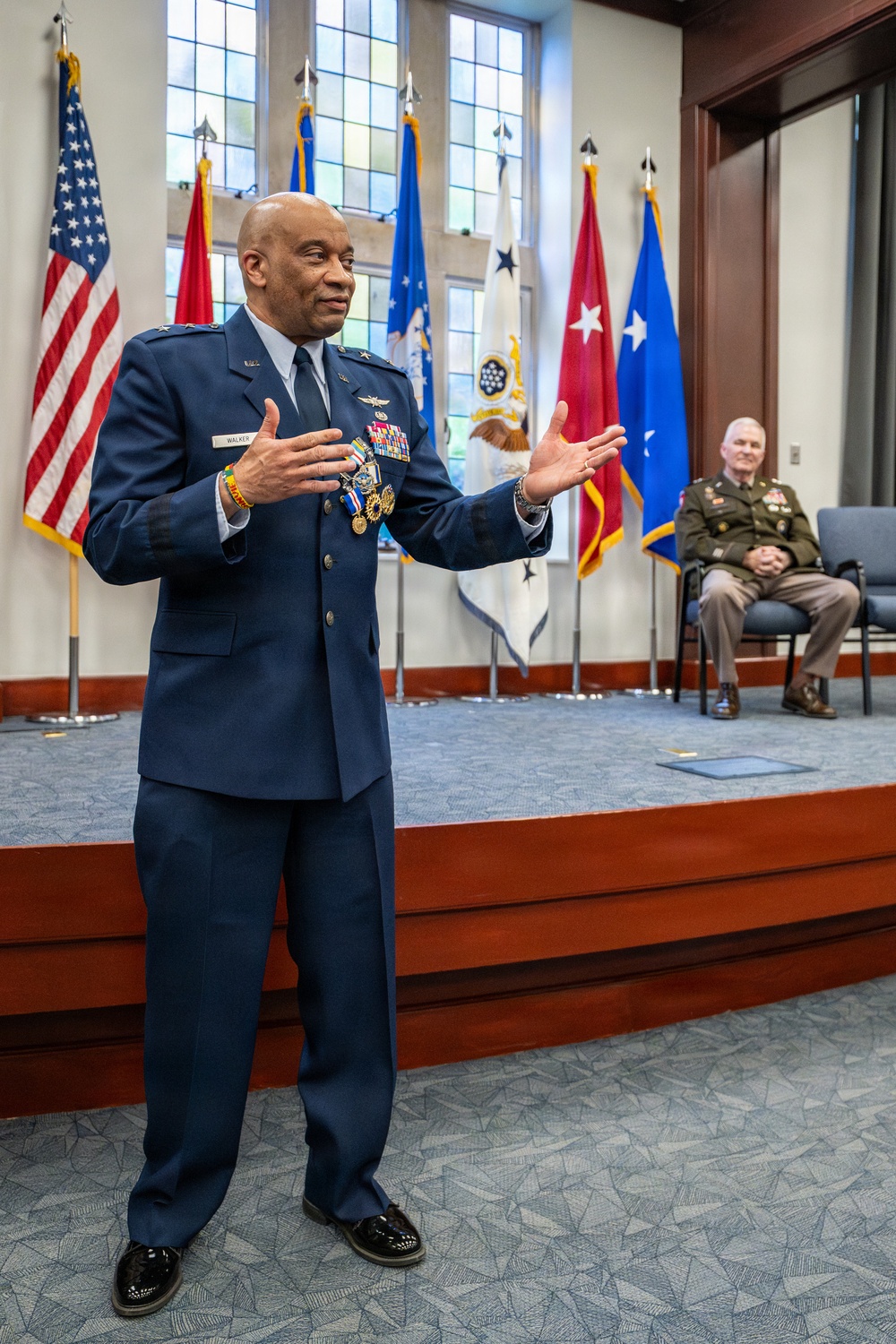
Photo By Dale Greer | U.S. Air Force Maj. Gen. Charles Walker, Air National Guard assistant to the judge...... read more read more
 Subscribe
U.S. Air Force Maj. Gen. Charles Walker concluded his military career during a ceremony here July 24, drawing a close to 35 years of service that saw him excel in top posts at the Kentucky Air National Guard, National Guard Bureau and United States Air Force.
Walker, Air National Guard assistant to the judge advocate general of the Air Force, thanked more than 100 friends, family, coworkers and mentors gathered here at the Scarritt Bennett Center for their support through the years, singling out his mother and father for fostering a uniquely protective environment in which to thrive.
“My parents created this little bubble around me that was only positive,” Walker said to the audience. “I knew no negative. And that is why I am here today — the guidance and inspiration that Charles and Mary Walker set about making for me as a kid.”
He found an equally supportive family in the United States Air Force, and especially in the Air National Guard.
“The Air Force has been part of my life since I was 19 years old and wandered into an ROTC detachment for a free t-shirt.” Walker said, laughing. “(I came) for the free t-shirt, and I stayed for the people.”
After four active-duty assignments and nearly two more years in the Air Force Reserve, the Florida native transferred to the Kentucky Air Guard’s 123rd Airlift Wing in Louisville in 2005.
“From the moment I joined the Kentucky Air National Guard, it felt like home,” he said, addressing a cadre of Kentuckians in the audience. “Thank you for being a part of this journey. This journey is not about me. It’s about helping the mission. The mission is all I ever cared about — and the people that made it happen.”
U.S. Army Maj. Gen. Haldane Lamberton, adjutant general of the Kentucky National Guard, said Walker has “a reputation for fixing things,” which has enhanced numerous organizations from the squadron level to the Pentagon over the past three decades.
“Because of Chuck’s people skills, because of his community skills, he was able to bring folks together,” said Lamberton, the ceremony’s officiant. “I could see it at the state level: Things were happening much more smoothy than they were before” because of Walker’s influence.
“Whether it was the active-duty Air Force or the Air Force Reserve or the Air National Guard, we’re better organizations because of you and your efforts,” he said.
Lamberton then presented Walker with the Distinguished Service Medal, the Defense Superior Service Medal and the Kentucky Distinguished Service Medal in recognition of his exceptional performance and leadership.
Walker entered military service in 1990, joining the active-duty Air Force through the Reserve Officer Training Corps after earning a bachelor’s degree in aviation management from Auburn University. He subsequently held leadership roles in personnel and communications, attending law school at night during his final active-duty tour while serving in a joint assignment with the United States Military Entrance Processing Command, where Walker led a team that dramatically modernized accession processing. He then graduated cum laude from the University of Illinois-Chicago School of Law.
In 2004, Walker joined the Air Force Reserve as a deputy staff judge advocate at Wright-Patterson Air Force Base, Ohio, before transferring the following year to the Kentucky Air Guard’s 123rd Airlift Wing, where he served as staff judge advocate. In 2013, Walker moved to Joint Force Headquarters—Kentucky National Guard, again serving as staff judge advocate for the Air Component. Four years later, he was named chief of staff of the Kentucky Air Guard and secured a promotion to brigadier general.
As a judge advocate, Walker completed two tours on the Operations Floor of the Combined Air Operations Center at Tyndall Air Force Base, Florida, providing daily guidance to commanders executing Operation Noble Eagle, the homeland defense mission established in the wake of the terrorist attacks of September 11, 2001. He also spent six years instructing commanders about essential legal issues as part of a national-level seminar course, earning the General Robert I. Gruber Excellence in Teaching Award.
In 2022, Walker was promoted to major general and took charge of the Office of Complex Investigations at the National Guard Bureau in Washington, D.C., where he led independent administrative investigations of sexual assault allegations involving National Guard members nationwide when law-enforcement agencies lacked jurisdiction or declined to conduct their own investigations, helping solve what previously had been two intractable barriers to justice.
In his final post as assistant to the judge advocate general of the Air Force, Walker was responsible for providing senior leadership and strategic direction for approximately 550 Air National Guard judge advocates and paralegals in the 54 U.S. states and territories.
In civilian life, Walker was appointed as a United States Bankruptcy Court judge for the Middle District of Tennessee in 2016. He continues to serve in that capacity today.
U.S. Air Force Maj. Gen. Chris Eason, judge advocate general of the Air Force, praised Walker for his proactive nature, operational focus, even demeanor and strategic vision, calling him “a pathway to the future.”
“General Walker’s always had a bias for action,” Eason said. “He’s constantly had a perspective of looking out for other people, and looking out for how we need to evolve to make us an organization that we need to be right now, right here, but also in the future.”
Eason said Walker built crucial bridges everywhere he went.
“One thing he did very well is he enhanced relationships, not just in the Guard, but outside the Guard too, in all the other necessary organizations that we need to be partnered with to make success a possibility. So: 35 years of being operationally minded, 35 years of legacy of simply making a difference.”
Charles Young III, general counsel of the U.S. Army, said Walker was instrumental in re-invigorating NGB’s Office of Complex Investigations, which had been leaderless for 18 months while facing staffing shortages and a lack of key resources.
“Not only did he step forward, but he stepped forward with an enthusiasm and balanced perspective that I don’t know that very many other people could have brought to a situation like that,” Young said.
“He brought a perspective and a set of balance that I think only someone who has a very deep inner keel can bring. He didn’t let personal circumstance or challenges to authority upset him. No matter how difficult the task, he handled it with great diplomacy and skill.”
Throughout their time working together, Young was always pleased to hear from Walker.
“It puts a smile on my face when I see that it’s Chuck Walker calling, because I know that not only is he bringing some very interesting and challenging circumstance, but he’s also bringing solutions.
“I think that’s emblematic of his career. I’m very appreciative and grateful for it, and I wish you the best. It’s been a blessing to work with you.”
In his parting comments, Walker offered some words of caution to audience members, many of whom were Air National Guard leaders gathered here for a training conference.
He asked them to help preserve the unique culture of the National Guard, which historically has relied on “part-time” Citizen-Soldiers and Citizen-Airmen to fill its ranks — people who hold full-time civilian jobs while serving their country on weekends and short-term active-duty tours as required for training or contingency operations.
In recent years, however, the Guard has transitioned to become a fully operational force, with attendant increases in full-time staffing.
“What makes us special is that we are citizens before soldiers; that we are in our community before we are out of our community,” Walker said. “Continue to figure out how to do things that embrace the part-time aspect of our force. The ‘easy button’ is that we need more full-time resources. But if we get too many, we will lose our edge and our advantage, and that is we approach things from a different perspective from the regular force. And that perspective is crucial to ensuing we give commanders the best right answer.
“So I implore you: Think about these things, and how we can continue to make the traditional Guardsman viable and part of what we do every day.
“Thank you for letting me have the opportunity to know each of you.”
| Date Taken: | 08.10.2026 |
| Date Posted: | 08.10.2026 13:11 |
| Story ID: | 571971 |
| Location: | NASHVILLE, TENNESSEE, US |
| Web Views: | 23 |
| Downloads: | 0 |

This work, Walker retires, concluding 35 years of distinguished military service, by Dale Greer, identified by DVIDS, must comply with the restrictions shown on https://www.dvidshub.net/about/copyright.


No keywords found.




