
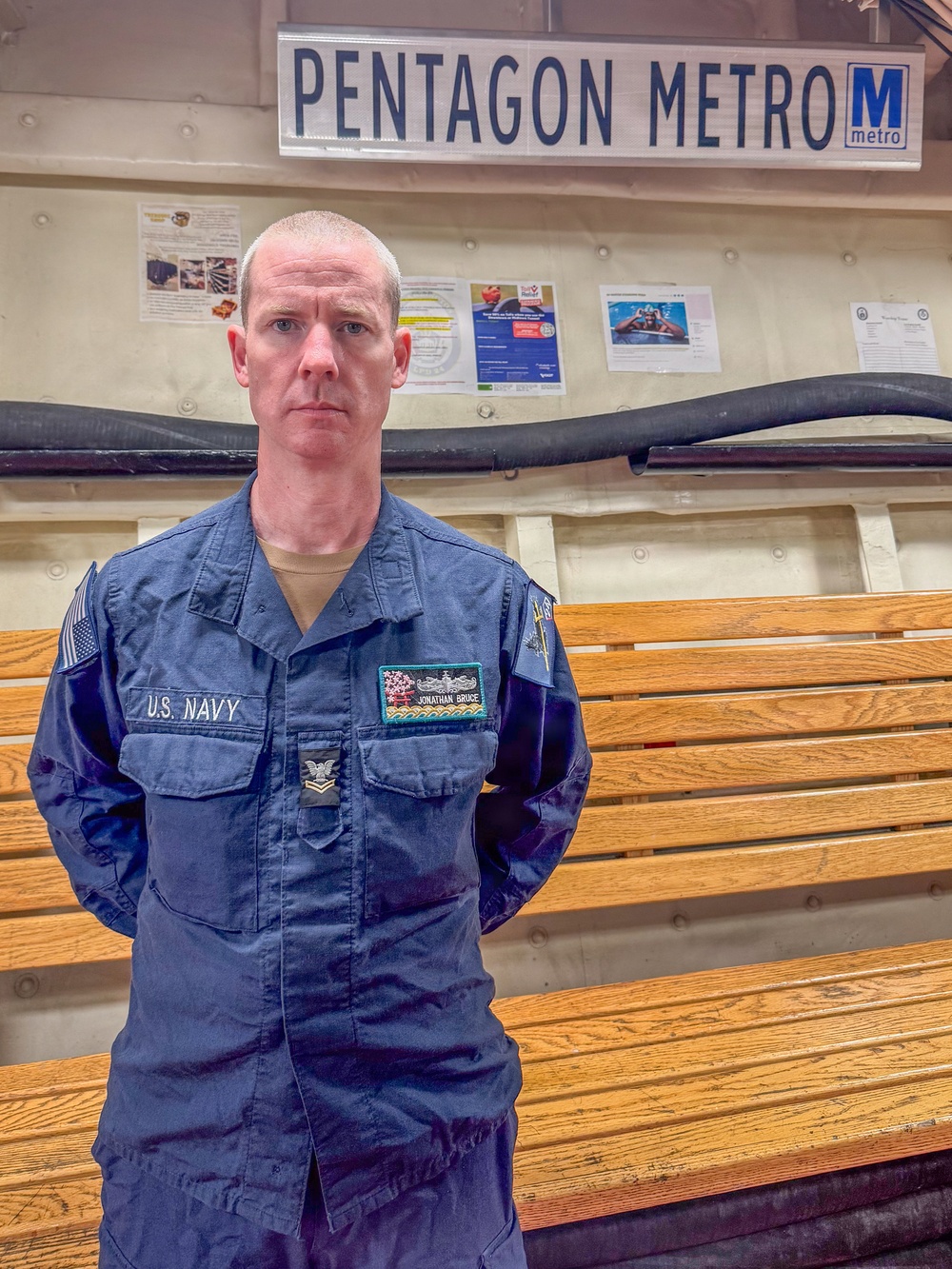
Photo By Petty Officer 3rd Class Brendan McCormack | NORFOLK, Va.--U.S. Navy Logistics Specialist 2nd Class Jonathan Bruce, a Sailor...... read more read more
 Subscribe
U.S. Navy Logistics Specialist 2nd Class Jonathan Bruce is a Reservist aboard San Antonio-class amphibious transport dock USS Arlington (LPD 24). A third-generation Sailor from North Carolina, his great-grandfather served aboard a minesweeper in the English Channel during World War I, his grandfather served as a pilot during World War II, his father served as a flight instructor in the Air Force during the Vietnam War and Bruce answered the call of duty in 2006 when he enlisted, at age 26, as an active-duty Culinary Specialist.
Separating in 2010, Bruce spent the next 10 or so years bouncing around a civilian career that left him unfulfilled. He completed an associate’s degree in 2015, after which he sought to finish a bachelor’s degree with a double major in risk management insurance and finance. This workload burned him out, however, and he did not finish the degree. Bruce is still a college senior in terms of credit hours, but maintains that because of the role the Navy is able to play in his life as a Reservist, he does not intend to go back and graduate.
If school out-burned Bruce, so too did his experience working for a major grocery store chain.
“I gave my manager an ultimatum: give me a raise or a promotion, or I will join the Reserves,” said Bruce. “He refused to give me the raise, so I joined the Reserves.” Bruce re-enlisted, this time as a Reservist, in 2021. A year later he turned in his two-week notice leaving retail.
As a Reservist, Bruce was looking for the kind of relationship with the Navy about which not many active-duty Sailors know is possible, but of which many Reservists take lucrative advantage. Rather than just the minimum commitment of one weekend per month and two weeks of annual training per year, Bruce cycles on and off active-duty orders regularly for a few months at a time.
Having served previously, Bruce knew the Navy could give him what cannot be found in most civilian jobs, nor even always in some of the other service branches: the ability to serve his country, travel the world, experience life on the frontlines between order and chaos and, for personal finance wonks like Bruce, better and tax-advantaged pay.
When he re-enlisted, Bruce did not return as a Culinary Specialist (CS) for at least two reasons. One, he had first-hand experience of something many Sailors know to be true only through second-hand experience, if they even know it at all: CSs have one of the hardest, most demanding jobs in the Navy, but they are not paid any more for it being harder. And two, when he re-enlisted, the Reserve program did not offer many opportunities for CSs to volunteer for orders, and he wanted to go on orders! So, he had to re-rate.
Bruce is colorblind, a fact which limited the rates available to him. He chose Logistics Specialist (LS) because, as components of Naval supply, LSs and CSs share a lot in common. Additionally, Bruce had spent part of his civilian career working for FedEx, so he had some logistics experience already. For certain rates, including LS, Sailors re-rating to them do not attend the “A” school for that rate, learning the job instead from hands-on, on-the-job training—a process called striking a rate. While Bruce was striking the LS rate, his prior FedEx experience gave him a significant advantage.
How does Bruce see his job?
“The supply Sailors are the individual strands that hold the entire web of the Navy together,” Bruce said. “We have kind of a background job. It’s not in the forefront but it is crucial nonetheless.”
Supply falls into an under-thanked category of jobs in which success is measured by how few people—not how many—take notice.
“Other rates aboard the ship have their jobs to worry about. If the supply chain is robust and efficient, no one else needs to think about supply. They all have everything they need to do their jobs. And that’s how it should be. On the other hand, if the supply chain fails, now they have to worry about their job and our job.”
Supply operations differ both quantitatively and qualitatively based on the size and type of ship, a difference that might not be noticed by non-LS Sailors except during at-sea replenishments, when all hands might be used to convey goods and parts from pallets on the deck to the storeroom shelves. Quantitatively, obviously, bigger ships require more supplies and parts, so the supply operation itself is correspondingly larger.
Qualitatively, though, “bigger ships can rely more on machine power, like forklifts, because one, there are more machines aboard the ship, and two, more of the pathway between the deck and the storeroom is traversable by machines,” Bruce explained. “Smaller ships rely comparatively more on manpower for exactly the opposite reasons—fewer machines and smaller passageways.”
The specific job of an LS is likewise a function of the size of the ship. On a smaller ship, there will be fewer LSs aboard, so they operate more as generalists responsible for multiple types of logistics work. On a carrier, though, there are many more LSs aboard and so many logistics tasks that they will instead specialize, and “an LS might do only hazardous material, for example.”
What does the average day look like for a second-class Logistics Specialist?
“There’s a lot going on,” said Bruce. “A lot of monitoring. One-off tasks from leadership; routine, daily tasks; delegating tasks to junior Sailors and even just helping them out. There are always parts to move, pallets to move, making sure Sailors have uniforms and informing other departments of arrival dates of parts they are expecting.”
And on the busiest day?
“All of the above, plus more,” he said. “The tasks at hand take more time than there is time available. Delegation is super important. And we just have to triage. We have to have an idea about tomorrow’s tasks, too. We take care of whatever whole tasks can be completed today and chip away at the ones that will take multiple days so their size and scope doesn’t snowball into something unmanageable.”
So far, Bruce has determined his favorite type of ship on which to serve are “amphibs,” or amphibious vessels like Landing Ship Dock (LSD), Landing Platform Dock (LPD), Landing Helicopter Dock (LHD) and Landing Helicopter Assault (LHA) ships. His preference derives from his observation that, on these ships, “conditions are better and the pace is slower.”
As a second-class petty officer, Bruce straddles two worlds. He has the highest rank that typically still completes the hands-on, technical work of his rate. But he also has the lowest rank involved in the bureaucratic and managerial work of his rate. And this sharing of responsibilities seems to suit him because he likes to work, but he also has the managerial experience of someone with more—and more varied—career experience than is often typical of second-class Sailors. Having spent 10 years in the civilian world before re-enlisting, he is a bit older than a typical second-class, but he brings to his job the benefits of (most of) a bachelor’s degree, an outsider’s perspective about how effective organizations can be run and—one should remember—an entire active-duty enlistment in one of the fastest-paced, most-stressful jobs in the Navy.
In other words, the Navy is quite lucky to have Sailors like Bruce. Naval supply routinely embeds Supply Corps officers to train with civilian logistics companies such as FedEx, in a process called Training with Industry (TWI), whose technologies and methods often represent the state-of-the-art of modern logistics. Competition forces innovation, and civilian/private-sector businesses must constantly innovate to stay ahead of their competitors.
By doing what he does as a Reservist—cycling on and off orders—Bruce conducts his own, personal version of TWI. And he brings that civilian experience back to the Navy each time he volunteers for new orders.
Bruce won’t be done with the Navy anytime soon. This upcoming fall is the first season he qualifies to promote to Logistics Specialist 1st Class, and he intends to stay active with the Navy until he promotes one or two ranks past that. And this much is clear: Bruce cares primarily about two things—helping junior Sailors and doing good work. Bravo Zulu, Logistics Specialist 2nd Class Jonathan Bruce, and may every department find Sailors with your mindset and commitment!
NAVSUP and Navy Supply Corps oversee a diverse portfolio including supply chain management for material support to Navy, Marine Corps, joint and coalition partners, supply operations, conventional ordnance, contracting, resale, transportation, security assistance, Sailor & family care, including food service, postal services, retail facilities, and movement of household goods. In addition to its headquarters activity, the NAVSUP Enterprise consists of 11 commands located worldwide.
| Date Taken: | 07.02.2026 |
| Date Posted: | 08.10.2026 13:14 |
| Story ID: | 571970 |
| Location: | NEW YORK, NEW YORK, US |
| Web Views: | 23 |
| Downloads: | 0 |

This work, NAVSUP Features Logistics Specialist, by PO3 Brendan McCormack, identified by DVIDS, must comply with the restrictions shown on https://www.dvidshub.net/about/copyright.

No keywords found.




