
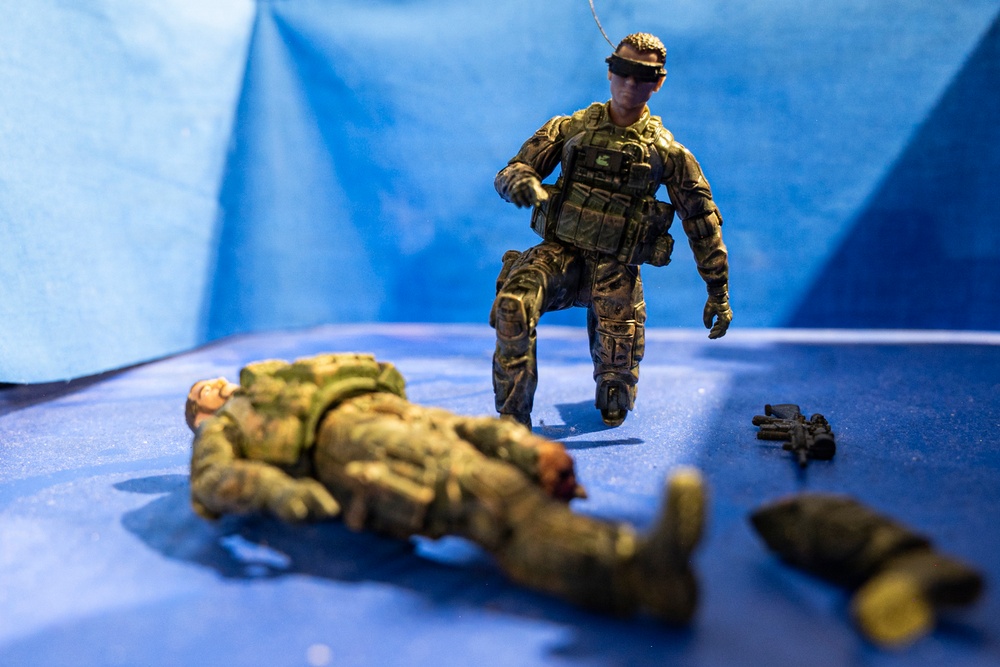
Photo By T. T. Parish | A scale model of an immersive combat casualty care simulator sits on display during a...... read more read more
Within the highly specialized realm of military medical acquisition, the difference between life and death on the battlefield is often determined before a warfighter ever deploys. Ensuring that readiness is the Medical Simulation and Training Program Management Office (MST PMO), a critical component of the Defense Health Agency’s Portfolio Acquisition Executive Medical Products under the Assistant Director for Research, Development and Acquisition.
Tasked with serving as the materiel developer and total lifecycle systems manager for medical training across the Department of War (DoW), the MST PMO equips military healthcare professionals with the tools to practice high-risk, life-saving procedures in risk-free environments.
Mission Focus: Driving DHA Objectives
The primary mission of the MST PMO is clear: improve healthcare and build readiness through simulation, training, and education. To achieve this, the PMO rapidly prototypes, develops, acquires, and fields custom medical training devices and systems for military hospitals and operational environments.
These core missions directly drive the wider objectives of the AD-RDA, DHA, and DoW. By providing a centralized center of excellence for medical simulation acquisition, the MST PMO ensures that the Component Acquisition Executive (CAE) can deliver modernized, standardized, and cost-effective capabilities to the Joint Force and caregivers in military hospitals.
“MST PMO is the full lifecycle acquisition management expert in this domain,” said Robert E. Bell III, M.S., PMP, the supervisory program manager for MST PMO. “In most cases, we can take a specific or derived capability requirement through development, testing, fielding, sustainment, modernization, and (eventually) retirement.”
This centralized approach directly supports DHA’s overarching mandate to build a medically ready force while standardizing care across all service branches.
Strategic Collaboration: Uniting Stakeholders for the Warfighter
To define mission objectives and shape acquisition strategies, the MST PMO relies heavily on a deeply integrated, collaborative network in the Central Florida region.
Internally, the PMO synchronizes efforts across the AD-RDA, DHA, and individual service branches to consolidate requirements and eliminate redundant technology investments. Externally, its strategic location within the Central Florida region allows the PMO to closely collaborate with industry innovators and academic institutions to develop world-class medical simulation innovations to meet the needs of medical providers across the U.S. Joint Force.
“We have an industry, government, and academic concept here in [Florida] called Team Orlando. The primary goal of Team Orlando is to improve the combat readiness, safety, and decision-making capabilities of the joint warfighter and federal first responder through advanced technology,” said Bell.
This continuous feedback loop ensures that the PMO understands the exact needs of medics on the ground and can leverage cutting-edge commercial technologies to meet those needs swiftly.
Forging Medical Readiness: Programs for the Battlefield and Beyond
During a time of widespread transition within the military medical development enterprise, the MST PMO remains anchored to the evolving demands of multi-domain operations.
Current areas of focus include the Training and Risk Assurance Compliance and Evaluation System (TRACES), Complicated Obstetrical Emergency Simulation System 2 (COES2), and Role 4 Modeling Tool (R4MT) initiatives, to name a few.
TRACES is a scalable, interoperable platform that integrates compliance oversight, safety management, quality assurance analytics, and standardized workflows into a single enterprise capability supporting Joint Trauma System. COES2 is a standardized upgrade of OB/GYN simulators with DHA-vetted curriculum fielded to military treatment facilities worldwide. And R4MT is a joint medical simulation tool used to predict and simulate casualty flow into Military Treatment Facilities (MTFs) to support contingency planning.
These programs aim to provide sustainment and enhancement training across the entire Military Health System, moving beyond legacy platforms to field advanced prototypes for use in both clinical and far-forward, operational environments.
A Solution-Based, Team-Oriented Approach
For the DoW, the functions provided by the MST PMO are indispensable. Operating advanced simulated warzones where students treat surgical mannequins allows for the mastery of critical skills without patient risk in near-real-world environments.
To achieve this, the MST PMO executive team actively fosters a team-oriented approach to mission accomplishment. Leadership emphasizes continuous integration and agile acquisition, ensuring that program managers, engineers, and clinical experts work in tandem rather than in silos.
“We are entirely aligned toward a single, vital objective: supporting our service members in uniform and ensuring they have the world-class training solutions required to remain at the top of their game,” said Bell. “We like to celebrate personal and work achievements together, and we meet face-to-face with virtually every member of our team twice a month in staff meetings. Although our MST PMO team is made up of both government civilians and contractors, we operate with a ‘one-team, one-fight’ mindset.”
Rather than applying a one-size-fits-all model, the PMO customizes its acquisition strategies—from the initial planning phases through implementation and sustainment—to ensure that technological deliverables remain closely aligned with the operational realities of the modern warfighter.
Disclaimer: This information includes elements of AI-generated content, which were reviewed and edited by relevant DoW personnel to verify appropriateness and compliance with DoW policies and guidance.
| Date Taken: | 08.10.2026 |
| Date Posted: | 08.10.2026 11:57 |
| Story ID: | 571962 |
| Location: | ORLANDO, FLORIDA, US |
| Web Views: | 35 |
| Downloads: | 0 |

This work, Team helps drive military acquisition, advance warfighter medical readiness through simulation and training, by T. T. Parish, identified by DVIDS, must comply with the restrictions shown on https://www.dvidshub.net/about/copyright.


No keywords found.





