
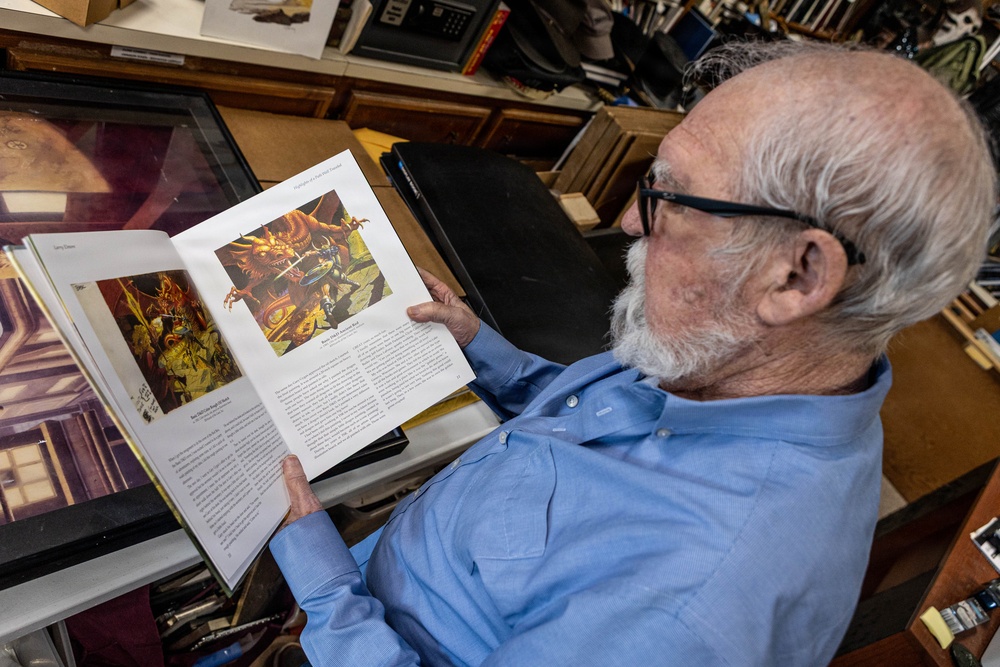
Photo By Savannah Baird | Larry Elmore poses in his studio in Leitchfield, Kentucky on July 10, 2026. Elmore...... read more read more
Leitchfield, Ky. — Art has been his whole life – so much so the Army selected him to illustrate a major modernized warfighter training project that later helped him launch a legendary fantasy illustration career.
Fantasy and science fiction illustrator Larry Elmore may be best known for his work on the early production of the “Dungeons & Dragons,” tabletop roleplaying game but before that, he was a Fort Knox Soldier and later a civilian contractor for the installation’s Training Aids Department (now the Training Support Center).
Elmore was drafted into the Army weeks after he graduated college with a Bachelor of Fine Arts from Western Kentucky University and married his wife, Betty. He completed basic training at Fort Knox and stayed there, being assigned to the post.
Expecting the worst, he remembered thinking, “I got through this first step in life, I'm in debt, I'm off to the Army, and I'm probably going to go to Vietnam...”
But that all changed suddenly.
“Once I got assigned, the Army saw my portfolio and realized I could draw just about anything from memory, so they put me on illustration work.”
In the 1970s, the Army changed the look of its field manuals to include more visual arts. Though Elmore was a draftee and could not officially be assigned to the illustrator military occupational specialty, his talents were put to use during his service.
From tanks to rifles, Elmore said he could retain the visual rendition of any object in his mind and draw it from memory if he had enough time to study it: “It was a God-given gift and I used it.”
Recently, Elmore attributed this ability to growing up in the country: climbing trees and drawing with his family under kerosene lamplight because they couldn’t yet afford electricity.
“During my early childhood we were pretty poor,” he said. “Dad contracted tuberculosis during World War II, which nearly killed him, so a lot of the time he couldn't work.”
Elmore said he and his mother would argue over paper during this time. She would use it to write to his father in the hospital; Elmore would use it to draw. His mother implemented a paper rationing system because of this.
“I look back on stuff like that and almost get emotional because the whole atmosphere of my life has changed so much,” he said.
While at Fort Knox, he no longer had to ration to indulge his passion. He was able to afford a comfortable living and focus on his art full time.
After completing his two-year draft contract, Elmore was invited to stay on as a contractor. He said this on-the-job experience provided a much-needed education about the illustration industry that set him up for success later in his career.
“Everything in my life, even the Army, has taught me a lot about art,” he said. “Illustrations in the ‘70s were just line work, pure ink – white and black, no grays – and they didn't teach you that in college. I developed those skills at Fort Knox.”
While he was sharpening his ink skills, a new employee joined the shop staff. After that, Elmore said yelling and laughter could regularly be heard from the breakroom each day.
The employee introduced the team to Dungeons & Dragons.
“We didn’t want to play at first,” said Elmore. “We had heard about it and all of the bad press it was getting – ‘it’s the devil’s game’ and all that – but all it was was fantasy, and we all liked fantasy.”
Everyone, according to Elmore, filled out their character sheets, wondering if it would be worth it. When gameplay began, he was instantly hooked, calling it "the king of all games."
“I think if you’ve got any creativity at all, once you play the game a time or two it’s almost like an addiction,” he said.
The pastime proved to be a great team-building avenue for the staff for over a year, and Elmore later discovered just how “worth it” learning the game could be to him.
One day, after spending time familiarizing themselves with the roleplaying game, recalled Elmore, one of the artists said he was going to submit his art to Tactical Studies Rules – the parent company for D&D – because “our art is much better than this.”
“At that time, D&D had just come out,” said Elmore, “and the artwork was pretty primitive.”
Elmore decided to roll the dice and submit a portfolio that included linework produced for the Army. TSR responded shortly after with an offer he couldn't refuse: They would double his salary, hire his wife, and fund their relocation to Wisconsin.
“I couldn't comprehend it,” he said. “I didn't think but for about 30 seconds. I just took my hand out and shook his, saying, ‘You just bought yourself an artist.’”
After seven years at Fort Knox, Elmore moved on to his next adventure in Lake Geneva, Wisconsin where he would create his most iconic work.
The famous “Red Box” set released in 2010, featured a warrior in combat with a red dragon, illustrated by Elmore during his time at the company. To this day it is considered one of the most recognizable images in the game’s history.
Though he thoroughly enjoyed working for TSR over the next six years, Elmore said he and Betty ultimately wanted to move back to Central Kentucky. He worked freelance on the side and said he worked himself almost to death running on three or four hours of sleep, living off of caffeine and nicotine to make it happen.
“I had a stroke or two and three heart attacks ... the third one killed me, but they brought me back to life and I’ve felt good ever since,” he said. “I had to change a lot of habits in life.”
Elmore then worked as a freelance illustrator for another 40 years after he left TSR in 1987. He said had TSR not been so adamant about hiring him, he likely would have retired at Fort Knox.
To this day, he looks back fondly at his time on the installation. In fact, he said one of the most unusual things he has ever done was at Fort Knox.
“While I worked there, I got to see things and go places that people didn't often get to go,” he said. “I got to go inside the Bullion Depository and I saw gold – lots of gold.”
He recounted a tour of the depository where he saw cells full of gold bars and couldn’t resist the urge to reach out and touch one.
“I got really close to the cells and thought ‘the guard’s not watching,’” Elmore said. “I stuck my finger between the bars – I could have gotten my whole hand inside – and all of a sudden, I hear, ‘I wouldn't do that if I was you, son.’”
He cherishes that close call at the depository as just one of many unforgettable moments from his time on post. For Elmore, looking back on those days is a reminder of how timing and chance shaped his destiny.
“I was very lucky,” he said. “Sometimes, I think to be successful you have to be good, but you got to have some of those weird breaks in life – and I got two or three.”
*VisitFort Knox Newsatwww.army.mil/knoxfor all of Central Kentucky's latest military news and information.*
| Date Taken: | 08.10.2026 |
| Date Posted: | 08.10.2026 09:55 |
| Story ID: | 571951 |
| Location: | FORT KNOX, KENTUCKY, US |
| Hometown: | LEITCHFIELD, KENTUCKY, US |
| Web Views: | 19 |
| Downloads: | 0 |

This work, From field manuals to fantasy realms: How Fort Knox helped launch a veteran's legendary career, by Savannah Baird, identified by DVIDS, must comply with the restrictions shown on https://www.dvidshub.net/about/copyright.


No keywords found.





