
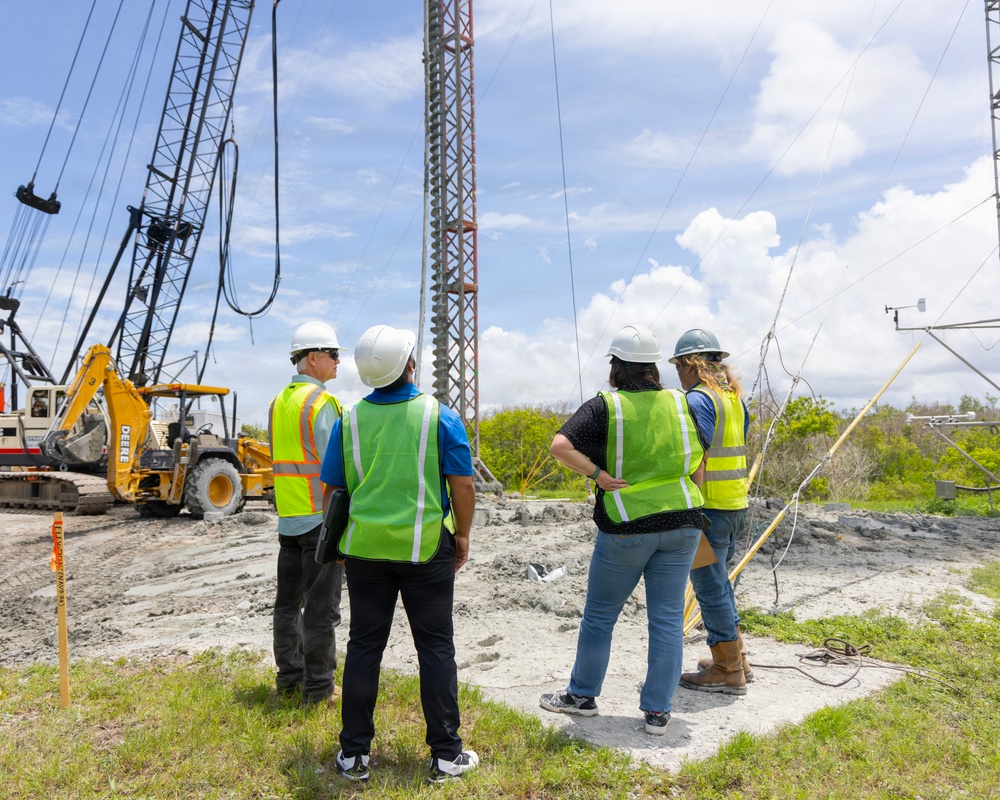
Photo By Justin Dixon | Civil Engineers are reimagining America’s gateway to space, designing the resilient...... read more read more
 Subscribe
Dominance in space begins on the ground. At Patrick Space Force Base and Cape Canaveral Space Force Station, Civil Engineers are forging power projection platforms for the Spaceport of the Future initiative.
The initiative is focused on modernizing the infrastructure needed to support a rapidly increasing number of launches, guaranteeing access to space, and deterring aggression in an increasingly contested domain.
“We were originally charged with the redevelopment of Cape Canaveral back in 2018 with Gen. Raymond’s strategic intent,” said Andy Duce, Program Manager of Space Launch Delta 45. “This has required Civil Engineers to completely rethink how Cape Canaveral is laid out and how infrastructure should be set up to support launch needs.”
Guided by five major lines of effort across architecture, infrastructure, operations, policy, and defense, the initiative is reshaping how the Space Force prepares for a future in which access to space is routine and resilient.
Civil Engineers are navigating challenges including how to build a range that can support numerous launches, understanding what logistical capacity is needed for launches to occur without limits, and how to minimize facility impacts to personnel.
When planning for the Spaceport of the Future began, the installation anticipated supporting approximately 75 launches annually. Today, that number has more than doubled, with a goal to reach over 1,000 launches each year by 2034 according to the Space Force’s Objective Force predictions.
Meeting that demand requires an entirely different approach to infrastructure. “The prospect of hundreds or thousands of launches annually forces Civil Engineers to focus on two components: redundancy and resiliency. This means designing power, water, and communication backbones that so that no single failure, extreme weather event, cyber, or physical attack can risk national security operations,” said Isabel Gray, a Palace Acquire Intern assigned to Cape Canaveral Space Force Station. “What we build today needs to last for years to come and be able to sustain thousands of launches during its lifespan.”
To support that vision, engineers are modernizing electrical grids, expanding transportation corridors capable of moving increasingly larger launch vehicles, evaluating additional liquid oxygen and liquid methane storage capacity, and designing resilient utility systems that can sustain continuous launch operations.
“Patrick Space Force Base and Cape Canaveral are effectively a city, but a city designed and built for the Space Race,” Duce said. “Civil Engineers are now responsible for designing and building future requirements to meet the growing launch demand.”
This entails modernizing foundational infrastructure to support the increase in launches, including orienting mission planning around upgrades to heavy-haul transportation routes, public roadways, utility networks, and workforce access.
Additionally, existing launch hazard areas require more than 1,000 personnel to temporarily evacuate during certain operations, prompting planners to evaluate relocating functions into more efficient campuses farther from launch complexes.
Civil Engineers are also coordinating with environmental experts to protect threatened and endangered species while ensuring mission success. “Modernizing a system while it remains actively operational is like rebuilding an airplane while it’s in flight,” Gray said. “Not an easy task.”
Resiliency has become a central principle as planners prepare for a future where launch operations significantly increase.
“If our infrastructure creates a bottleneck, we lose our strategic advantage, regardless of how advanced our satellites or rockets are,” Gray said. “By building resilient, high-capacity and secure spaceports today, Civil Engineers are directly ensuring that the United States can dominate the space domain continuously, without delay or disruption by adversaries.”
However, that vision extends far beyond the next launch. “Spaceflight will most likely become routine and part of everyday life.” Duce said. “But no roads, no commodities, and no logistical flows means no launches. Our job is to listen to the dreamers and make it happen.”
As America’s gateway to space evolves, Civil Engineers are doing more than supporting today’s launch enterprise. They are building the resilient foundation that will enable America’s future in space.
| Date Taken: | 08.10.2026 |
| Date Posted: | 08.10.2026 09:35 |
| Story ID: | 571949 |
| Location: | US |
| Web Views: | 30 |
| Downloads: | 0 |

This work, Building the Spaceport of the Future From the Ground Up, by Diana Nesukh, identified by DVIDS, must comply with the restrictions shown on https://www.dvidshub.net/about/copyright.


No keywords found.




