
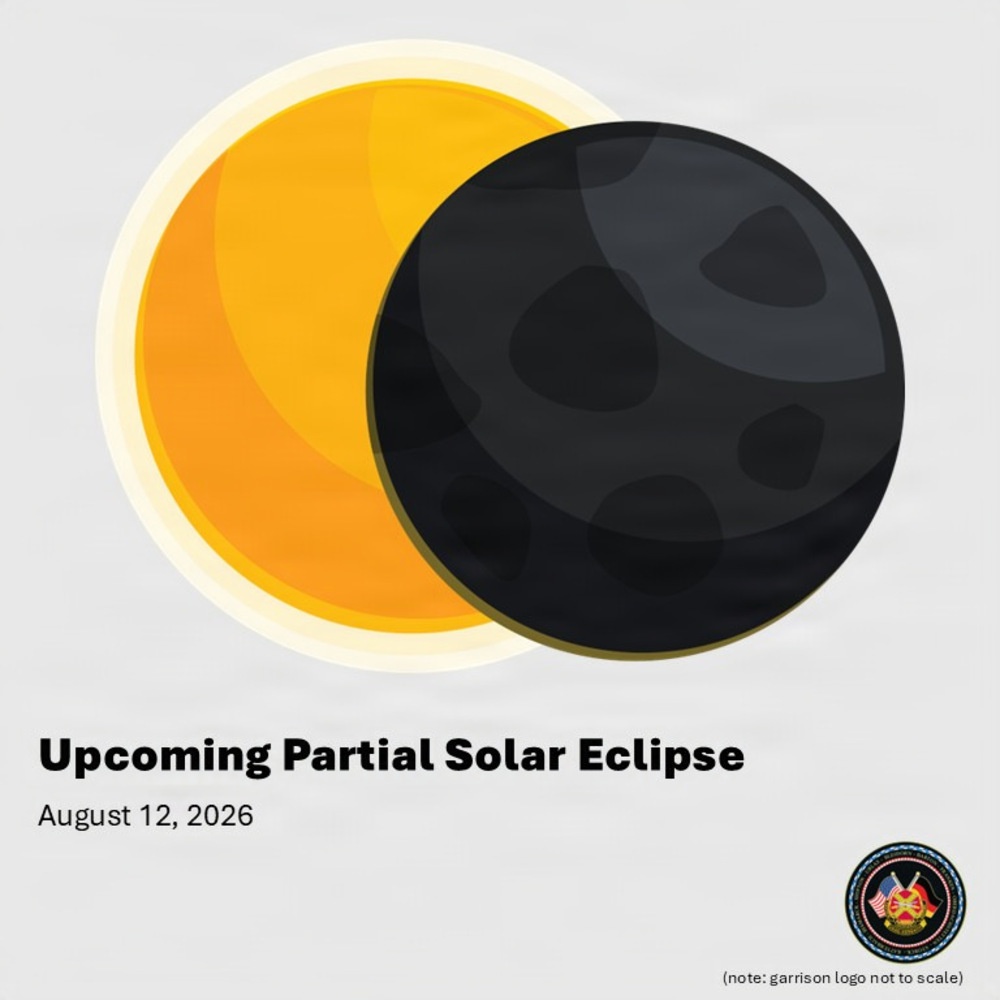
Photo By Jonathan Bell | 2026 Partial Solar Eclipse graphic for the Aug. 12, 2026 partial solar eclipse in...... read more read more
(ANSBACH, Germany) - On the evening of Wednesday\, August 12\, 2026\, sky watchers in U.S. Army Garrison (USAG) Ansbach and across Europe will witness a historic celestial event, a partial solar eclipse. This is the deepest solar eclipse visible in Germany since 1999, and the country will not see this much of the sun obscured again until July 2075. A total eclipse will occur across a narrow corridor of the Earth—stretching across Greenland, western Iceland, and northern Spain— and Germany will be treated to a spectacular, deeply dramatic partial solar eclipse.
Because the eclipse occurs late in the evening, the event will unfold as the sun is low in the western sky. In Ansbach, the moon will begin to obscure the Sun's disk while it is still several degrees above the horizon, culminating in a striking "sunset crescent" where the sun sets while still heavily eclipsed.
Phase progress:
Eclipse Begins (First Contact) 7:20 PM (19:20) - Local Time (CEST) The moon begins to make a small "bite" in the upper-right edge of the sun.
Maximum Eclipse (Peak) 8:13 PM (20:13) - Local Time (CEST) 87.8% of the sun’s disk is covered. Only a thin, downward-pointing crescent remains.
Sunset in Ansbach 8:39 PM (20:39) - Local Time (CEST) The sun sets on the western horizon while still roughly 60% eclipsed.
Eclipse Ends (Last Contact) 9:04 PM (21:04) - Local Time (CEST) The moon completely clears the sun's disk (invisible from the ground).
Because the peak of the eclipse occurs just 26 minutes before sunset, the landscape will take on an eerie, dimmed, and golden-orange hue. Standard daytime eclipses occur high in the sky, but the August 12 event offers a rare photographic opportunity: a sharp, fiery crescent sun sinking behind local landmarks like the Margrafen-Schloss (Ansbach Residenz) or the rolling Franconian hills. To view this, you must secure a viewing spot with an unobstructed, completely clear view of the west-northwest horizon.
Adding to the magic of the evening, the peak of the Perseid Meteor Shower occurs on the very same night (August 12–13, 2026). Because the eclipse coincides with a new moon, the night sky will be exceptionally dark. Once the sun-crescent sets and twilight fades, viewers in rural areas around Ansbach can expect to see up to 100 meteors per hour streaking across the sky.
Observing a solar eclipse is a highly rewarding experience, but doing so without proper protection can lead to permanent, irreversible physical damage.
The primary danger of looking directly at the sun is solar retinopathy. When intense solar radiation hits the eye, the lens focuses this light directly onto the retina at the back of the eye. The light triggers rapid chemical reactions that destroy the rod and cone photoreceptors.
Many household items are mistakenly believed to be safe for solar viewing. None of the following items are safe: · Standard sunglasses (even polarized or double-layered ones) · Exposed photographic film or negatives · CDs, DVDs, or floppy disks · Smoked glass · Smartphone camera screens (direct sunlight can also melt the camera sensor)
To enjoy the eclipse without risk, you must utilize either direct viewing filters or indirect projection methods.
For direct viewing, you must use specialized solar eclipse glasses. · ISO 12312-2 Certification: Safe solar viewers are thousands of times darker than standard sunglasses. Ensure your glasses are certified under the international standard ISO 12312-2. · Inspection: Always inspect your glasses before use. If you see any scratches, pinholes, wrinkles, or separation of the filter from the frame, discard them immediately. · Optical Warnings: Never look through binoculars, a telescope, or a camera lens while wearing eclipse glasses. The concentrated light from these optical devices will instantly burn through the thin filter and destroy your eyes.
If you do not have eclipse glasses, you can easily and safely view the eclipse using an indirect projection method. A pinhole projector projects a miniature, safe-to-view image of the sun onto a white screen.
· A long cardboard box (such as a cereal box, shoe box, or mailing tube) · A small sheet of clean, unwrinkled aluminum foil · A sheet of plain white paper · Opaque tape (such as duct tape or electrical tape) · A sharp pin, needle, or thumbtack · Scissors or a utility knife
| Date Taken: | 08.09.2026 |
| Date Posted: | 08.10.2026 04:30 |
| Story ID: | 571944 |
| Location: | ANSBACH, BAYERN, DE |
| Web Views: | 76 |
| Downloads: | 0 |

This work, Viewing the August 12, 2026 Solar Eclipse in USAG Ansbach, by Jonathan Bell, identified by DVIDS, must comply with the restrictions shown on https://www.dvidshub.net/about/copyright.

No keywords found.





