
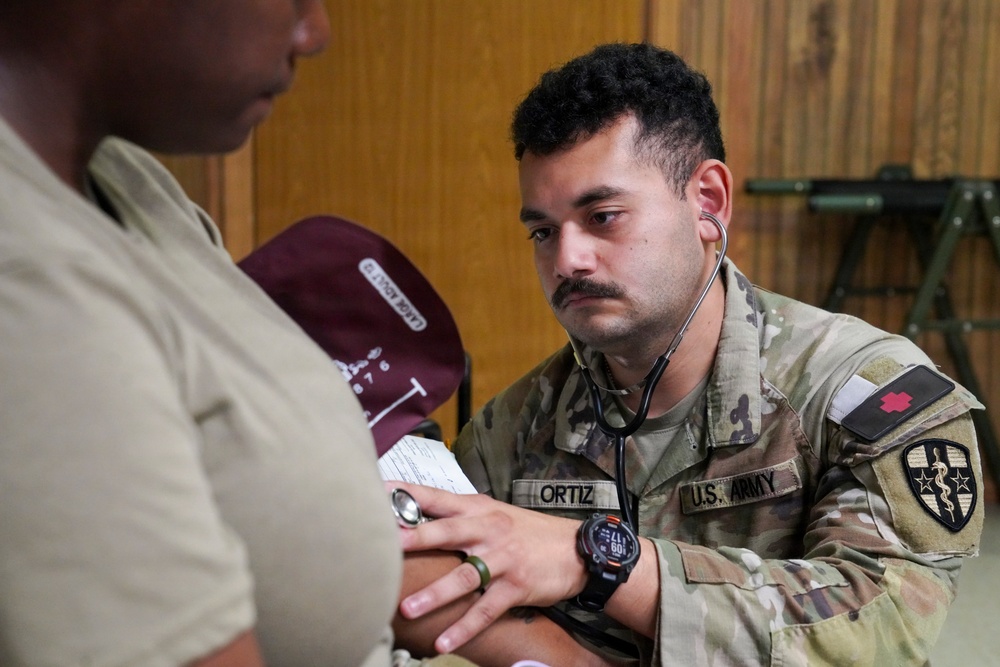
Photo By Sgt. 1st Class Christopher Hernandez | U.S. Army Reserve Spc. Nekoda Ortiz, a combat medic with the Nashville, Tenn., based...... read more read more
FORT MCCOY, Wis. — More than 80 U.S. Army Reserve Soldiers from myriad units stemming from the Army Reserve Medical Command organized and performed a real-world medical mission in support of approximately 6,000 U.S. service members and NATO partner nations that comprised of the training audience for Warrior Exercise 26, or WAREX 26, in conjunction with Regional Medic 26 here, from July 21, 2026, through August 9, 2026.
WAREX 26, in tandem with RM 26, is a multicomponent, multinational joint training exercise that amalgamates the specialties and functions of a multitude of combat support, combat service support and medical organizations to emulate large-scale combat operational and multi-domain environments.
The AR-MEDCOM composite medical team consisted of the following units — the Fort Bragg, North Carolina-based 7458th Medical Operational Readiness Unit; the North Charleston, South Carolina-based 7224th Medical Support Unit; the Webster, New York-based 7207th MSU and collocated 7412th Troop Medical Clinic; the Nashville, Tennessee-based 7229th MSU; the Fort Jackson, South Carolina-based 7226th MSU and collocated 7359th Veterinary Detachment.
Army Reserve Capt. Adenike Konneh, a family nurse practitioner with the 7229th MSU, said the AR-MEDCOM Soldiers provided unit-level care centrally focused on disease and non-battle injury prevention, or DNBI — alternatively known as Role 1 military medical care.
“Our primary mission is to do a Role 1 medical clinic and provide medical (support for) the Soldiers that are here,” said Konneh. She said Soldiers visit the troop medical clinics for injuries, illnesses, and for other needed medical support and are then able to return to training.
Army Reserve Maj. Bernardo Harris, a health services human resources officer assigned to the 7224th MSU and overall officer in charge of the real-world medical mission for WAREX 26 and RM 26, said the military medical collective operated one main TMC on cantonment here, with two TMCs in two separate field-training areas.
“Having three TMCs at different locations helps the training audience because it decreases the timeframe for the Soldier to get the care that they need,” Harris said.
Harris said if any injuries or illnesses warranted elevation of medical triage and treatment, then coordination would follow with civilian medical assets and facilities adjacent to the installation here.
“We understand that there are some injuries that comes up to where we have to send them to a higher level of care that we are not able to provide at the TMCs, so we have a local partnership with the local hospitals in Tomah and Sparta that allows us to bring Soldiers out there in a higher level of care that we can’t perform here,” said Harris.
Konneh said in addition to DNBI, she and her team would instruct and enlighten troops on proactive and reactive injury prevention for the sake of training preservation.
“We do a lot of education, as well as what you need to do when you’re feeling the pain in your knees, when you’re feeling the pain in your back, when you’re carrying all those loads — make sure that you’re resting in between and doing things in between that would prolong the way training would affect whatever you’re doing (then).”
Although the real-world medical mission mainly supported the training audience in their WAREX 26 and RM 26 endeavors, it gave newer and inexperienced Soldiers the opportunity to hone their knowledge and skills, said Harris.
Army Reserve Sgt. Cameron Bernabei, a combat medic with the 7412th TMC, said for his annual training experience in the U.S. Army Reserve, it immediately precipitated his engagement with real-world military medicine.
“When I got here, my first patient was with a pretty traumatic injury, and I had to snap right into military medicine, and that’s something I never had the option to do as a Sergeant and a medic,” said Bernabei.
The Fairtown, New York denizen said adaptability and education were his biggest key takeaways from the AT experience.
“We came here not knowing we were going to be in tents and not knowing the situation of our TMC where it is in a tent,” said Bernabei. “And I think having the ability to adapt to the conditions has taught me a lot about life in general because things change all of the time and you just have to be ready for it.”
“I’m also going to take away a lot of the education that I gained while I was here and all the moments I had with providers, and they were coaching me on what to do when I get to PA school and how to be a better student and be a better provider in the future. It’s just made me excited to be further in medicine,” Bernabei said.
The AR-MEDCOM Soldiers and their role in WAREX 26 and RM 26 exemplifies the Army Reserve’s aptitude in rapid mobilization in support of thousands of U.S. service members and joint military members in training environments replicating large-scale operational environments.
| Date Taken: | 08.09.2026 |
| Date Posted: | 08.10.2026 13:34 |
| Story ID: | 571934 |
| Location: | FORT MCCOY, WISCONSIN, US |
| Web Views: | 19 |
| Downloads: | 0 |

This work, 'Warrior Medics' diminish disease, non-battle injuries during RM 26, WAREX 26, by SFC Christopher Hernandez, identified by DVIDS, must comply with the restrictions shown on https://www.dvidshub.net/about/copyright.


No keywords found.





