
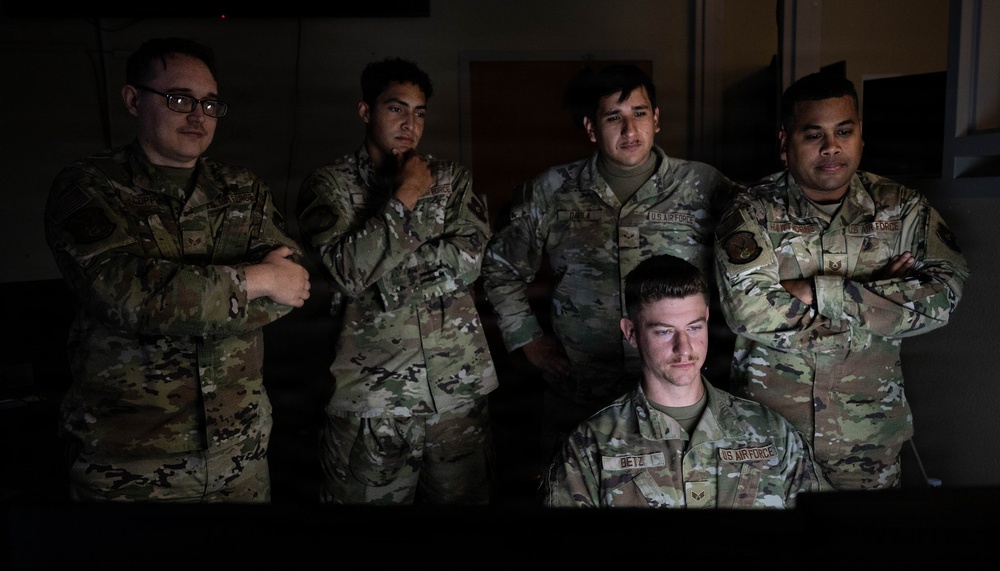
Photo By Senior Airman Carson Jeney | U.S. Airmen with the 5th Communications Squadron (5th CS) Communications Focal Point...... read more read more
 Subscribe
MINOT AIR FORCE BASE, N.D. – At the start of the workday for a typical Airmen, you show up to your respective shop and log in to your computer. If needed, you make a phone call or two, and print something off. The 5th Communications Squadron’s Communications Focal Point is responsible for Team Minot’s efficient start of shift routine, ensuring we are able to log on, communicate, and execute the mission.
“Tracking, scheduling, reporting, and documenting,” said U.S. Air Force Tech. Sgt. Tyrone Hawthorne, 5th Communications Squadron Communications Focal Point noncommissioned officer in charge. “That's our four tenets, it's essentially what the CFP does.”
As the primary link between both the 5th Bomb Wing and 91st Missile Wing and the communications specialists within the squadron, the CFP acts as a centralized hub, triaging tickets to ensure they reach the right work centers.
“CFP is important because all the issues come through us first, like phone calls or tickets,” said Hawthorne. “Once we get that, we distribute it to the other sections so the job can get done.”
Not only is CFP the hub between Minot Airmen and the 5th CS, but also with higher headquarters and the base. CFP is responsible for distributing, tracking and completion of Tasking Orders (TASKORDS) issued by Air Forces Cyber and United States Cyber Command.
“Our role in the TASKORD process is to receive those directives, push them out to the production work centers, track the status of the work and report the completion of the TASKORD to higher headquarters,” said U.S. Air Force Master Sgt. Shawn Ransome, 5th CS CFP section chief. “We’re the belly button when it comes to the communication piece between us, Air Force Global Strike Command and higher entities.”
Within the 5th CS, there are two flights: Plans and Programs, and the Operations Flight. CFP falls under the Operations Flight and is responsible for directing tasks and tickets to different shops such as Radio Frequency, Network Administrator, Wing Cybersecurity, Network Infrastructure, and Client Systems, to name just a few.
“As CFP technicians, we process most of the scheduling and tasking for all of the shops within the CS.” said U.S. Air Force Senior Airman Bryan Ramirez, 5th CS CFP technician. But triage is only part of their daily battle rhythm.
The CFP also directly manages additional administrative programs.
“The CFP handles the Local Registration Authority, who is responsible for creating and issuing SIPR accounts and tokens.” said Ransome. “They’re also responsible for the Integrated Maintenance Data System program in the unit, which is how we track maintenance on our network equipment. They also take lead during a Negligent Discharge of Classified Information incident. They coordinate with the 5th BW Information Protection, unit security managers, and higher headquarters to investigate, resolve and sanitize the spillage.”
Ultimately, the 5th CS's footprint extends far beyond the average office desktop or telephone. Their infrastructure binds the entire base and its remote locations together.
“Of course there’s NIPR, SIPR, VoIP,” said Ransome. “However, we also have E911 services, the call manager, the 5th Medical Group’s DHA systems, the weather sensors and servers, long haul network and radio services connecting the MAFs (Missile Alert Facility) back to Minot AFB, to name just a few.”
With such a vast network to defend and maintain, the CFP relies on users to identify issues with the equipment on the network. When submitting a ticket through Enterprise Information Technology as a Service (EITAAS), clarity and detail are paramount to avoiding delays.
“One major thing that can slow down a ticket is a lack of information,” said Ransome. “When someone creates a ticket that doesn’t have enough details, the CFP cannot route that request until they get all the information needed before it’s routed to the respective work center.”
Even after a ticket is submitted, resolving the issue remains a two-way street.
“Communication is a big part,” said Hawthorne. “When my technicians reach out to get additional information, sometimes we run into an issue where users do not reply to our phone calls or emails.”
Ultimately, the behind-the-scenes vigilance of the 5th CS ensures Team Minot remains secure, connected, and combat ready always.
“Our IT network and the AFNET by extension, gets attacked every day. You don't hear about it because your comm airmen are doing what they need to do to mitigate those threats,” said Ransome. “So next time you see a comm airman, say thank you because if they weren't doing what they are doing, we would be offline.”
| Date Taken: | 08.05.2026 |
| Date Posted: | 08.07.2026 16:57 |
| Story ID: | 571891 |
| Location: | MINOT AIR FORCE BASE, NORTH DAKOTA, US |
| Web Views: | 13 |
| Downloads: | 0 |

This work, Communications Focal Point: the backbone of keeping Team Minot online, by SrA Carson Jeney, identified by DVIDS, must comply with the restrictions shown on https://www.dvidshub.net/about/copyright.


No keywords found.




