
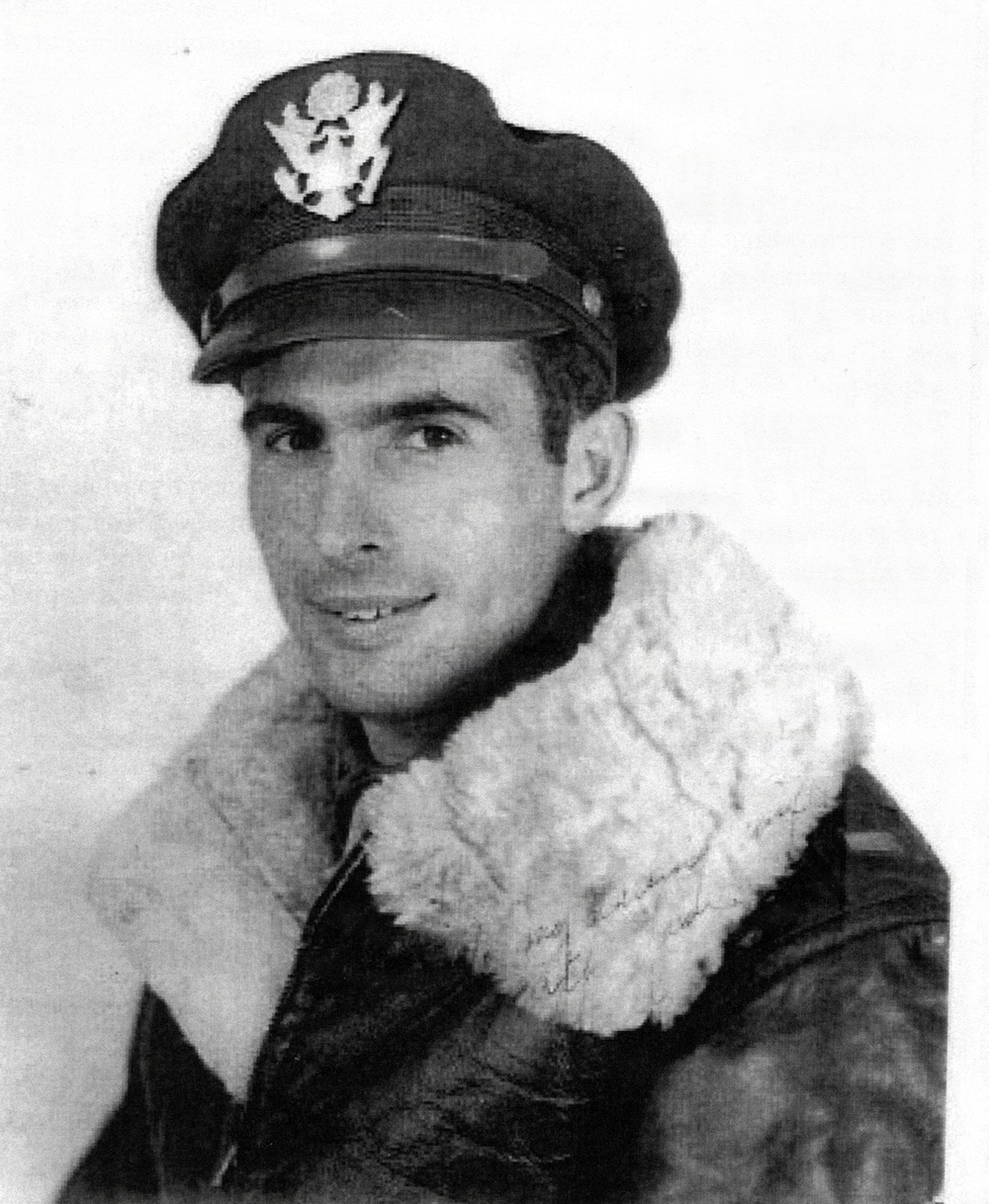
Courtesy Photo | Lt. Alvin M. Pollingue was a P-47 Thunderbolt fighter pilot during World War II. ...... read more read more
 Subscribe
The Purple Heart The Purple Heart medal of the US Armed Forces is the oldest military award in America, with origins going back to August 7, 1782. On that day, General George Washington created the Badge of Military Merit, awarded for ““any singularly meritorious act.” It later became known as the Purple Heart.
After a period of disuse, the award was revived by then Army Chief of Staff General Douglas MacArthur (on February 22, 1932, which was the 200th anniversary of the birthday of George Washington. It was then that the criteria changed from “any singularly meritorious act” to a focus on military personnel wounded or killed in combat.
In 1942, President Franklin D. Roosevelt extended the Army’s Purple Heart eligibility to members of the Navy, Marine Corps and Coast Guard in World War II. In 1952, President Harry Truman made it retroactive back to the American entry into the First World War.
The history of the 142nd Wing contains the names of a number of personnel, mostly from the Second World War era when the unit was designated as the 371st Fighter Group, who were awarded the Purple Heart. Some were awarded to the living, and others, posthumously. On this National Purple Heart Day, we remember First Lieutenant (1st Lt.) Alvin Michael Pollingue, who was awarded the Purple Heart posthumously.
Alvin M. Pollingue Alvin M. Pollingue was born on September 12, 1919 in Eunice, Louisiana. He was a graduate of Southern Louisiana Industrial Institute in Lafayette, the University of Louisiana at Lafayette today. He worked in a construction office before he enlisted in the Army on January 6, 1942. He was later accepted for pilot training and earned his wings and a commission as an officer at Napier Field near Dothan, Alabama.
Lt. Pollingue was assigned to the group’s 405th Fighter Squadron on November 13, 1943, per Special Order #62 of the 371st Fighter Group. He was with the outfit in its training phase, then deployment by ship overseas to England, the early days of combat operations in the Air Offensive, Europe from Bisterne, and the mid-June move to Advanced Landing Ground A-6, Beuzeville, a.k.a. La Londe, or Sainte-Mère-Église, for combat operations in the Normandy Campaign.
He celebrated his first wedding anniversary to the former Miss Mildred Louise Adams just a week earlier, such as a serviceman could when deployed to a combat zone overseas, and was the father of their baby daughter, Camille Marie. And the group itself had just celebrated its first anniversary on Saturday, July 15, 1944.
Fatal Mission Sunday, July 16 brought rains and no flying, and in the afternoon on Monday, the weather cleared enough for the group to fly some combat missions. At 1512 hours, the 405th FS commander, Maj. Harvey L. Case, Jr., took off, leading three flights of his squadron on a mission to dive bomb some railroad bridges at coordinate vK-192023 (in vicinity of (IVO) La Flèche) and vK 914063 (IVO Montoire-sur-le-Loir).
Out of the 12 P-47’s, eight were loaded with two 500-lb bombs each and four were assigned escort duty, with all aircraft carrying 2,000 rounds of .50-caliber machine gun ammunition each. Lt. Pollingue flew P-47D-20-RE Thunderbolt, serial number 42-76435. They flew in weather that was 4/10 to 6/10 cumulus from 6,000 to 7,500 feet, with visibility of four to five miles.
Although Discharge Squadron did not find the assigned targets at the coordinates they were given, they found another railroad bridges in enemy-held territory at coordinate vK-0319 (IVO Sable-sur-Sarthe, to the northwest of La Flèche) and one flight dropped eight bombs on it, beginning their dives from 9,000 feet at 55-degrees angle, with weapons release at 2,500 feet. They knocked the bridge out “with 2 direct hits that buckled bridge.”
They then found 17 goods cars and three fuel cars which they strafed and left in flames. But this part of the mission was costly. Maj. Case gave the following statement on what happened in a post-mission report: “I was leading the squadron on a dive bombing mission to La Fleche, France. After completion of the dive bombing run, I mad a low altitude pass to observe bombing results on the target.
While on the pass, I discovered approximately twenty (20) railroad cars, well camouflaged, in the immediate area. I climbed and reassembled my flight for a strafing pass. As I pulled away from my run, turning left, I observed Lt. Pollingue firing from three hundred (300) feet in a slight dive. He was directly over the cars and strafing as he closed and he continued to fire to approximately fifty (50) feet. Just as he passed over a fuel or oil car it exploded and set his plane afire at the supercharger.
I called him on the radio and advised him to climb his ship and bail out. He climbed immediately to approximately one thousand (1000) feet and attempted to roll the ship on its back. The plane fell off into a left spiral. I observed about ten (10) feet of the chute dangling out of the cockpit at about five hundred (500) feet. The ship then stalled and spun to the right hitting the ground on its back.
I did not see the chute open and the plane exploded and burned as a result of the crash.” This statement was included in the Missing Air Crew Report the unit filed for Lt. Pollingue, numbered MACR 6888. The crash location was reported at vK1905, just north of La Flèche. Time of the crash was given as 1605 hours.
The 371st Fighter Group’s warbook, The Story of the 371st Fighter Group in the ETO, describes this incident from the perspective of listeners on the ground:
“Listening to the progress of one of the missions over a loudspeaker, Discharge cover flight reported a train below and asked permission to strafe it. Major Case was heard to say, “OK, let’s see some good strafing.” The next thing to come over the R/T was “Pull up! Pull up! You’re on fire!” Other voices cut in frantically calling for the pilot to bail out as fast as possible. A short silence, then a groan, “Oh, my God!”
Lt Alvin Pollingue had hit a tankcar of incendiaries and the resultant explosion set him afire. He pulled up and rolled his ship over, but must have been tangled up in the cockpit. He augered in with the ship.”
Warrior, husband, father, son, brother, Alvin M. Pollingue was 24 years old. He was the first member of the 405th Fighter Squadron to be killed in action, and the last of the 371st Fighter Group’s losses during the Normandy Campaign (June 6 to July 24, 1944).
Perhaps tempered by this sudden, terrible loss, the squadron flew on and found another bridge to attack at coordinate vK-2913 (IVO La Fontaine-Saint-Martin) for the other bomb-laden flight, which dropped eight bombs with unobserved results. They observed 50-plus goods cars in the marshaling yard on the west side of Angers IVO coordinate vO-8279 but refrained from strafing, and returned to A-6 airfield at 1707 hours. In addition to the loss of Lt. Pollingue and his aircraft, another P-47 on the mission was written off with “CAT A” battle damage.
After the Battle French sources appear to indicate a somewhat different location for where Lt. Pollingue and his aircraft came down over 20 miles east of La Flèche, near Vaas, and three miles east of Vaas at Moriers, at a place called "Le Bord de la Route."
On July 20, 1944, Lt. Pollingue was laid to rest at the communal cemetery in Vaas, France. The inhabitants of the town turned out in large number, despite the German ban on such assemblies. The residents could not all fit inside the small church for the funeral service, but covered his coffin with flowers in gratitude for his sacrifice for freedom.
On March 23, 1945, some months after German forces were pushed away from the area, Lt. Pollingue’s body was exhumed by the Army’s American Grave Registration Service and transported to the American military cemetery at St. James, France. It’s now known as the Brittany American Military Cemetery and Memorial, at Saint-James, Département de la Manche, Basse-Normandie, France. He was buried at Plot J, Row 6, Grave 15. This cemetery is the final resting place for four 371st Fighter Group pilots, with two others still missing in action, remembered on the Tablets of the Missing.
Lt. Pollingue was awarded the Purple Heart for his ultimate sacrifice, along with the Air Medal with five oak leaf clusters for his wartime combat service.
Remembering Lt. Pollingue Back in the United States, Lt. Pollingue’s named was added to the plaque of the World War II Honor Roll of Dead and Missing Army and Army Air Forces Personnel associated with the University of Lafayette, on the outside of Our Lady of Wisdom Catholic Church on East St. Mary Boulevard. There are 132 names on this plaque.
Fast forward to 2004, And Lt. Pollingue’s grave at St. James has been decorated with flowers every year on Memorial Day by Jacky Emery. On May 8, 2006 citizens of France led by the Vedacensis Association erected a memorial stele to Lt. Pollingue’s sacrifice at the southwest approach to a bridge across the Loir River Not to be confused with the Loire River), an affixed a plaque with the following translation from French:
IN TRIBUTE to Lieutenant Alvin M. POLLINGUE 405th Squadron of the 371st Fighter Group of the 9th US Air Force American airman who fell at Vaas on July 17, 1944 and to all those who contributed to the defense of Liberty Vedacensis Association Vaas township 2006 Souvenir Francais
We say “Merci beaucoup to these thoughtful citizens of France, who remember Lt. Pollingue. And on this August 7, National Purple Heart Day, we too remember 1st Lt. Alvin M. Pollingue. As the memorial roll of honor plaque at the UL at Lafayette says, “We Pause to remember Lest They Died in Vain.” May a grateful nation and its Allies always remember such service and sacrifice.
| Date Taken: | 08.07.2026 |
| Date Posted: | 08.07.2026 12:28 |
| Story ID: | 571855 |
| Location: | PORTLAND AIR GUARD STATION, OREGON, US |
| Web Views: | 20 |
| Downloads: | 0 |

This work, “OK, let’s see some good strafing” - The Purple Heart Mission of First Lieutenant Alvin M. Pollingue, must comply with the restrictions shown on https://www.dvidshub.net/about/copyright.


No keywords found.




