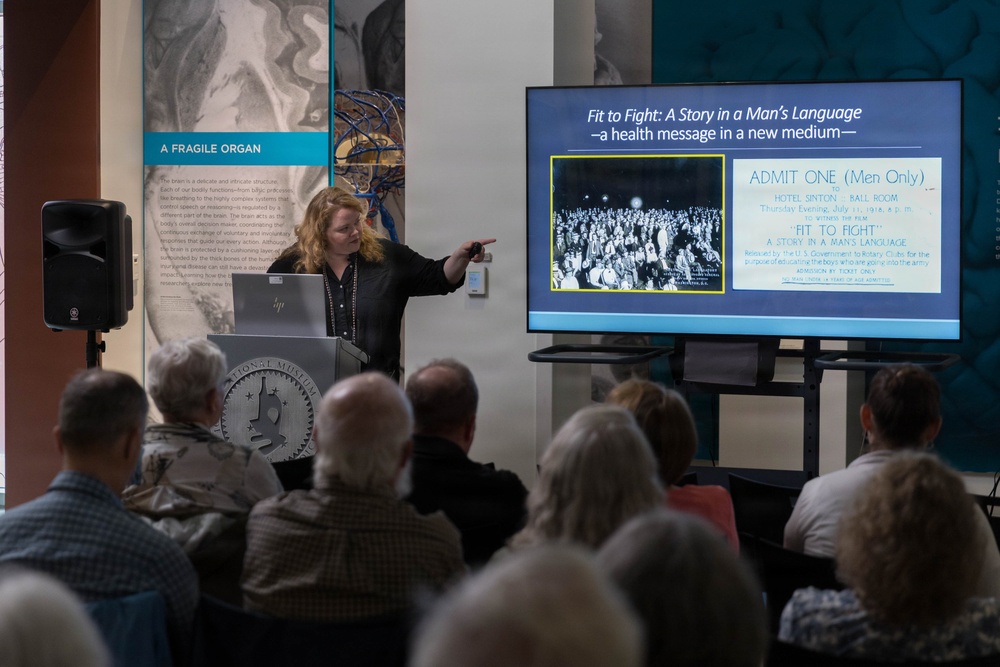
The National Museum of Health and Medicine hosted an August Lecture where Chief Archivist Laura Cutter explored how sexually transmitted infections (STIs) affected service members during World Wars I and II. STIs were a serious threat to military readiness and forced leaders to rethink how they protected the health of their troops. She explained how the military responded to these challenges and how health education became an important tool for protecting the force.
STIs affected thousands of service members. During World War I, about 380,000 troops received a diagnosis. At one point, as many as 18,000 soldiers each day could not report for duty because they were sick. Treatments often lasted six months and cost the government about $50 million (adjusted for inflation, that would be about $982 million today).
At first, the military relied on strict rules and medical treatments to prevent infections. During the lecture, Cutter highlighted a World War I prophylactic kit, known as a “pro kit.” The military gave these kits to service members after possible exposure to help prevent infection. However, many service members found the treatment uncomfortable and chose not to use it, which limited its effectiveness.
“The military had to learn that there is a balance between rules and educating people so they make the safest decisions,” Cutter said.
During World War II, military leaders changed their strategy. They expanded access to condoms, increased health inspections, and created more education programs. Posters, films, and other materials encouraged service members to protect their own health and the health of their units.
“The military moved away from a ‘one narrative approach,’” Cutter said. “They adapted the messaging to show the recipient why they should care, based on their values or personality.”
The National Museum of Health and Medicine preserve the records and artifacts that tell this story. The collection includes World War I- and World War II-era prophylactic “pro-kits,” materials related to “Fit to Fight” a pioneering World War I-era educational film on the dangers of venereal disease, posters, anatomical specimens, wax models, and photographs. These items show how military medicine and health education changed over time.
“These records are incredibly important to preserve because they document a growing change in health messaging,” Cutter said.
The lecture showed that keeping service members healthy remains an important part of military readiness. It also showed how lessons from the World Wars continue to shape military medicine and public health today.
To learn more about the NMHM, or about upcoming events, please check us out on the web, or social media.
| Date Taken: |
08.07.2026 |
| Date Posted: |
08.07.2026 09:00 |
| Story ID: |
571836 |
| Location: |
SILVER SPRING, MARYLAND, US |
| Web Views: |
21 |
| Downloads: |
0 |
PUBLIC DOMAIN

This work, Fit to Fight: The Historic Campaign to Stop Disease from Sidelining Troops, by Kenya Baylor, identified by DVIDS, must comply with the restrictions shown on https://www.dvidshub.net/about/copyright.