
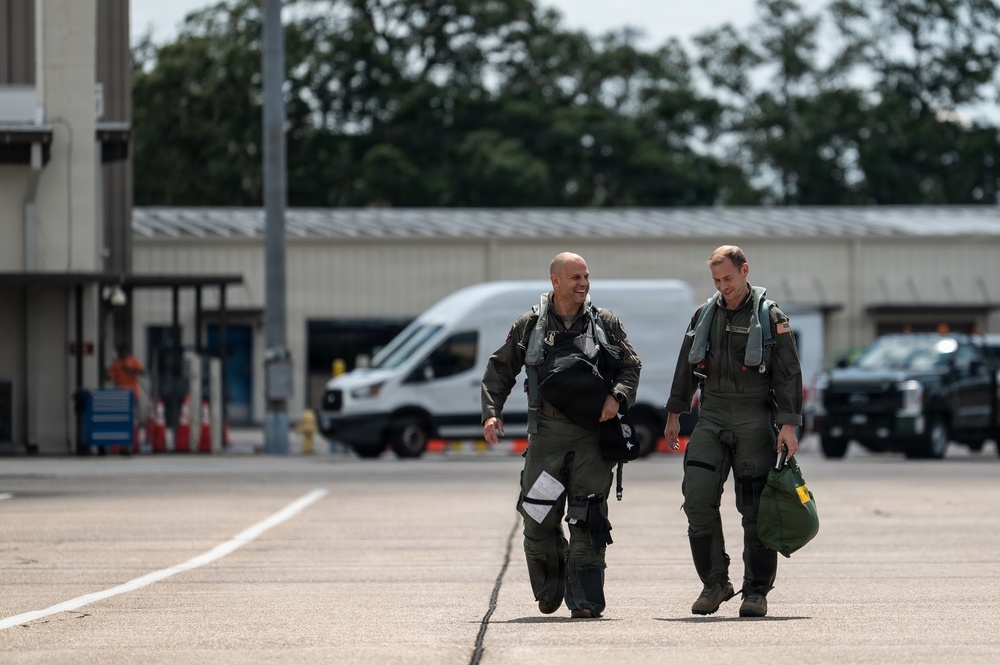
Photo By Staff Sgt. Christian Conrad | Lt. Col. Ben Wysack, Operational Flight Program Combined Test Force F-16 test...... read more read more
EGLIN AIR FORCE BASE, Fla. –
“It is far more important to know what person the disease has than what disease the person has.”
- Hippocrates
At 500 m.p.h., the F-16 sliced through the air, moved by 20,000 pounds of thrust.
The plane, a friendly, was nevertheless hurtling toward Ben Wysack’s nose, closing the distance at a quarter mile per second.
Wysack’s eyes narrowed. He pitched his own F-16 down, matched their approach and centered himself on the aircraft.
Almost imperceptibly, he saw the sun glare off the other aircraft’s canopy. A mile off. Then, in an instant, it leapt to just a hundred meters in front of him. A collision seemed all but certain.
Wysack’s breathing stayed steady.
Just.
Enough.
Time.
“In dogfighting, it’s called a high aspect cross,” Wysack explained.
To a casual observer, the two aircraft appeared to play chicken.
With milliseconds to spare, both pilots steered into aggressive dives, just missing the other, each plane groaning under the great force of the near miss.
“You try to gain a position of advantage over your adversary during that maneuver,” said Wysack, then an instructor pilot with the U.S. Air Force Weapons School, eight years into his career. “Doing so, though, exposes you to around eight or nine Gs.”
Roughly 1,700 pounds of force bore down on both pilots.
To maintain consciousness while those forces push blood away from the brain and into the lower body, fighter pilots use Anti-G Straining Maneuvers, or AGSMs, combining precise breathing with muscular contractions to keep blood circulating.
“You turn your whole upper body in the seat and position your head to the opposite side all while turning your neck as far back as possible across your tail to keep sight of your adversary,” Wysack said.
With his body pressed against the outer confines of his cockpit, Wysack descended into a near vertical dive, craned his neck for a better look, advanced the throttle into full afterburner and approached supersonic speed…
But something was wrong.
Wysack tried to turn his head back to check his fast-decreasing altitude. Instead, he was met with a pilot’s nightmare.
“My helmet had slipped off the seat edge and became wedged between the canopy and ejection seat,” he said. “I couldn’t move.”
He tried to grab the throttle to return it to idle but couldn’t reach it. In extreme pain, fighting against nine Gs and hurtling toward the ground at 700 m.p.h., Wysack marshaled the remaining strength in his neck and core to free himself.
With a single, forceful yank, he freed his helmet and regained control of his neck.
He grabbed the throttle.
Pulled it back from afterburner to idle.
And passed out.
“I’d lost my AGSM trying to relieve my neck pain,” he said.
Incredibly, Wysack came to just in time to pitch his aircraft back level and save both his F-16 and himself, if only just.
Subsequent spinal X-rays revealed Wysack had aggravated an old hairline fracture in his C5 vertebra and severely compacted several cervical discs. It was a diagnosis Wysack, whose lifelong love of flying began when he was a child, would endure for the next 16 years.
“It was nothing that, at the time, would ground me permanently, so back to flying I went with a lot of new long-term neck pain and stiffness,” he said.
In the years that followed, Wysack lived quietly with a ticking time bomb. His mastery of his craft increased. He took on more responsibility. He trained more pilots. And in February 2024, now-Lt. Col. Wysack was still flying high-G training sorties.
Then, after nearly two decades of hibernation, the injury returned with renewed ferocity.
“It was another Air Combat Maneuvering sortie and I was again looking over my shoulder for the adversary,” Wysack recalled. “Suddenly, a shooting and pulsating pain ran from my neck down to my toes. I experienced about 10 seconds of full left-body paralysis—so severe that I couldn’t keep my hand on the throttle during that short period.”
He again recovered the aircraft without further incident. But this time, the experience shook him. When infrequent numbness began spreading into other areas of his body, Wysack went to his flight doctor.
“There comes a point where you need to prioritize your health and the safety of the aircraft over your flying status,” Wysack said.
The prognosis was grim.
“Dude... you’re close to being quadriplegic.”
Wysack’s surgeon didn’t mince words.
“You have one slip of your disc and your spinal cord is going to get cut,” Wysack recalled them saying.
Doctors found significant spinal compression at Wysack’s C3 and C4 vertebrae with evidence of spinal cord damage, including areas that were dead or dying. The surgeon ordered an emergency operation before full paralysis set in and told Wysack he was almost certainly permanently grounded.
“It was one of the most sobering and sad experiences of my life,” Wysack said. “Unfortunately—or perhaps fortunately—I didn’t have much time to ruminate on it.”
Eight days later, Wysack was under the knife.
After a two-level anterior cervical discectomy and the fusion of his C3, C4 and C5 vertebrae, the surgery was deemed a success. But in the months that followed, success took on different meanings.
“Ever since I was 16 and was able to drive myself to the airport for flying lessons, I’ve either been working to fly or have been flying,” Wysack said. “Learning that my medical waiver to get back onto flying status had a one percent chance of approval felt like a monumental shift in my life.”
Since joining the Air Force at 17, Wysack had never had a break in flying—not for a staff job, not for an in-residence school assignment.
“Grounding felt like my boots had been filled with cement,” he said.
For the first time in his adult life, the pilot whose identity had been built inside cockpits had to rebuild himself outside one.
The early stages of recovery focused on allowing the tissues involved to heal before they could be pushed again.
In other words: rest.
Dr. Robert Osborne, Wysack’s physical therapist and a member of the 33rd Training Squadron’s Aircrew Performance Team, knew that would be a hard sell.
The Aircrew Performance Team, part of the Air Force’s Comprehensive Readiness for Aircrew Flying Training (CRAFT) program, embeds physical therapists, strength and conditioning coaches, dietitians, cognitive performance specialists and recovery specialists directly alongside flying squadrons.
Rather than treating injuries in isolation, the team works together to improve performance, reduce injury risk and extend flying careers through individualized care.
For Wysack, that meant rebuilding more than a neck.
While Osborne and the team’s strength professionals progressively rebuilt the resilience of his cervical spine, dietitians helped reduce inflammation and improve body composition. Recovery specialists worked to restore mobility around the surgical site while cognitive performance experts ensured the demands of high-performance flying remained part of the recovery equation.
Every member of the team had a role to play. But despite the myriad resources working toward Wysack’s recovery, there was still one vital prescription for which there was no specialist: time.
“Take a lifelong athlete like Ben, who’s coming to you with all this motivation, all this energy, then tell him the best thing he can do for himself is take it easy—see how that works out,” Osborne laughed. “For someone like him, the key was to keep his motivation up.”
Wysack, a former Division I linebacker for the Air Force Falcons, accepted the new regimen with a certain begrudging discipline.
The first week, Osborne handed him a pair of five-pound weights.
“You gotta be kidding,” Wysack said, still a lean 220 pounds despite his injury.
The pace was agonizing. Five pounds became 10. Ten became 20. Slowly, the treatment team added what Wysack needed most: a sense of progress.
“I wanted nothing more than to prove to the Air Force that I was fit enough to climb back into the cockpit,” Wysack said. “Thankfully, their treatment plan isn’t a ‘one size fits all’ approach.”
The APT recognized that Wysack’s lower body and cardiovascular conditioning remained largely intact from before surgery, so the team adjusted his treatment to allow days focused on moving heavier weight with less-affected muscle groups, increasing Wysack’s fitness in the process.
“Weird, maybe, to call a challenging workout session a ‘treat,’ but that’s exactly how Ben saw it,” Osborne said. “It kept his spirits up, which, in turn, helped his recovery.”
Wysack’s recovery turned into a kind of balancing act. Protect the injury without suffocating the person.
For Wysack, progress also brought temptation. Urged on by recent gains and eager to break through to the next level of care, he began pushing harder. During one pull-up movement, one extra rep became one too many. He tweaked his forearm.
“A speed bump, ultimately,” Wysack said. “But that didn’t make it less annoying.”
At the APT, setbacks aren’t treated as failure, he said. They’re data points. Another part of the laboratory.
“Every inch of the building is pointed at helping optimize the warfighter,” Wysack said. “They have acupuncturists, dieticians, massage therapists—pretty much any kind of recovery or preventative upkeep or training you want to accomplish, you can.”
Osborne describes the mission in practical terms.
“If someone’s in the military, they work a physical job,” he said. “If our team can keep these members ready to accomplish the mission and allow them to perform better for longer, then we’ve hopefully more than justified our existence.”
The APT’s treatment philosophy focuses heavily on holistic health, integrating physiological and psychological care. There are smiles and fist bumps, but depressive episodes are also a reality the team regularly contends with. Wysack’s recovery was no exception.
“When I was injured, I was still battling a tough divorce from a 22-year marriage,” said Wysack, who shares three teenage daughters with his ex-wife. “The APT literally saved my life. My body and soul were reborn in this facility. I honestly don’t think I would have made it through these life changes without these amazing people.”
Osborne knew the weight Wysack was carrying. Still, the morning routine stayed constant.
“Morning, Rob—what’s the plan today?” Wysack would ask with a smile.
“Band work, Rex—your favorite,” Osborne would answer back.
“Oh, fun...”
Rex—“king” in Latin—is Wysack’s call sign, a memento of his days in the cockpit and a tradition well observed by the fighter pilot community.
Call signs are usually given in jest, Osborne said. Something backhanded. Something embarrassing. Not this one.
“Some 2,000 years ago, Hippocrates wrote, ‘It is far more important to know what person the disease has than what disease the person has,’” Osborne said. “Rex is a tremendous human. Nobody gets to where he is in life without being smart and skilled and working hard. But he’s more than that. He’s also a caring father, a thoughtful friend and a blast to be around.”
The APT had to treat a cervical fusion, damaged discs and weakened tissue. They also had to treat a father, a fighter pilot, an athlete and an Airman; a man trying to understand who he was if he never flew again.
Wysack kept showing up.
He never missed a session. He never complained. He never gave up or finished early.
At a certain point, he said, it ceased being about whether the waiver would be approved.
“But it wasn’t gonna be denied because I didn’t try hard enough.”
Every day:
“Morning, Rob — what’s the plan for today?”
“Let’s do some push work.”
“Sounds good.”
Every night, Wysack organized documentation, searched for resources and asked for help.
Behind the scenes, the Aircrew Performance Team, too, was documenting every step of Wysack’s recovery.
Through the Aircrew Performance Assessment, or ACPA, the team measured eight performance indicators directly tied to the physical and cognitive demands of fighter aviation, including neck endurance, spinal endurance, lower-body power output, body composition and cognitive task switching.
Unlike a traditional fitness assessment, the ACPA isn’t designed to determine whether an Airman is fit for military service. It’s designed to identify injury risk, establish individual performance baselines and help aircrew maximize their effectiveness in the cockpit.
For Wysack, though, the assessment became something more.
Despite guidance suggesting his cervical fusion would likely prevent him from returning to flight, the objective data gathered by the team told a different story. Across nearly every category, Wysack performed at or above the level of the average new fighter pilot.
Those results became a key part of the waiver package demonstrating that Wysack wasn’t simply recovered, but remained physically and cognitively capable of flying the F-16 at the highest level.
Though after 20 months, Wysack’s patience dwindled, and with it, his hope of ever returning to the cockpit.
Then a call came in.
Wysack was on temporary duty away from home when his flight doctor called.
“I was on a break during a meeting,” he said. “I remember thinking, ‘Well, this is probably important.’”
The voice on the other end was casual, delivering the news like an offhand comment about the weather.
“Hey, your waiver came through.”
His heart leapt into his throat.
“Oh… awesome,” was all he could say. He hung up, finished his meeting and walked back to his hotel room.
Forty years earlier, Wysack had walked out of a screening of “Top Gun” with his dad—the third one he had been to that week—and decided then that he wanted to be a pilot and nothing else.
There, in the quiet of his hotel room, he again felt that pull toward the cockpit.
“Grateful,” he said. “Grateful was probably the biggest thing I felt in that moment.”
Wysack still attends sessions with the APT, though now with the goal of prevention and longevity.
“I still bug them from time to time,” he laughed. “Especially Rob. He still asks me how I’m feeling. I still ask him for workout advice. They’ll always be a resource I take advantage of for as long as I can.”
As an F-16 test director for the Operational Flight Program Combined Test Force, Wysack is no stranger to finding limits and respecting them. He now applies that philosophy to himself.
“As much as I wish I could say I can now turn my head and feel nothing, there’s still pain,” he said. “When I was in my 20s, I felt invincible and that led me to make some dumb decisions, and while I’m not claiming I’m any smarter now, I am more experienced and aware of my limitations.”
One day, Wysack will climb down from the cockpit for the last time, past the controls, past the memories, past the name emblazoned on his jet—the name he’s been called thousands of times.
“Rex.”
But when that day comes, Wysack won’t leave the cockpit as the same man who once tried to muscle through pain at nine Gs. He’ll leave as someone who learned that taking care of oneself sometimes demands that one be taken care of by others.
Air Combat Command’s Aircrew Performance Center uses advanced technology and targeted conditioning to increase performance, lethality and longevity of fighter pilots for high-end future combat environments. For more information on the program, call 850-883-3652.
| Date Taken: | 08.06.2026 |
| Date Posted: | 08.06.2026 17:32 |
| Story ID: | 571781 |
| Location: | EGLIN AIR FORCE BASE, FLORIDA, US |
| Web Views: | 683 |
| Downloads: | 0 |

This work, One Percent: Aircrew Performance Team helps F-16 pilot defy grounding odds, by SSgt Christian Conrad, identified by DVIDS, must comply with the restrictions shown on https://www.dvidshub.net/about/copyright.


No keywords found.





