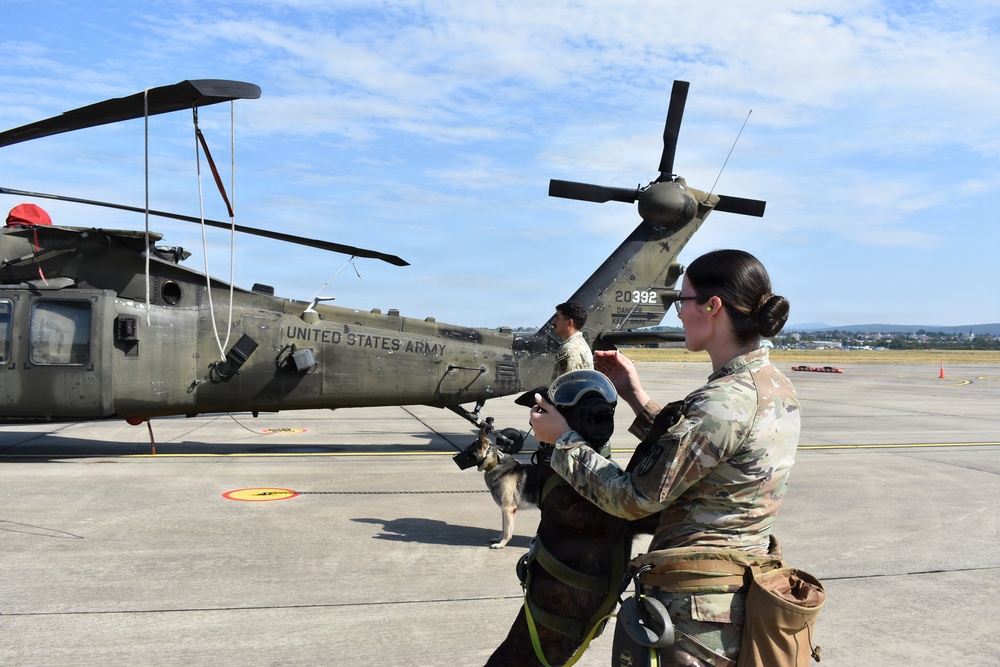
WIESBADEN, Germany — Military working dog handlers, Army combat medics, civilian K9 handlers and security personnel from installations across Germany and Belgium gathered at the Wiesbaden Veterinary Treatment Facility for a training event focused on Tactical Combat Casualty Care and UH-60 Black Hawk familiarization.
Approximately 15 participants—including U.S. Army MWD handlers, 68W combat medics and civilian K9 handlers from Pond Security Service GmbH—took part in the crawl phase of preparations for a larger exercise scheduled for September. The training emphasized life-saving veterinary first aid, prolonged field care, and safe helicopter operations, ensuring handlers are prepared to care for their canine partners in austere environments.
"The three primary goals of K9 Tactical Combat Casualty Care are to prevent additional casualties, treat the casualty, and complete the mission," said Capt. Amanda Zanger, officer in charge and veterinarian at the Wiesbaden Veterinary Treatment Facility, as she opened the classroom instruction.
Zanger explained that the course is designed specifically for handlers and combat medics because they are often the first on scene when a working dog is injured.
"You guys are going to be at the point of injury," Zanger said. "Our vets are going to be hundred of miles away. You're going to have to rely on your training and your medics to take care of your casualty."
The classroom portion covered the MARCH algorithm, canine vital signs, heat injuries, hemorrhage control and prolonged casualty care. Participants learned to recognize early signs of medical emergencies and practiced interventions that could keep a military working dog alive until veterinary treatment becomes available.
Zanger emphasized that modern operations may require handlers to care for an injured dog for extended periods.
"MEDEVAC and CASEVAC may not going to be available," Zanger said. "Prolonged care is something you're going to have to rely on your skills and your equipment for before we can treat the dog."
The training also addressed the unique challenges faced by civilian security dog handlers. Unlike military units with dedicated veterinary assets, civilian teams may have significantly longer travel times before reaching emergency veterinary care.
Alexander Hildebrandt, a K9 handler with Pond Security Service GmbH, said the opportunity filled an important training gap.
"We don't really have the opportunities for this ourselves," Hildebrandt said. "Our NCOIC suggested we participate, and we were very, very happy to do it."
Pond Security Service K9 teams support U.S. Army installations by performing vehicle inspections, gate operations and anti-terrorism missions alongside military police.
"We're basically the civilian counterpart to the Military Police," Hildebrandt explained. "We support them at the gates and on missions when they don't have the time or additional manpower."
For Hildebrandt, every aspect of the course was valuable.
"Really everything," Hildebrandt said. "That's no exaggeration. These are things you just don't learn as a civilian. It helps with early detection, first response and then getting the dog to the hospital where the professionals can take over."
He noted that, depending on the location, reaching veterinary care can take significant time, making the ability to provide immediate treatment critical.
The practical portion of the event included familiarization with UH-60 Black Hawk helicopters, allowing handlers and their dogs to safely experience aircraft noise, rotor wash and loading procedures before operational missions.
Staff Sgt. Stacey Collins, assigned to the 100th Military Police Detachment, Combined Military Working Dog Detachment-Europe, attended the course with her new military working dog.
"This is my second time doing the training of hot load, cold load and K9 TCCC," Collins said. "However, this is my first time doing it with my new dog."
She said helicopter familiarization is essential because military working dog teams frequently deploy independently.
"The training is very beneficial to us as we do deploy a lot as a singular unit," Collins said. "Getting our dogs familiarized in aircraft is important. That way, in the case of an emergency, they are already familiar with the procedures as well as the handlers."
Introducing dogs to helicopters before an operational mission also reduces stress during real-world emergencies.
"It can be difficult depending on the dog's temperament because it's not a familiar location that we train on often," Collins said. "The environment is very loud, which can bother the dog's hearing a little bit."
By bringing together military and civilian working dog teams, combat medics and veterinary professionals, the Wiesbaden Veterinary Treatment Facility strengthened interoperability while improving participants' ability to preserve the lives of military working dogs in both combat and garrison environments.
| Date Taken: |
08.06.2026 |
| Date Posted: |
08.06.2026 06:48 |
| Story ID: |
571715 |
| Location: |
DE |
| Web Views: |
21 |
| Downloads: |
0 |
PUBLIC DOMAIN

This work, Wiesbaden Veterinary Treatment Facility Hosts K9 Tactical Combat Casualty Care and UH-60 Familiarization Training, by Michelle Thum, identified by DVIDS, must comply with the restrictions shown on https://www.dvidshub.net/about/copyright.