
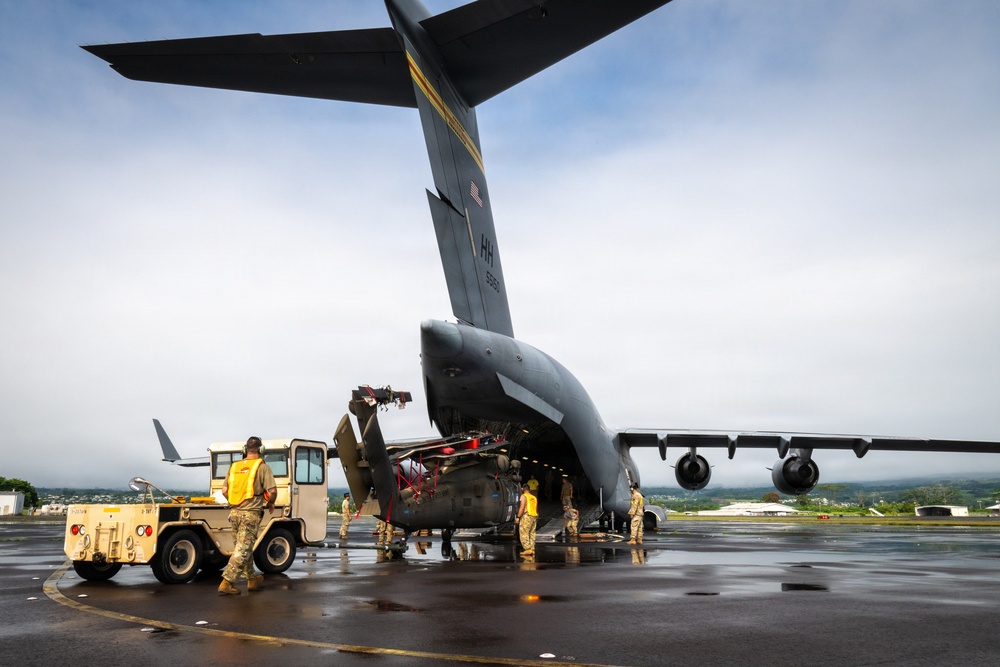
Photo By Senior Master Sgt. Mysti Bicoy | Hawaii Army National Guard Soldiers and Hawaii Air National Guard Airmen prepare to...... read more read more
 Subscribe
How years of friendship, shared purpose and quiet professionalism made the Hawaii Army National Guard's first Black Hawk deployment to the Philippines possible.
By Senior Master Sgt. Mysti Bicoy
HILO, Hawaiʻi - History is rarely defined by a single flight. More often, it is shaped quietly over time through shared purpose, enduring friendships and the commitment of people who choose to build something that will outlast them.
On a warm morning in Hilo, that history moved slowly toward the open cargo ramp of a Hickam-based C-17 Globemaster III operated by Airmen of the Hawaii Air National Guard's 204th Airlift Squadron. Inside, Soldiers and Airmen settled into the measured rhythm of preparation as the metallic click of cargo chains echoed through the aircraft. Loadmasters exchanged hand signals while maintainers completed a final walk-around of the Hawaii Army National Guard UH-60M Black Hawk. Months of coordination had led to this moment, and years of determination were about to leave the ground.
With its rotor blades folded for transport, the Black Hawk inched toward the waiting C-17. To anyone watching from the edge of the flightline, it may have looked like another strategic airlift mission. For the Soldiers and Airmen guiding it aboard, however, the aircraft embodied years of planning, professional collaboration and friendships strengthened through aviation exchanges between the Hawaii Army and Air National Guard and the Philippine Air Force.
When the Hickam-based C-17 departed Hilo July 31 for Clark Air Base, Philippines, it marked the first overseas deployment of a Hawaii Army National Guard Black Hawk to conduct bilateral aviation training with the Philippine Air Force. It also launched the first aviation engagement under the Hawaiʻi–Philippines State Partnership Program, bringing together Hawaii Army National Guard Soldiers, Hawaii Air National Guard Airmen and members of the Philippine Air Force's 205th Tactical Helicopter Wing to plan, maintain and fly together.
The mission was historic, but its origins were remarkably simple. Three years earlier, aviation professionals from Hawaiʻi and the Philippine Air Force recognized they operated variants of the same aircraft, creating the foundation for everything that followed.
The Hawaii Army National Guard flew the UH-60M Black Hawk, while the Philippine Air Force operated the S-70i, an internationally produced variant of the Black Hawk. Their similar design and operating concepts provided a common foundation for years of aviation exchanges that eventually made this deployment possible.
Rather than limiting exchanges to classrooms and familiarization visits, both organizations envisioned pilots, crew chiefs and maintainers planning, troubleshooting and flying together. Turning that vision into reality required patience, persistence and sustained commitment.
For Maj. John Worthington, officer in charge of Task Force Lapu-Lapu, the goal was never simply to move a helicopter across the Pacific. The Black Hawk was simply the vehicle for something larger: creating the conditions for two professional aviation organizations to operate together with confidence long before a crisis demands it.
"Three years ago, this mission existed only as an idea," Worthington said. "Today, we're watching that idea become reality because people across both organizations stayed committed to the same goal. Every exchange, every planning conference and every professional relationship helped bring us to this point. This mission has never been about moving a helicopter. It's about creating opportunities to operate together in ways that make both organizations stronger."
To Maj. Gen. Stephen Logan, the operation demonstrated what years of deliberate investment between partner forces can achieve.
"This operation is a proof of concept that culminates years of collaborative training between the Philippine Air Force and Hawaii Army National Guard Aviation," Logan said. "Through multiple integrated flights, we're demonstrating the kind of interoperability allies and partners will depend on during future operations across the Indo-Pacific."
On the Hilo flightline, that strategic idea was taking physical form. Long before the C-17 taxied toward the runway, the Black Hawk had become the center of a carefully coordinated operation in which every checklist, hand signal and tie-down mattered. Nothing was rushed because nothing about the mission had been built overnight.
High above the flightline, U.S. Army 1st Sgt. Christopher Pacheco knelt atop the folded rotor system, guiding the Black Hawk inch by inch into the cargo compartment as loadmasters called directions and ground guides communicated through deliberate hand signals.
The movement looked almost effortless. Cargo chains rattled against the aircraft floor as hand signals passed quietly between loadmasters and ground guides. Only those who had spent years preparing for it understood how much work had gone into making it appear that way.
Years earlier, Pacheco had stood beside members of the Philippine Air Force during one of the first aviation subject matter expert exchanges between the two organizations. They discussed maintenance procedures, compared technical practices and examined aircraft that, despite flying under different flags, shared the same purpose. At the time, no one knew exactly where those conversations might lead. Now the answer was slowly disappearing into the cargo bay beneath him.
“When we first began working with the Philippine Air Force, none of us imagined we'd one day be loading one of our own Black Hawks onto a C-17 to deploy and fly alongside our partners,” Pacheco said. “This mission represents much more than transporting an aircraft. It's the result of years spent earning professional trust by training together.”
As Pacheco guided the Black Hawk farther into the aircraft, members of the 204th Airlift Squadron focused on a different challenge. Transporting a combat-ready helicopter across the Pacific required far more than loading cargo. Every pallet, restraint, weight calculation and tie-down had been planned and verified well before the C-17 arrived in Hilo.
Master Sgt. Eric Dignam understood that work better than most. From the initial site survey through final execution, he helped shape the movement alongside planners from the Hawaii Army National Guard and Hawaii Air National Guard, ensuring the aircraft, personnel and equipment could be transported safely and arrive ready for the training ahead.
As a traditional Guardsman, Dignam balanced a civilian career while helping plan one of the most significant aviation engagements in the history of the Hawaiʻi–Philippines State Partnership Program.
"People see a C-17 loaded with cargo, but they don't always see the planning and commitment behind every pallet, every tie-down and every decision we make," Dignam said. "Transporting the Black Hawk across the Pacific required making sure every detail was right so our partners could train together safely. Being part of the first aviation engagement of its kind between Hawaiʻi and the Philippines is something I'll always be proud of."
As the final restraints were secured and the cargo inspection completed, the Black Hawk sat motionless inside the C-17. For the first time, a mission that had existed for three years in planning meetings, maintenance exchanges and briefing slides had become something tangible. The aircraft was ready, and so were the people.
When the cargo door closed, the early morning sounds of the flightline gave way to the steady roar of four engines preparing for departure. Ahead was the Pacific. On the other side were partners who had helped make the journey possible.
The Pacific crossing took less than a day. Building what waited on the other side had taken years.
When the cargo ramp lowered at Clark Air Base, the warm night air rushed into the cargo compartment as the Hawaii National Guard crew methodically guided the Black Hawk down the ramp with the same precision that had carried it aboard in Hilo. Only hours earlier, U.S. Army 1st Sgt. Christopher Pacheco had helped direct the aircraft into the C-17. Now, alongside fellow Soldiers, he watched years of planning become something tangible on the flightline.
Waiting nearby were members of the Philippine Air Force's 205th Tactical Helicopter Wing. For many, this wasn't a first meeting but the continuation of conversations that had begun years earlier during aviation exchanges in Hawaiʻi and the Philippines. Those conversations had started in classrooms, maintenance bays and briefing rooms. Now they continued where both organizations had always hoped they would: on a flightline, standing beside the Black Hawk that had finally made the journey.
No ceremony marked the moment. None was needed. The mission had already begun.
For Lt. Col. John Delgado, chief standard evaluation officer of the Philippine Air Force's 205th Tactical Helicopter Wing, the arrival represented far more than any other aircraft. It marked the next chapter in a partnership that had evolved through years of aviation exchanges into meaningful operational cooperation.
"This partnership has been built over years of mutual respect, professional trust and a shared commitment to regional security," Delgado said. "What began as subject matter expert exchanges has grown into meaningful operational cooperation that has been essential to developing our Black Hawk capability. As a relatively new operator, we've benefited tremendously from the Hawaii Army National Guard's experience. Their support has helped us validate our procedures, refine our planning and safely build the capabilities needed to employ our Black Hawk fleet. More importantly, it has given us a proven path forward while strengthening our ability to respond together to future security challenges, humanitarian emergencies and disaster response operations."
Pilots leaned over mission maps comparing routes, weather and communication procedures. Crew chiefs disappeared beneath engine cowlings together, trading maintenance techniques refined through years of operating the same aircraft in different environments. Maintainers passed tools back and forth as naturally as conversation, stopping occasionally to ask why one procedure differed from another or how a particular inspection was performed.
No one seemed concerned about whose checklist they were holding. They were far more interested in understanding why it worked.
For Worthington, the deployment confirmed what years of planning had been building toward.
"Success was never measured by whether we could move a Black Hawk to the Philippines," Worthington said. "That was simply the first step. Success is seeing Soldiers, Airmen and Philippine Air Force personnel planning together, solving problems together and building the kind of professional confidence that only comes from working side by side. Aircraft give us a reason to come together. What we build around them is what really matters."
Over the following days, the Black Hawk became a familiar sight above Clark Air Base as mixed crews flew orientation sorties, completed maintenance operational checks and rehearsed hoist and external-load missions. Each sortie reinforced the same objective: building confidence together long before those skills would be needed.
For Hawaiʻi and the Philippines, humanitarian assistance and disaster response is not an abstract mission discussed in classrooms or planning documents. Both island communities understand the uncertainty that follows typhoons, earthquakes, volcanic eruptions and flooding. They know helicopters often become the first aircraft overhead after disaster strikes, delivering emergency responders, evacuating injured civilians and reconnecting communities cut off from the outside world. That reality shaped every flight during the engagement. The crews were not simply rehearsing procedures. They were preparing for the day someone would depend on them to get it right.
Years from now, another generation of Soldiers, Airmen and Philippine aviators may prepare for an even more ambitious aviation engagement without realizing where many of their procedures, relationships and shared practices first took shape. They will inherit planning refined through this deployment, maintenance techniques strengthened through collaboration and professional friendships built one exchange, one flight and one conversation at a time. Most will never know the names of the people who built those foundations. They won't have to. That's how the strongest partnerships endure.
Days earlier, the Black Hawk had rolled slowly toward the open cargo ramp of a waiting C-17. To most people, it looked like another aircraft preparing for transport. The Soldiers and Airmen guiding it aboard saw years of persistence, friendships strengthened one conversation at a time and the quiet confidence that comes from solving problems together before circumstances ever demand it.
When the cargo door finally closed, it did not simply carry a helicopter across the Pacific. It carried an idea: that the strongest partnerships are not built during emergencies—they are built long before they are ever needed.
| Date Taken: | 12.31.1969 |
| Date Posted: | 08.06.2026 03:59 |
| Story ID: | 571708 |
| Location: | PH |
| Web Views: | 19 |
| Downloads: | 0 |

This work, The Flight Before the First Flight, by SMSgt Mysti Bicoy, identified by DVIDS, must comply with the restrictions shown on https://www.dvidshub.net/about/copyright.


No keywords found.




