
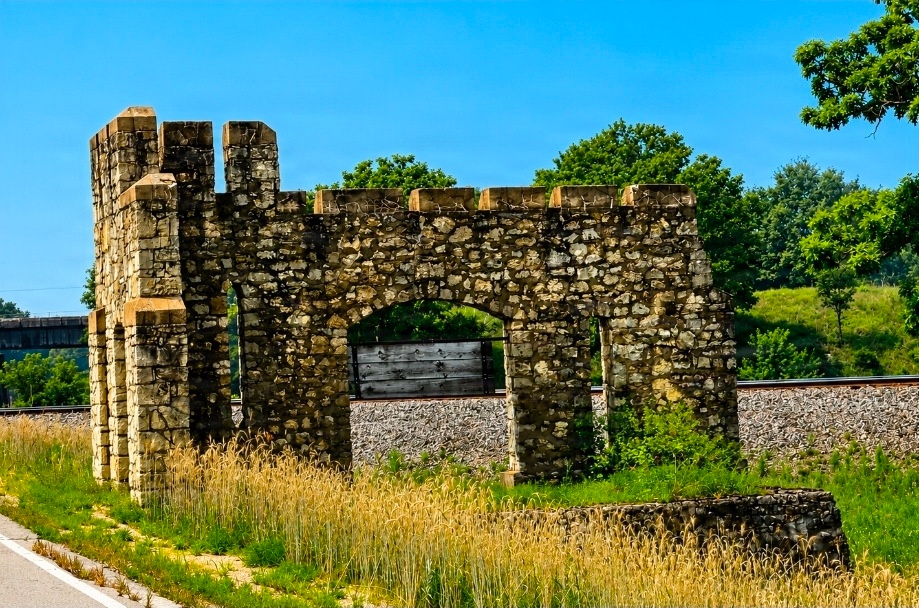
Photo By Scott Sturkol | A gate section built by the Works Progress Administration in 1941 is shown on South...... read more read more
 Subscribe
Along Ginger Road in Fort McCoy’s South Post housing area stands a solitary stone gateway. To many who pass by, it is simply another historic structure seen around post.
But more than 85 years ago, it served as one of the first sights welcoming Soldiers, civilians, and visitors arriving at Camp McCoy during one of the most significant periods in the installation’s history.
Today, only one of the original stone gate sections remains standing.
Constructed by the Works Progress Administration (WPA) in December 1940, the gates marked the original entrance along State Highway 21 as Camp McCoy prepared for the rapid expansion that would accompany America's entry into World War II.
According to Fort McCoy History and Heritage and other Fort McCoy historical files, the WPA built the gates in response to the relocation and construction of Highway 21, although the entrance road itself had existed since military training first began at Camp McCoy in 1909. The gates represented much more than an attractive entrance.
During the late 1930s and early 1940s, Camp McCoy was transformed from a seasonal National Guard training camp into one of the Army’s premier mobilization and training centers. New barracks, warehouses, headquarters buildings, motor pools, and support facilities appeared throughout the installation as the Army prepared for the possibility of war.
The WPA played an important role in that transformation.
From 1935 through 1941, the federal New Deal agency completed numerous construction projects across Wisconsin while providing employment during the Great Depression. At Camp McCoy, the WPA partnered with the War Department on a building program that included six wooden structures and two decorative stone entranceways — one along Highway 21 at today’s South Post housing area and another at the Highway 16 entrance. These stone gates remain among the only surviving WPA-built structures at Fort McCoy.
Historical and archaeological records maintained by Fort McCoy also show the WPA’s project headquarters was located just south of Quartermaster Avenue. From there, workers coordinated construction projects that helped reshape Camp McCoy in the years immediately preceding World War II. Among those projects were the Ginger Road entrance gates, which became a defining feature of the South Post landscape.
For thousands of Soldiers arriving during the early 1940s, the stone gates marked the transition from civilian life to military service.
Many traveled to Camp McCoy by rail, arriving at nearby McCoy Station before entering the installation. Others approached by automobile along Highways 21 or 16, passing near the stone entrance.
Fort McCoy historical records note that memories of arriving Soldiers often became part of the installation’s heritage. For many, seeing the Ginger Road stone entrance, nearby railroad lines, and sprawling tent cities formed their first impression of Camp McCoy in those early days — a place where later hundreds of thousands of Soldiers would ultimately train during World War II.
For many years after construction, decorative artillery pieces flanked the entrance, reinforcing Camp McCoy’s identity as an Army training installation. While the cannons are no longer present and only one section of the original gate survives today, the remaining stonework continues to symbolize an important chapter in Fort McCoy’s history.
Unlike the installation’s oldest building — the 1911 concrete ordnance storehouse — the Ginger Road gate was never intended to store equipment or support training directly. Instead, it served as a ceremonial threshold, welcoming generations of Soldiers at a time when Camp McCoy was rapidly becoming one of the nation’s busiest military training centers.
Today, the lone gate stands quietly outside the South Post housing area, a lasting reminder of the craftsmanship of the WPA and the thousands of Soldiers who passed through its entrance during one of the most transformative periods in Fort McCoy’s history.
Fort McCoy has supported America’s armed forces since 1909. Located in the heart of the upper Midwest, Fort McCoy is the only U.S. Army installation in Wisconsin.
The post’s varied terrain, state-of-the-art ranges, new as well as renovated facilities, and extensive support infrastructure combine to provide military personnel with an environment in which to develop and sustain the skills necessary for mission success.
The installation has provided support and facilities for the field and classroom training of more than 100,000 military personnel from all services nearly every year since 1984.
Learn more about Fort McCoy online at https://home.army.mil/mccoy, on Flickr at https://www.flickr.com/photos/fortmccoywi, and on DVIDS by visiting https://www.dvidshub.net/unit/FMPAO.
Also try downloading the My Army Post app to your smartphone and set “Fort McCoy” or another installation as your preferred base. Fort McCoy is also part of Army’s Installation Management Command where “We Are The Army’s Home.”
(Editor's Note: Historical information for this article was compiled from Fort McCoy History and Heritage, Fort McCoy historical files, archaeological research maintained by the Directorate of Public Works Environmental Division, and previous Fort McCoy Public Affairs Office historical publications.)
| Date Taken: | 08.05.2026 |
| Date Posted: | 08.05.2026 18:37 |
| Story ID: | 571691 |
| Location: | FORT MCCOY, WISCONSIN, US |
| Web Views: | 1,044 |
| Downloads: | 0 |

This work, Lone stone gate preserves memory of Fort McCoy’s historic South Post entrance, by Scott Sturkol, identified by DVIDS, must comply with the restrictions shown on https://www.dvidshub.net/about/copyright.


No keywords found.




