
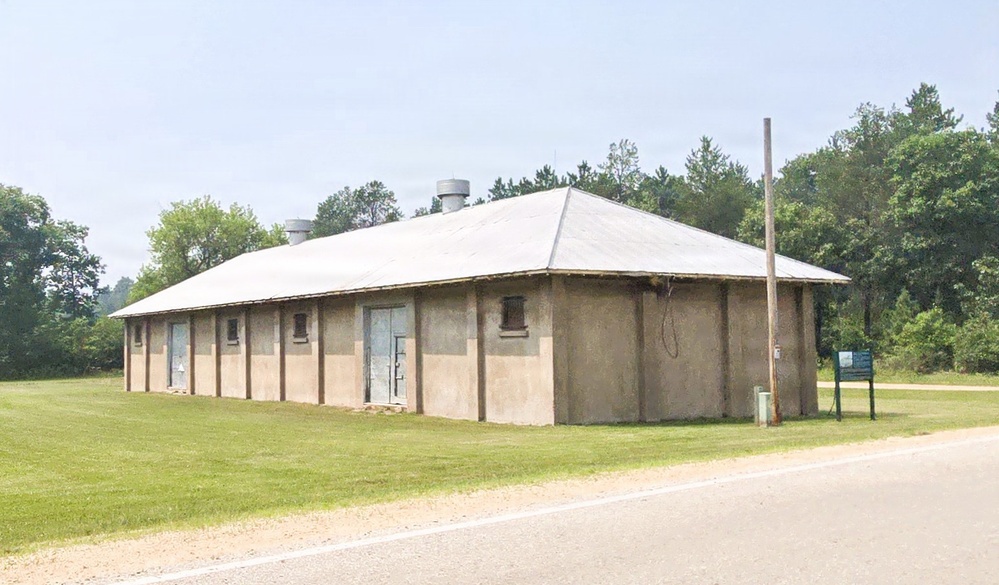
Photo By Scott Sturkol | This concrete storehouse, shown July 16, 2026, is the oldest standing building at Fort...... read more read more
 Subscribe
Long before Fort McCoy became one of the Army’s premier training installations, before thousands of Soldiers arrived each year by highway and aircraft, and decades before World War II transformed the post into a sprawling cantonment, a single concrete structure quietly took shape on what is now the installation’s South Post.
Today, that modest building — a concrete storehouse also known as the Ordnance Magazine — remains the oldest standing structure at Fort McCoy. Built in 1911, the building has endured for more than a century, surviving wars, changing missions, and generations of Soldiers while offering a tangible connection to the installation’s earliest history. Fort McCoy historical records identify the structure as the first permanent concrete building constructed after the establishment of the military reservation in 1909.
When construction began on the storehouse, Fort McCoy was still in its infancy. Known then as Camp Robinson on the south side of the railroad tracks and Camp Emory Upton to the north, the installation consisted largely of temporary galvanized buildings, open training grounds, and artillery firing areas.
The Army had selected the rugged hills and valleys between Sparta and Tomah because the terrain closely resembled many of the landscapes Soldiers might encounter in combat while providing abundant space for maneuver training. During the summers of 1909 and 1910, Regular Army artillery batteries and National Guard units trained on the reservation, helping establish Camp Robinson as one of the nation's premier field artillery camps.
As training increased, Army leaders recognized that the installation required more permanent infrastructure.
In 1910, Congress authorized additional funding to improve the camp, and work began to replace temporary facilities with more durable construction. Among the first of those improvements was the concrete ammunition storehouse completed in 1911 at a reported cost of $8,000. The structure represented the Army's confidence that the installation would become a permanent military reservation rather than a temporary encampment.
The building’s location was no accident.
Historical records show the storehouse was built adjacent to the southern spur of the joint Chicago & North Western and Chicago, Milwaukee & St. Paul railways, placing it within easy reach of rail transportation that served the installation. The railroad was one of the primary reasons the Army selected the McCoy property in 1909. It allowed troops, horses, artillery pieces, ammunition, construction materials, and other supplies to move efficiently onto the reservation while supporting the growing training mission.
An unloading sidetrack served Camp Robinson, and another rail spur extended into the maneuver camp, making rail transportation the logistical backbone of the young installation.
For the concrete storehouse, proximity to the railroad meant supplies could be unloaded directly from railcars and quickly distributed to nearby ranges.
The building served as an Ordnance Magazine, storing targets, ammunition-related equipment, and other materials supporting the adjoining small-arms range on South Post. Built of reinforced concrete with thick walls, the structure reflected early 20th-century Army engineering practices intended to provide secure, durable storage for military equipment while minimizing fire risk.
Historical photographs show the building standing alone amid open training grounds, surrounded by an installation that looked far different from today’s Fort McCoy.
Outside the storehouse, Camp Robinson continued to grow.
Roads were improved, rifle ranges expanded, office buildings and additional storehouses were added, and by the years leading into World War I, the installation had earned a reputation as one of the country’s finest artillery training camps. Thousands of Soldiers trained there before deploying overseas, while construction steadily transformed what had begun as a temporary maneuver site into a permanent military installation.
The railroad remained central to that growth.
For decades, trains carried generations of Soldiers through McCoy Station East and McCoy Station West. They transported livestock, artillery pieces, vehicles, food, coal, lumber, and countless other supplies needed to sustain military operations.
According to Fort McCoy historical records, the rail lines helped Camp Robinson evolve into Camp McCoy and eventually Fort McCoy, linking the installation with communities across the Midwest and supporting every major expansion of the post throughout the first half of the 20th century.
More than 115 years after construction began, the old concrete storehouse remains.
While hundreds of buildings have been constructed, renovated, or demolished since 1911, the Ordnance Magazine continues to stand as the installation's oldest surviving structure. It is a reminder of Fort McCoy’s beginnings — when railroads were the lifeline of military logistics, artillery echoed across the Wisconsin hills, and a young Army installation was laying the foundation for more than a century of service to the nation.
Fort McCoy has supported America’s armed forces since 1909. Located in the heart of the upper Midwest, Fort McCoy is the only U.S. Army installation in Wisconsin.
The post’s varied terrain, state-of-the-art ranges, new as well as renovated facilities, and extensive support infrastructure combine to provide military personnel with an environment in which to develop and sustain the skills necessary for mission success.
The installation has provided support and facilities for the field and classroom training of more than 100,000 military personnel from all services nearly every year since 1984.
Learn more about Fort McCoy online at https://home.army.mil/mccoy, on Flickr at https://www.flickr.com/photos/fortmccoywi, and on DVIDS by visiting https://www.dvidshub.net/unit/FMPAO.
Also try downloading the My Army Post app to your smartphone and set “Fort McCoy” or another installation as your preferred base. Fort McCoy is also part of Army’s Installation Management Command where “We Are The Army’s Home.”
(Editor’s note: Historical information for this article was compiled from Fort McCoy historical files, installation heritage publications, archival photographs, and historical documentation maintained by the Fort McCoy Public Affairs Office.)
| Date Taken: | 08.05.2026 |
| Date Posted: | 08.05.2026 18:13 |
| Story ID: | 571690 |
| Location: | FORT MCCOY, WISCONSIN, US |
| Web Views: | 18 |
| Downloads: | 0 |

This work, Fort McCoy’s oldest building still stands as a silent witness to the installation’s earliest days, must comply with the restrictions shown on https://www.dvidshub.net/about/copyright.


No keywords found.




