Photo By Rachel Selby |
Brandy Aaron, a fabric worker on Pine Bluff Arsenal's textile production line, works......read moreread more
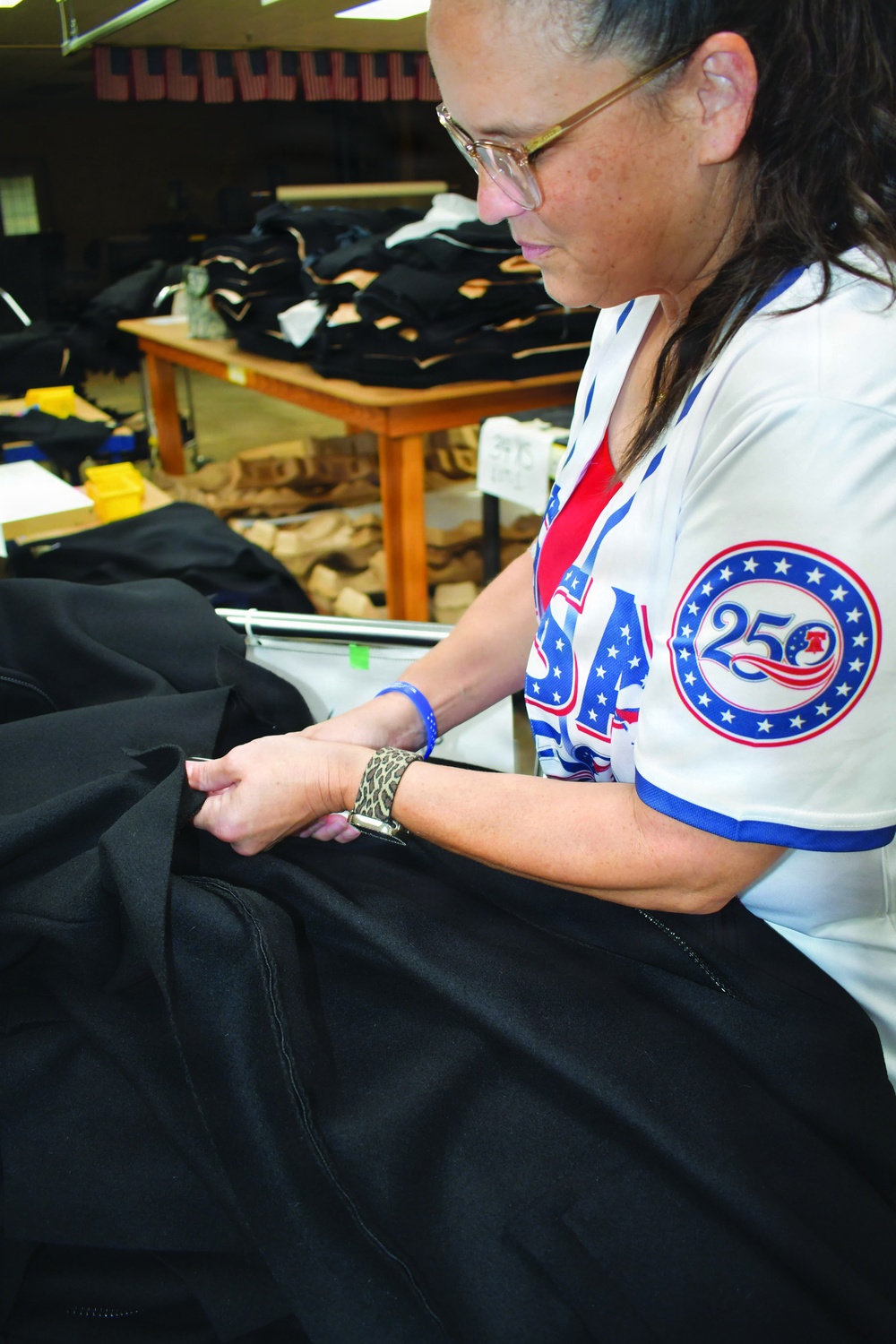
Photo By Rachel Selby | Brandy Aaron, a fabric worker on Pine Bluff Arsenal's textile production line, works on a parka zipper. PBA is set to produce approximately 1,320 West Point parkas. see less
| View Image Page
Pine Bluff Arsenal’s Directorate of Chemical and Biological Defense Operations, Textiles and Protective Clothing production, has been called again to produce wool parkas for the U.S. Army Military Academy at West Point, located in West Point, New York.
“This new batch of parkas came to us very quick – end of June is when we found out,” said Kawana Taylor, textile project manager. Fabric arrived for this production run of parkas approximately the first week of July.
“West Point has its own sewing facility,” said Jason Fullen, chief of the Chemical and Biological Division. “Last September, we demonstrated we could cut the fabric to specifications. Recently, Greg Brown, West Point project manager, mentioned the enormous workload and backlog at their sewing facility.”
During the initial production run last year, more than 800-plus parkas were scheduled to be produced. At that time, the fabric cutter had broken down at the West Point facility, leading officials to ask PBA for assistance in getting additional parkas produced.
“For this production run, West Point is backlogged. I was told they had approximately 500 parkas left in stock,” said Molly Moore, a PBA fabric worker. “We are set to produce approximately 1,320 parkas this time.”
The deadline for this production run is by middle of September.
“We have talked with West Point about sending them in batches once they are complete,” Taylor said.
Moore said the production line started producing parkas the week of July 20.
“Before production started, we received part of the fabric and began the two and a half day cutting process,” she said. “Because we don’t have a pocket machine, West Point sends the pockets pre-made, and PBA handles the topstitching.”
Moore added that West Point sends everything PBA needs.
“We are still waiting on the embroidery part for the front of the parka,” Moore said. “These will be for the classes in the 2030s.”
PBA was contacted on July 21 by West Point Division Chief Rob Sestan to gauge interest in producing an additional 6,750 pairs of heavy gray trousers. West Point is also providing additional equipment to enhance PBA's production efficiency and capacity.
Pine Bluff Arsenal has built a growing portfolio of textile products since launching its textile initiative in 2015. Initial research and groundwork began to establish industrial textile capabilities at PBA, and both capacity and product variety have expanded since.
Additional personnel have joined the production line, and new equipment has been added, including a Gerber cutter, an embroidery machine, a heat transfer machine and additional industrial sewing machines.
The installation received a Center of Industrial and Technical Excellence certification for textile manufacturing in April 2022, one of three CITE designations the arsenal has obtained.
Founded in 1802, West Point is the nation’s oldest military academy. It trains cadets to become officers in the U.S. Army through a rigorous four-year program focused on developing leaders of character.