
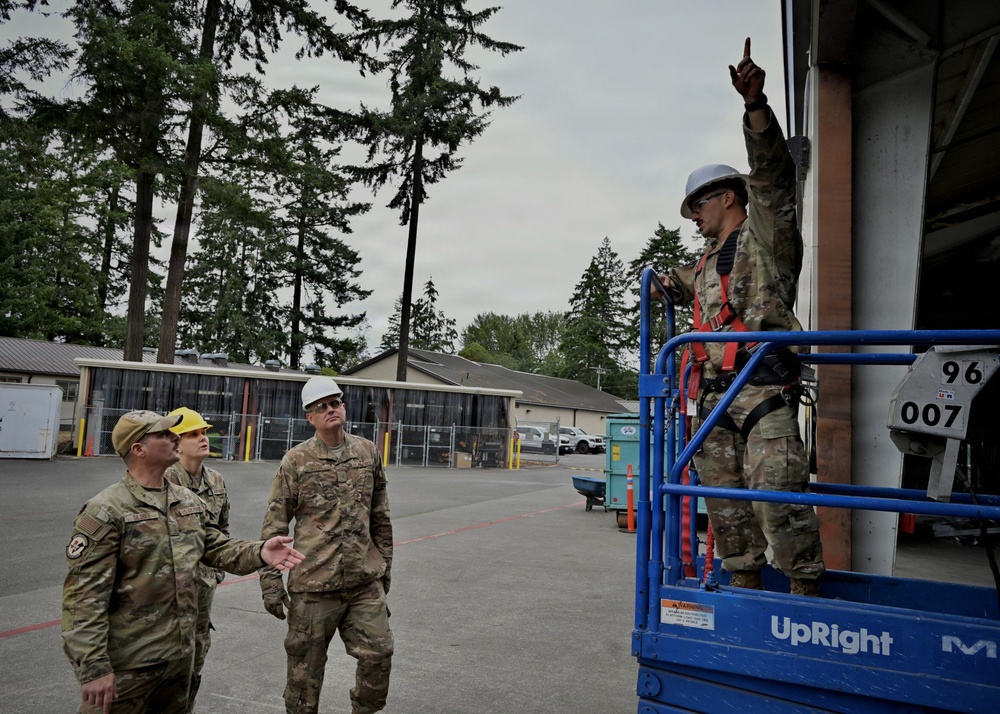
Photo By Maj. Phil Fountain | Senior Master Sgt. Ryan Silsbee (left), the senior enlisted leader of the 149th Civil...... read more read more
 Subscribe
CAMP MURRAY, Wash. – Airmen with the Texas Air National Guard’s 149th Civil Engineer Squadron of the 149th Fighter Wing, based at Joint Base San Antonio-Lackland, Texas participated in a National Guard Bureau deployment for training here during the past two weeks.
Camp Murray is adjacent to Joint Base Lewis-McChord, in the northwestern portion of the state. It is located off Interstate 5, south of Seattle, between Tacoma and Olympia, the state’s capital.
The deployment for training, or DFT, included about two dozen members of the 149th CES. They supported a project dubbed Operation Iron Phoenix, a six-phase design for the 194th Wing of the Washington Air National Guard. The legendary phoenix rising above the globe is part of the 194th Wing’s emblem and is also symbolic of the DFT project, as the mythical bird often represents transformation and renewal.
“They’re renovating one of our previous maintenance warehouses into the 194th Wing fitness facility,” said 1st Lt. Austin King, a general engineer with the 194th Civil Engineering Flight.
The facility is set to be named the Price Fitness Center after retired Col. Ryan Price, the wing’s former deputy wing commander. “He retired last year but the gym was always an interest of his,” King said.
The lieutenant is a prior enlisted U.S. Marine; he earned an undergraduate degree in civil engineering from the University of Miami, in Florida. King said he moved from the Sunshine State to the Evergreen State in 2019 to work with a private sector civil engineering firm, and earned his Air Force commission with the Washington ANG in 2022.
“[The gym is] going to allow for more space for exercising, a yoga studio, and restrooms and a drinking fountain, which is an upgrade from our existing facilities,” King said. “This will help as our airmen have to meet the same fitness standards of the active duty (Air Force).”
As designated Prime BEEF (Base Engineer Emergency Force) unit, the 149th CES is well-trained for this operation.
The Air Force Prime BEEF mission traces its origin to United States involvement in Southeast Asia in the 1960s, according to the National Museum of the United States Air Force. Such units were first deployed to South Vietnam in 1965 to provide “a wide range of services, including, communication, housing, sewage, electrical, lighting, and general construction.” Their effectiveness showed a need for this enduring mission across the Air Force enterprise.
The training was not just conceptual, as members of the 149th CES have deployed to U.S. Central Command and U.S. Africa Command areas of responsibility in recent years.
The DFT program is governed by ANG Instruction 36-510, which describes them as “a supplemental training program to meet requirements beyond home station capabilities…to accomplish AFSC and contingency training to maintain the highest level of readiness possible.” Deployment sites can be active-duty bases, regional training sites, and partner installations.
Senior Master Sgt. Ryan Silsbee, the squadron’s senior enlisted leader and an emergency management specialist, recently served overseas. He said this type of training is invaluable, especially for newer airmen holding civil engineer Air Force Specialty Codes, or AFSCs. Airmen of all ranks may be asked to step into unfamiliar roles, from operating large vehicles to managing logistics and project sites when assigned to a combatant command.
“Deployment for trainings are done on a four-year cycle,” Silsbee added, “these projects will be designed to have access for multiple AFSCs to be able to do their training, between electrical, carpentry, HVAC (heating, ventilation and air conditioning), heavy equipment. Most of the civil engineer backgrounds will be exercised for these projects.”
Silsbee has participated in several DFTs with the 149th CES. His training has taken him overseas to Armenia, Germany and Norway, as well as other stateside locations, and in Canada.
A lot of planning goes into preparing for DFTs, but even with the best planning, teams need to be agile in the face of unforeseen challenges.
“Plans are worthless, but planning is everything,” then-President Dwight D. Eisenhower reportedly said in 1957. “There is a very great distinction because when you are planning for an emergency you must start with this one thing: the very definition of ‘emergency’ is that it is unexpected, therefore not going to happen the way you are planning.”
DFTs are not emergencies, but much the same, the planning process requires a planner to anticipate situations, with the best being able to then quickly adjust and prioritize efforts based on shifting conditions.
In this case, King said the initial construction plan was for a waterfront morale, welfare and recreation (MWR) project here; local challenges arose preventing the endeavor from going forward, at least for now. Camp Murray’s DFT project and all the associated annual training missions were on the verge of being scrubbed.
But sometimes circumstance and serendipity interconnect.
King happened to be in National Capital Region for a DFT program manager course when he was told the situation changed for the MWR project back home. He then worked with NGB program managers to clear a change order, and he helped the 194th Wing shift gears to the fitness center project. This prevented a cascading effect on unit training schedules while still accomplishing another Washington ANG priority.
“A different project, but similar scope of work,” King said. “They would have been putting up stud walls and installing bathroom fixtures, all the same. It’s a little bit different location but similar work.”
DFT projects add value to the ANG writ large. According to King, the first comparison is to determine cost if put out to bid. He estimated a commercial price tag for this project could exceed $1 million. These projects combine fiscal stewardship with critical training.
“What we are doing, what it’s costing the Air National Guard is probably about $250,000 considering airfare, rentals, lodging and the rest, in addition to the materials,” said King. “The Air National Guard is improving its facilities on a grand scale at a fraction of the cost.”
From his 20-plus years of experience, Silsbee added, the “work that’s being done saves the government tons of money to be able to get a project done faster rather than going through contracting to get a general contractor out here.”
But beyond cost savings, DFT projects primarily facilitate timely training for ANG civil engineers, to ensure they are ready to support combat operations abroad or a disaster response stateside.
“Airmen are getting their AFSC training, which is hard to do when you’re a traditional Guardsman,” King said.
This is particularly true for the Texans present.
Nearly all members of the Lone Star State contingent were composed of drill status guardsmen, who typically serve one weekend per month and two weeks per year. They hold other employment or are full-time college students. The DFT environment allowed them to hone and develop skills across the gamut.
“These opportunities are phenomenal,” Silsbee said, “these are great opportunities for those young airmen to actually swing the hammer, to mess with an HVAC system. Rather than being in a hot environment while we’re deployed (overseas), we can do it in a controlled environment where they’ve got a lot more assistance and help.”
For Amn. Aidan Gregory, an engineering apprentice with the squadron, said the DFT was eye-opening to see how his AFSC contributed with other civil engineering career fields.
“It’s been a pretty cool and a nice learning experience,” said Gregory, a first-term airman with one stripe on his uniform. “It’s also good to get some training hours. The workdays fly by super-fast; it’s fun, you learn new things.”
Outside the Texas ANG, Gregory attends a community college in San Antonio studying cybersecurity. He said, in addition to learning his AFSC, he learned valuable life skills. Wherever his military or civilian careers take him, Gregory developed know-how to be a multi-capable airman and better employee in the future.
Gregory said he’s now literate on tools he’s never seen before and he expects it to enhance his personal life as well, from new knowledge of electrical, HVAC and structural operations.
“It’s always nice to have these hands-on skills,” Gregory said, “these can apply to basic tasks at home, knowing how to use these tools to get things done.”
The airman also credited the leadership and patience of the noncommissioned officers, or NCOs.
“The NCOs are letting me try things out. I’m not just standing there watching people who are experienced with their job do their thing. I’m getting in there doing tasks for AFSCs that aren’t even mine,” Gregory said.
Silsbee explained how DFTs can supercharge upgrade training plans and prepare members for unexpected situations.
“In these controlled environments, we’re able to actually take our time and train the younger airmen to get better at the construction that’s going to be expected to do in a combat situation,” Silsbee said. “So, not having the stress of a deployment or being away from family, they’re able to actually spend the time and get better by trial-and-error, and being able to have that slack to work on construction.”
Master Sgt. Jason Ellsbury, 149th CES superintendent for electrical systems, power production and HVAC systems was one of the 149th CES team leaders. He oversaw water fuels systems maintenance, including plumbing and electrical operations.
Ellsbury, himself a traditional guardsman, said the DFT program allowed his team to encapsulate their required annual training with an effective plan of action.
“It’s huge, with most of our members being two days out of the month, much of that is administrative, meetings, ceremonies, and so forth,” Ellsbury said, “this is actual hands-on training, that’s hard to schedule during drill.”
Ellsbury is a seasoned leader who served in the U.S. Army Reserve before joining the ANG into a security forces career field with the Tulsa, Oklahoma-based 138th Fighter Wing. He cross-trained into a civil engineering position around 2008 while he was in the Sooner State, then transferred to the Alamo City’s 149th CES about six years ago.
He explained how these skills apply during an overseas contingency operation.
“You get on the ground in your deployed location and they have specific needs, and our job is to solve whatever problem, whether housing for life, health, safety for the occupants or the units we’re supporting so they can complete the mission,” said Ellsbury of past deployment experiences.
Further, Ellsbury said DFTs help airmen avoid skills regression.
“You may be more experienced in one area but haven’t touched something since tech school,” he said, “then you go on a (contingency) deployment and have a vague memory, but you’re not up to speed on it.”
Silsbee said much the same of deployments and the value of the DFT program for civil engineers to learn the cross trades.
“There are some deployments where you might be the only CE person and actually have to help in every one of the AFSCs,” Silsbee said. “Being able to use this time, gaining that experience, have those discussions, and have that same thought process…that’s the great experience we have here at the DFT.”
Moreover, clear project management objectives were in place to complement the training requirements.
Kingsaid milestones were created and the whole project was mapped on a Gantt chart to connect all construction activities in chronological order.
SupportingKingis Master Sgt. Granville Carpenter, a member of the Indiana Air National Guard who’s serving as the frontline DFT project manager. He previously earned his engineering degree from Purdue University.
“Earlier this year, I came out ADVON (advanced echelon) with my leadership and everything just clicked,”said Carpenter who’s assigned to the Terra Haute based 181st Civil Engineering Squadron.“They needed a PM here in Washington and I was able to jump onboard to help this move this project forward. It’s been a great experience.”
“Each day brings a new challenge,”Carpenter said,“I enjoy working with the different units and keeping the trains running on time. They each have different personalities but we’re all working toward the same goals.”
Together,Kingand Carpenter routinely made comparisons of performance with progress against the schedule depicted on the spreadsheet bars.
“We keep track of the manhours, broken down by AFSC, and by individual, and we report those up to NGB,” King said. “So far, the units have been ahead of schedule.”
Silsbee explained how the Texans planned to meet and exceed their objectives.
“We’ve broken up into four separate teams,” Silsbee said. “We’ve got electricians running on one end of the building to actually build up all the walls, and then on the other end of the building, we’ve got carpentry actually building out the framing for the bathrooms.”
“And our utility guys are running the plumbing, and once they’re done, the electricians will pretty much swap places and the carpentry will start doing the sheet rock and the electricians will start running the bathroom power,” Silsbee added.
Overcoming even minor challenges increases readiness. Harkening back to the Eisenhower adage on planning, King’s anticipation was evident of his oversight of the project.
“We have an idea of the construction materials that we needed,” said King about resource allocation. “But day-to-day we may find we need small parts or small tools…there’s longer turnaround time (for purchasing), which just requires us to be better at planning and coordinating.”
Within the DFT, contingency plans are in place to ensure training continues should any work stoppages occur, allowing units to take advantage of unique training unavailable at their home station.
“There are opportunities to cross-train,” King said. “The previous rotation was able to get small arms training with our security forces squadron, some vehicle training, and an intel brief. We make as many opportunities available for the rotation units as we can.”
However, the DFT experience was not all hard work and it increased unit cohesion and airman morale. Two reenlistments and a promotion took place, and airmen explored nearby Pacific Northwest attractions and recreation during their off-duty time.
“I think it’s really awesome,” said Gregory, the beforementioned junior enlisted airman.
“If you go on a DFT and you’re a young airman, I’d say, ‘definitely get out of the hotel room and go explore the state or other country you’re in.’ I heard they were in Germany (before) and got to check out Germany on the weekends. This year, here in Washington, I got to check out Mount Rainier and Seattle, and I’ve never been here before,” Gregory said.
The late Robert Baden-Powell, who was a British army officer and early proponent of youth scouting, reportedly said, “A week of camp life is worth six months of theoretical teaching in the meeting room.” Similarly, the DFT built skills beyond the blueprints and relationships independent of punch lists.
“They’ve been knocking it out of the park, I’m very proud of them and their effectiveness,” Ellsbury said.
In addition to the 149th CES, other units provided support for the project’s phases. To date, civil engineers from West Virginia, Guam and New Jersey have participated in this project. Others slated to follow include units from Pennsylvania and Indiana, as well as a team from Canada.
While the training is valuable in and of itself, the outcome is important to the military units it will support upon completion.
Col. John McKinley, 194th Wing base civil engineer, was keenly interested in the project. He visited the 149th CES personnel early on and visited with the full team as they closed out their portion of the project, and he provided a challenge coin to an outstanding performer.
“To the Texas Air Guard CE members, thank you for helping push this along even further,” McKinley said. “It’s not the project we wanted but I’m glad this was a great substitute. It’s going to help our readiness, because, as you noticed, we really don’t have a gym. We carved a room out of the DFAC (dining facility) that’s a little too small to be a gym.”
Sonia Bechtloff, the wing’s deputy base civil engineer, joined McKinley on the final day. She said this project will support the joint National Guard force and other missions at the Washington Military Department headquarters.
“This facility will play a critical role in maintaining the physical readiness of our personnel (Air and Army) while providing our Honor Guard with the dedicated, high-quality space they need to sustain their mandated ceremonial excellence,” Bechtloff shared. “The dedication of the DFT teams is truly driving this project forward.”
The Price Fitness Center is expected to open in late August 2026, which coincides with the 20th anniversary of the 194th Wing. Activated on August 31, 2006, the 194th was the Air National Guard’s first non-flying wing. Their primary federal missions focus on special warfare, cyber and intelligence.
“Not only will the Air National Guard use this, but the Army Guard will also use this facility,” Bechtloff said. “Everything on Camp Murray is joint because we’re here together.”
| Date Taken: | 07.12.2026 |
| Date Posted: | 08.05.2026 14:25 |
| Story ID: | 571568 |
| Location: | WASHINGTON, US |
| Web Views: | 18 |
| Downloads: | 0 |

This work, Air National Guard Engineers Train for Deployment, Increase Readiness, by Maj. Phil Fountain, identified by DVIDS, must comply with the restrictions shown on https://www.dvidshub.net/about/copyright.


No keywords found.




