
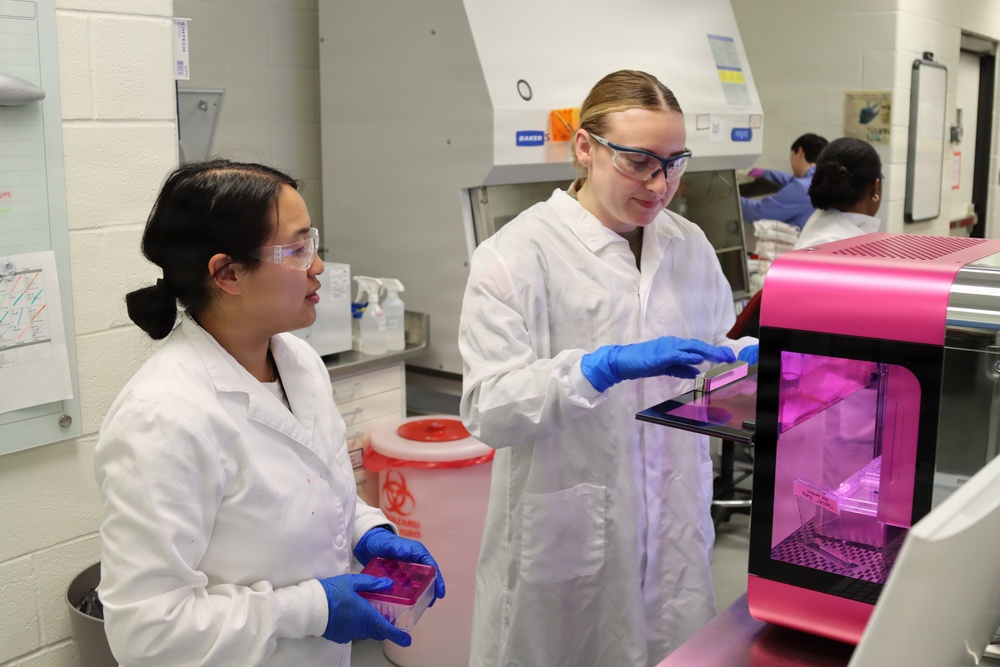
Photo By Patrick Rodeheaver | U.S. Military Academy Cadet Jenna Hart operates an inkjet bioprinting platform,...... read more read more
Aberdeen Proving Ground, MD – Five cadets from the United States Military Academy at West Point added laboratory coats to their uniforms this summer, working closely with scientists at the U.S. Army Combat Capabilities Development Command Chemical Biological Center (DEVCOM CBC) to research advanced solutions against chemical, biological, radiological, nuclear, and explosive (CBRNE) threats.
The annual internship program serves as an opportunity to apply academic theory to hands-on science and technology challenges in direct support of chemical and biological defense in operational warfare scenarios. By pairing future officers with leading Army civilian professionals, the Center receives direct feedback from the Army’s future leaders, and the cadets come away with a deep understanding of the cutting-edge technology they will eventually see in the field.
"I see this as a vital opportunity to instill the importance of chemical and biological defense in our future leaders," said Dr. Greg Peterson, chief scientist in the Protection Division of the Research and Operations Directorate at DEVCOM CBC. "Cadets value structure, and they’re intelligent and eager to learn. Shaping their experience and giving them a true appreciation for what DEVCOM CBC does for the warfighter is incredibly rewarding."
During their time at the Center, Cadets Jenna Hart and Elly Melton worked directly under the mentorship of Molecular Toxicology Branch researchers Dr. Emma Sarles, bioengineer, and Priscilla Lee, biologist.
Hart’s rotation focused on cell culture techniques and independent bioprinting studies supporting the Center's In-House Laboratory Independent Research (ILIR) program. The internship gave her the opportunity to build technical confidence. "She also significantly improved her technical communication skills by presenting her West Point team's academic-year findings during our ILIR quarterly update," said Sarles.
Melton, a mechanical engineering major, took on an end-to-end bioprinting project that merged mechanical design with biological systems. Her experiment spanned sample printing, biochemical analysis, and microscopy. “As engineers, I wanted Elly to get a clear picture of what a day in the life looks like in the biology space," Sarles said. "She participated in every aspect of my work, exposing her to a side of engineering she would not normally see in a traditional classroom."
In the Biodefense Branch, Cadet Jaxxon Otteson worked alongside virologist Dr. Maria Arevalo to study bacterial identification. Using advanced microbiological and DNA sequencing techniques, Otteson successfully grew, characterized, and identified mixed bacterial populations. "It was rewarding to watch him get excited about hands-on laboratory experimentation," Arevalo said. "He collaborated with several team members across our branch, learning firsthand that defense research is a team sport."
Under Peterson's guidance, Cadet Samuel Harvey advanced research on defensive equipment, focusing on integrating metal-organic frameworks into cellulose nanofibers. Harvey, who had been working on a DEVCOM CBC-funded project at West Point, sent his own samples ahead of his arrival to maximize his time using the Center's specialized analytical instruments.
"Samuel arrived with a clear objective and a highly motivated mindset," Peterson said. "We were able to show him how additional analytical techniques could be used to steer his research.”
Additionally, Cadet Cameron Bell collaborated with research chemist Ann Kulisiewicz to assist with the synthesis of metal-organic framework (MOFs) on metal foams for the detection of chemical warfare agents and toxic industrial chemicals.
“I always enjoy learning from the cadets just as much as I enjoy teaching them about the science that we are doing in the lab. As future warfighters, they provide an invaluable perspective to the researchers at CBC,” said Kulisiewicz. “I hope that the cadets leave this experience with a greater understanding of the technology that they currently have and know that there are many people working to improve that technology so that they can be successful on their missions.”
As cadets return to West Point, they take with them more than technical experience. They leave with a greater appreciation for the scientists, engineers, and technicians who support the warfighters every day – an understanding that they will carry with them as future Army leaders.
| Date Taken: | 08.04.2026 |
| Date Posted: | 08.04.2026 14:38 |
| Story ID: | 571525 |
| Location: | ABERDEEN PROVING GROUND, MARYLAND, US |
| Web Views: | 21 |
| Downloads: | 0 |

This work, West Point Cadets Intern at DEVCOM CBC for the Summer, by Imani Games, identified by DVIDS, must comply with the restrictions shown on https://www.dvidshub.net/about/copyright.


No keywords found.





