
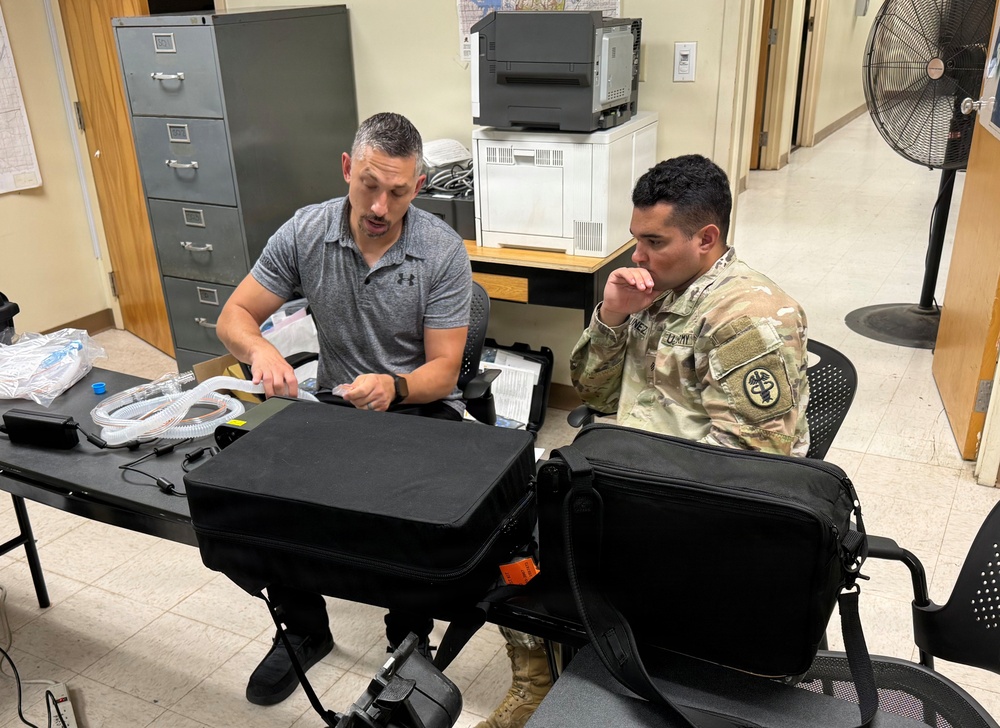
Courtesy Photo | Matthew Hernandez, an electronics technician with U.S. Army Medical Logistics Command,...... read more read more
FORT RILEY, Kan.– Inside a temporary workspace filled with portable ventilators, infusion pumps and patient monitors, Matthew Hernandez picked up an equipment manual and walked a young noncommissioned officer through the maintenance procedures of a medical device that could potentially save the life of a fellow Soldier on the battlefield.
It was invaluable side-by-side training for Sgt. Cristian Nunez, the lone biomedical equipment specialist, or 68A, for his unit under the 1st Infantry Division and his first duty assignment outside of a clinical hospital setting.
This hands-on mentorship is exactly what it looks like when U.S. Army Medical Logistics Command pushes its technical expertise directly to the tactical edge.
Over two weeks in July, a two-man flyaway team from AMLC’s Medical Maintenance Operations Depot in Utah, or MMOD-UT, deployed to Fort Riley to support Charlie Company, 299th Brigade Support Battalion, 2nd Armored Brigade Combat Team, 1st Infantry Division, as the unit prepares for an upcoming deployment rotation.
Hernandez and fellow technician Harland Wells touched a total of 129 individual pieces of medical equipment, performing tests, calibrations and repairs on everything from portable ventilators and surgical suction units to IV pumps and blood-fluid warmers.
“It boils down to readiness, so they can actually do their job when they go out there,” Wells said of the pre-deployment support mission.
By pushing technical experts directly to the field, AMLC’s flyaway capability can all but eliminate the time-consuming process of units boxing up their equipment and shipping it back to a depot for routine testing and repairs.
“Having this direct, on-site support from MMOD maintainers is highly effective as we prepare for upcoming rotations,” said Maj. Eric Coate, the company’s commander. “Completing quality control checks and repairs locally eliminates the downtime of shipping gear back and forth. It ensures our equipment is fully functional and ready to provide continuous patient care to the same high standard as a permanent medical facility.”
MMOD-UT is one of three stateside MMODs under AMLC, also including sites in California and Pennsylvania. These facilities provide sustainment-level maintenance support and serve as technical centers of excellence for different types of medical equipment, supporting specific geographic regions both in the continental U.S. and abroad.
While AMLC’s Forward Repair Activity-Medical, or FRA-M, program provides fixed-base operations at several major installations, the flyaway capability allows seasoned MMOD techs to take their expertise directly to units in the field outside the FRA-M footprint.
The mission at Fort Riley was a synchronized effort across the logistics enterprise. Before the MMOD-UT team arrived, a representative from the U.S. Communications-Electronics Command’s Integrated Logistics Support Center conducted an advanced assessment, allowing the team to pre-order necessary repair parts.
“It's really a force multiplier,” Hernandez said. “It eliminates the shipping times, gives faster results and gives them the experience to fix it in-house so they don't have to ship it the next time.”
But the MMOD-UT team didn’t just fix equipment – they built future readiness through the form of hands-on training.
While on the ground at Fort Riley, Hernandez dedicated time during the maintenance mission to help Nunez get acclimated to his maintenance role with a field unit.
“As a 68A from a hospital background, working side-by-side with AMLC technicians was an invaluable experience,” Nunez said. “I observed firsthand as experts in the field performed inspections, preventive maintenance and calibrations, as well as repairs on field equipment with which I had no prior experience.”
Hernandez walked Nunez through instruction and maintenance procedures on several complex systems, such as newly fielded ventilators and patient monitors.
“It gave him hands-on, on-the-job training so he could actually walk through the equipment and test it, rather than just reading the manual,” Hernandez said. “You have to actually walk through the steps, which is way more beneficial. He’s a smart young Soldier, he took good notes, and he was eager to learn.”
Beyond the technical skills, the flyaway team provided the junior 68A with a vital lifeline. Hernandez and Wells shared contact information to establish a direct line for communication back to enterprise experts at AMLC for any future troubleshooting needs.
“Having reliable back-end support and keeping open lines of communication with AMLC will be critical during this upcoming deployment,” Coate said.
For Nunez, knowing he has a direct line to enterprise experts, coupled with the wealth of information provided by MMOD technicians during the maintenance mission, translates directly to operational confidence.
“This opportunity has greatly improved my confidence to tackle future technical issues,” Nunez said. “The AMLC technicians reinforced that having a thorough, practical understanding of the equipment is the key to effective problem-solving. I am now much better equipped to work independently and resolve issues as they arise.”
MMOD-UT Director Jose Vasquez summarized the impact of the mission, saying these collaborative efforts highlight AMLC’s critical role in the wider Army deployment cycle.
“By dispatching technical experts to the tactical edge, AMLC not only ensures that life-saving devices are ready for the fight today, but that the Soldiers responsible for them are trained and confident for the fights of tomorrow,” he said.
AMLC, a major subordinate command to CECOM, serves as the Army’s Class VIII medical materiel command, delivering integrated medical logistics that enables Army and Joint Force readiness from the strategic support area to the tactical edge.
| Date Taken: | 08.04.2026 |
| Date Posted: | 08.04.2026 10:35 |
| Story ID: | 571487 |
| Location: | FORT RILEY, KANSAS, US |
| Web Views: | 83 |
| Downloads: | 1 |

This work, AMLC flyaway teams provide pre-deployment readiness, training to medical maintainers, by C.J. Lovelace, identified by DVIDS, must comply with the restrictions shown on https://www.dvidshub.net/about/copyright.


No keywords found.





