
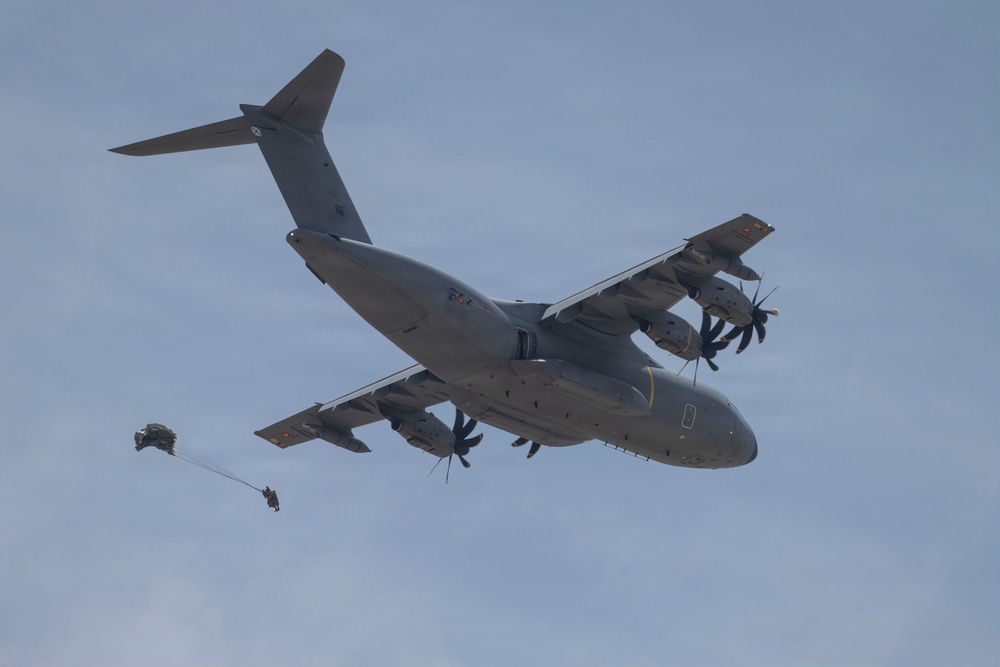
Courtesy Photo | Following test jumps of the T-11 personnel parachute from the A400M at U.S. Army Yuma...... read more read more
 Subscribe
Useful for seizing isolated airfields deep behind enemy lines which can then be used to receive and deploy more troops and armaments, the tactic of mass parachute jumps has a long history with American forces.
The T-11 personnel parachute is the mainstay of U.S. personnel parachutes.
The T-11 offers jumpers a slow and stable descent, especially in high winds, and can support more weight than previous parachutes, a crucial advantage for warfighters who carry robust, heavy gear.
During developmental testing at U.S. Army Yuma Proving Ground (YPG) in the early 2000s, the T-11 proved to be a remarkably robust system, able to compensate for multiple kinds of malfunctions that testers intentionally rigged into it: Even when testers put different reefing lines throughout the canopy and tried to restrict airflow inside, it still inflated. Now long-fielded, the T-11 has returned to YPG for further refinements and improvements since undergoing its initial developmental testing here. YPG is home to all manner of parachute testing, with spacious and instrumented ranges large enough to accommodate even the world’s largest cargo parachutes.
Today, YPG is leading a project to test interoperability between the U.S. T-11 main parachute and the European A400M transport plane.
Earlier this year the T-11 main parachute underwent test jumps from the A400M at YPG using torso mannequins with stubs for arms to simulate jumpers instead of live jumpers. The mannequins were ballasted with weight, then loaded onto an aluminum deployment rack specially designed and constructed by YPG engineers that allows the air crew to move and deploy the mannequins by means of a large crank, ensuring a safe and uniform drop from the aircraft. Since there is no physical instrumentation on the parachutes themselves during these tests, evaluators depend on Go Pro cameras in the aircraft and ground-based tracking instruments for video and data of each parachute’s deployment, particularly the critically important first seconds of flight.
“That was pretty successful,” said Ervin Rosales, YPG test officer. “We gathered some good data that gave us good insight and data to proceed to live jumps.”
Following this testing, more than two dozen YPG personnel supported two weeks of test jumps of the T-11 and MC-6 personnel parachutes in Spain at Zaragoza and Torrejón Air Bases. Test items like cameras and instrumentation like portable tracking mounts had to be shipped from YPG in advance. Rosales found the host nation easy to work with.
“They were very welcoming and helpful with the requests we had and everything we needed,” said Rosales. “It was well coordinated and pretty dynamic and flexible with their schedule.”
During the series of jumps, active-duty members of YPG’s elite Airborne Test Force became the first personnel in history to jump the T-11 from the A400M.
| Date Taken: | 08.06.2026 |
| Date Posted: | 08.06.2026 14:24 |
| Story ID: | 571408 |
| Location: | YUMA PROVING GROUND, ARIZONA, US |
| Web Views: | 72 |
| Downloads: | 0 |

This work, U.S. Army Yuma Proving Ground personnel test T-11 interoperability at home and abroad, by Mark Schauer, identified by DVIDS, must comply with the restrictions shown on https://www.dvidshub.net/about/copyright.


No keywords found.




