
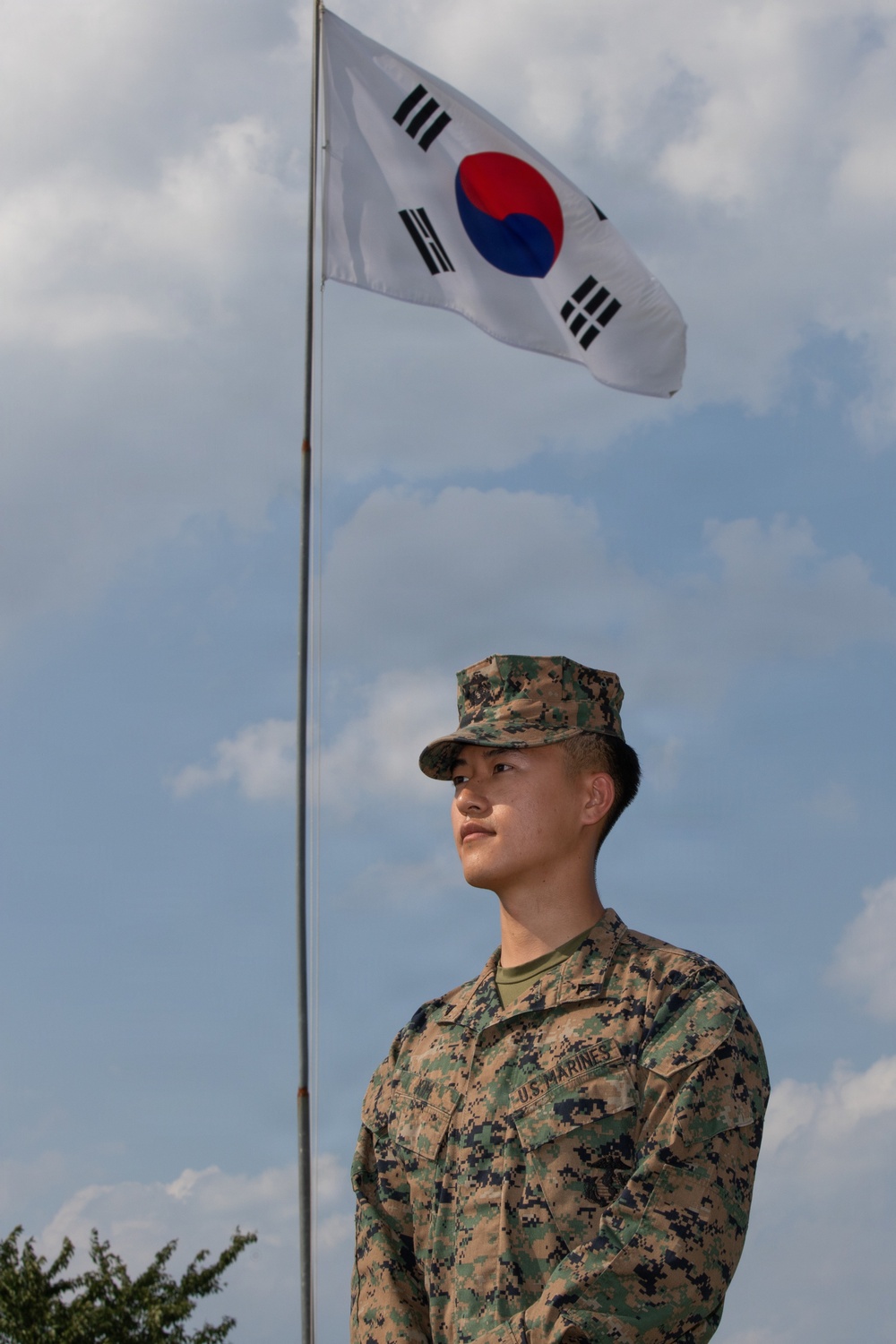
Photo By Lance Cpl. Marcus Henson | U.S. Marine Corps Lance Cpl. Min Suk Kim, an inventory management specialist with...... read more read more
 Subscribe
POHANG, South Korea – Executing a Combined Joint Logistics Over-the-Shore operation is a highly complex logistical undertaking characterized by the friction inherent in multinational operations. Projecting combat power, heavy equipment and sustainment from the maritime domain to an austere beachhead demands precise synchronization with allied partners. While strategic interoperability is frequently framed around integrated systems and shared technological networks, the tactical reality on the ground reinforces a core Marine Corps tenet: the most vital interoperability asset in the commander’s arsenal is the individual Marine.
For the Marines and Sailors executing the offload on the shores of Pohang, that critical human capability is embodied by Lance Cpl. Min Suk Kim.
During this iteration of CJLOTS, Marine Wing Support Squadron 171, Marine Aircraft Group 12, 1st Marine Aircraft Wing, was attached to Combat Logistics Regiment 35, 3rd Marine Logistics Group, for the overarching logistics mission. During CJLOTS and Korean Marine Exchange Program 26.2, Kim served as a supply clerk and Korean interpreter within this construct, bringing a unique background to the mission that served as a force multiplier for 3rd MLG.
Born and raised in Jeonju, South Korea, Kim first swore an oath to defend his homeland as a soldier in the Republic of Korea military. Today, he wears the Eagle, Globe, and Anchor as a U.S. Marine. This dual-service perspective, coupled with the exceptional performance that recently earned him selection as the 1st Marine Aircraft Wing Marine of the Quarter, provides the command with a distinct tactical advantage when navigating the linguistic and cultural complexities of partnered operations.
U.S. Marine Corps Capt. Nelson Sharps, a Richmond, Virginia, native who served as the officer in charge of the aviation combat element’s Arrival and Assembly Operations Element and as motor transport company commander, emphasized that Kim’s impact extends far beyond standard translation.
“While technological interoperability is vital, human cooperation ultimately defines the strength of our strategic partnerships,” said Sharps. “Interoperable systems are enablers; the critical component of our alliance is our ability to build a common understanding. Service members like Lance Cpl. Kim bridge cultural and linguistic gaps, allowing U.S. and ROK forces to seamlessly synchronize plans, actions and decisions.”
In the fast-paced environment of 3rd MLG’s CJLOTS offload, automated systems and standard communication channels often fall short. Literal translations can strip away critical elements of the commander’s intent. Because Kim deeply understands the operational cultures of both militaries, he effectively mitigates that risk. “Where cultural barriers and linguistic nuances threaten to desynchronize operations with our ROK partners, Lance Cpl. Kim ensures direct, high-fidelity communication,” Sharps explained. “His translations preserve the precise intent of both parties, transforming potential misunderstandings into shared clarity and giving our command a distinct tactical advantage in partner-nation integration.”
For Kim, transitioning from a conscripted ROK soldier to a volunteer U.S. Marine wasn’t about replacing his past but building upon a foundation of service.
“For me, it wasn’t about replacing one identity with another; it was about expanding it,” Kim said. “Serving in the ROK military taught me responsibility to my homeland. Becoming a United States Marine made me feel like I was truly part of something bigger than myself. I haven’t forgotten where I came from, but my experiences in the Marine Corps have shaped me in so many ways that, today, I honestly feel more like a Marine than simply someone who is Korean.”
Both militaries demand strict discipline and teamwork, making Marine Corps recruit training a familiar crucible for Kim. Rather than unlearning past instincts, he found that the Corps deepened his understanding of accountability, a trait reflected in his recent selection as the 1st Marine Aircraft Wing Marine of the Quarter. However, Kim noted a distinct shift in operational philosophy between the two forces, specifically regarding decentralized command.
“One of the biggest differences I’ve noticed is the emphasis on initiative,” Kim observed. “In the Marine Corps, Marines are trusted to think independently and make decisions at the lowest level when the situation requires it. I also believe the U.S. military has gained extensive experience through decades of modern combat operations, which has influenced its approach to leadership, training and warfighting.”
When Kim interacts with his ROK counterparts on the pier or the beachhead in Pohang, his shared background serves as an immediate catalyst for cooperation, clearing the way for swift logistical coordination. “There’s usually an instant connection,” Kim said. “Once they find out I used to serve in the ROK military, I’m no longer just another U.S. Marine; I become someone who understands where they’re coming from. We can relate to each other’s experiences, and that creates trust almost immediately.”
That mutual trust remains the bedrock of the ROK-U.S. alliance. Stepping back onto Korean soil in a Marine Corps uniform carried heavy emotional weight for the Jeonju native and served as a powerful reminder of why 3rd MLG remains forward-deployed in the Indo-Pacific.
“Seeing Korea today, a free, democratic and prosperous nation, reminds me of what that alliance has helped protect,” Kim reflected. “I didn’t feel like I was standing on opposite sides. Instead, I felt honored to represent the Marine Corps while returning to the country where I was born. Wearing the Eagle, Globe, and Anchor in Korea reminded me that the U.S.-ROK alliance is built on mutual respect, trust and the shared sacrifices of those who came before us.”
As 3rd MLG continues to project logistics power and sustainment across the Indo-Pacific, complex exercises like CJLOTS rely on more than just maritime prepositioning ships and heavy equipment. Through exceptional Marines like Lance Cpl. Kim, the command proves that the ultimate enabler of a lethal, partnered force remains the human connection.
| Date Taken: | 08.02.2026 |
| Date Posted: | 08.02.2026 23:13 |
| Story ID: | 571360 |
| Location: | POHANG, KR |
| Web Views: | 270 |
| Downloads: | 0 |

This work, Shared Ground: LCpl Min Suk Kim Brings the Human Element to 3d MLG’s Partnered Operations, by 2LT Cooper Haseley, identified by DVIDS, must comply with the restrictions shown on https://www.dvidshub.net/about/copyright.

No keywords found.




