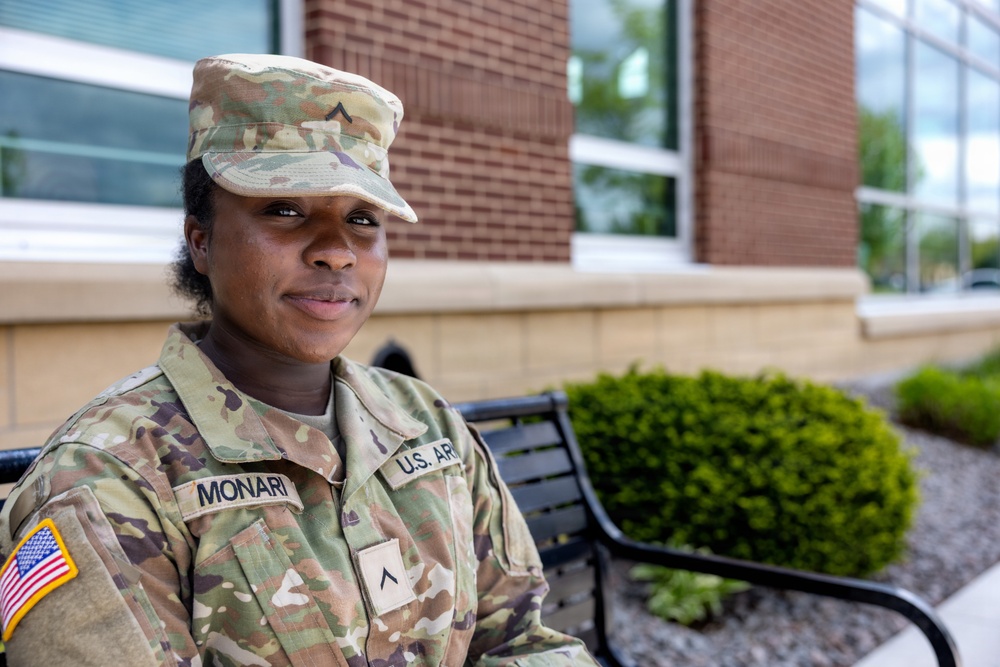
Pvt. Stefany Monari never considered joining the military until a few Minnesota National Guard recruiters came to her school for a presentation during her junior year history class.
“I joined because I wanted to be a part of something that’s bigger than me,” said Monari, who was born in Nairobi, Kenya and raised in Nakuru before moving to the United States. “It was an opportunity I could not pass up.”
A 2026 graduate of St. Michael-Albertville High School, she enlisted as a financial management technician last April. She attended Basic Combat Training, or BCT, through the National Guard’s split operations program. The split operations program allows high school juniors to attend training during the summer before their senior year, return home to finish school and then complete career training after graduation.
Monari credited the Minnesota National Guard’s Recruit Sustainment Program, or RSP, in Arden Hills with helping her prepare for BCT at Fort Sill, Oklahoma. She said RSP also helped build her confidence before attending training.
“Being in that environment before really helped,” said Monari. “If I had gone straight to Basic without RSP, I would have panicked because it’s kind of scary, not knowing anything.”
Once at training, Monari was tested physically and mentally throughout the ten weeks. For her, the most difficult moments came during a five-mile ruck march.
“I was questioning my decisions,” she added. “I was asking myself, ‘How, how did I end up here?’ But I was also amazed by myself because this was not something I imagined I would ever do.”
One accomplishment Monari is particularly proud of was being selected to serve as a platoon guide during the training cycle, a goal she set before beginning Basic. She said she learned to focus on the end goal instead of the temporary challenges throughout training.
Some of Monari’s strongest memories from BCT came during the long ruck marches where trainees relied on each other to keep moving forward.
“When people would fall out of the rucks, I would go to the back of the line and try to walk with them and encourage them,” said Monari. “One of my battle buddies stopped in the middle of the ruck march. She was like ‘I’m not doing this. I cannot do this,’ she was crying and the drill sergeants were like ‘come, come into the van,’ trying to get her to quit.”
As the trainee stood in the middle of the road, Monari recalled Soldiers from each platoon encouraging her not to give up.
“We came together for this one trainee, we just became a family,” said Monari. “We grew together; we grew to love and care for each other. It was amazing to see.”
Just before the final graduation requirement, Monari faced her own set of challenges. She sprained her ankle just days before and feared she would not be able to complete the Forge. The Forge is a 96-hour field training exercise that tests trainees’ physical, mental and tactical readiness. Soldiers are also required to complete a 12-mile road march during the final event.
“I could barely walk to chow,” she said. “I was scared because if you don’t complete the Forge, you’re not going to graduate. So, after final formation [each night], I would walk around just to strengthen it.”
Despite the injury, her determination paid off. She completed the Forge along with all other requirements and was preparing to graduate. During the graduation rehearsals, she recalled the drill sergeants calling out names.
“I was shocked,” she said. “I had no idea what the drill sergeants were calling people up for until they said we were the honor graduates. I was really proud and I could not wait to tell my family about this.”
Monari is currently attending career training. Once completed, she plans to attend the University of Minnesota Twin Cities and pursue a career in the medical field as an anesthesiologist while continuing her service in the Minnesota National Guard.

 Subscribe






