
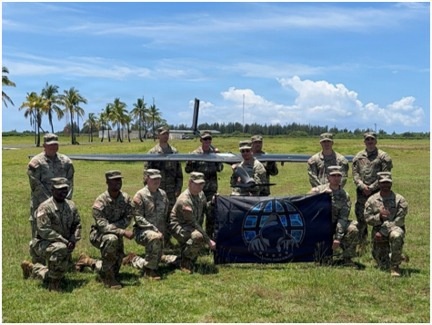
Photo By Nicole Presti | Earlier prototype of APOLLO with U.S. Army Soldiers testing in Hawaii... read more read more
By Eleanor Kent, Army FUZE
WASHINGTON, D.C. — A little over a year after winning first place at the xTech|Live at SOF Week 2025 competition, https://www.icarus.one/ has progressed from an idea to full scale prototypes being deployed with Soldiers at recurring Army experimentation events supporting the Multi-Domain Task Forces (MDTFs), U.S. Army Special Operations Command (USASOC) and many other joint users. Company leadership says Icarus’ trajectory was accelerated by Army FUZE — including both the Army FUZE xTech and Small Business Innovation Research (SBIR) Programs — and by the Soldiers and operational users whose hands-on engagement has shaped APOLLO, their first product, at every step.
From a small garage in El Segundo, CA with a handful of engineers to recurring engagements with Army organizations across the globe, Icarus’ trajectory over the past year — powered by Army FUZE, xTech and direct Soldier engagement — reflects exactly the kind of rapid iteration and non-traditional industry partnership Army leaders have championed across acquisition and transformation efforts.
At the center of that growth is the company’s long-endurance stratospheric sensing platform, APOLLO — a high-altitude solar-powered aircraft designed to provide persistent sensing, communications relay, and data backhaul capabilities in contested environments, all while remaining a low-cost, mass-producible asset.
The opportunity to enter the Army ecosystem through xTech|Live at SOF Week 2025 in Tampa\, Florida proved to be a transformative turning point for Icarus — one the company says it would not have had without the xTech program. At the time\, the company consisted of four engineers working out of what Cameron Hargis\, Head of Business at Icarus\, described as “a small industrial garage” in El Segundo\, CA.
Icarus entered the xTech competition with an early prototype aircraft and a long-term vision for a low-cost, persistent stratospheric sensing platform.
“We had prototyped a few high-altitude gliders,” Hargis said. “The ultimate goal was to create APOLLO, a solar-powered aircraft meant to fly in the stratosphere at 60,000 feet and above with extended range and long endurance.”
According to company leadership, the concept drew interest from members of the former Intelligence, Surveillance and Reconnaissance (ISR) Task Force, now aligned under the Office of the Deputy Chief of Staff for Intelligence, G-2, receiving invaluable mentorship and early validation of the APOLLO vision from officials such as Mr. Andrew Evans, Director of the Strategy and Transformation Office (DAMI-ST) — guidance Icarus leadership has repeatedly pointed to as foundational.
Hargis said the team believed the Army’s interest in a low-cost, persistent, and attritable ISR capability for distributed environments was a major factor in the company’s success during the competition.
“Around 90 companies competed in the one-minute pitch round,” Hargis said. “Sixteen were selected to pitch on stage, and we came away with first place.”
The company ultimately won first place and received a $25,000 prize during the competition — funding that Henry Kwan, Founder and CEO of Icarus, said carried major significance for the startup at the time.
“We didn’t have a lot,” Kwan said. “We had raised some venture capital, but we were still a very small company. I remember taking my 1996 Ford Bronco to the Mojave as our company vehicle. There was a lot of motivation to win the competition because it would genuinely help us accelerate our capabilities and deliver to the warfighter. It was almost like we had to win just so we could keep surviving as a company. We’re deeply grateful to xTech, FUZE, and to the Army leaders who saw the potential in what we were building before anyone else did.”
Since winning xTech|Live at SOF Week 2025\, Icarus has expanded to 50 employees\, advanced APOLLO from a Technology Readiness Level (TRL) 3 to TRL 7\, scaled into multiple significantly larger facilities in order to manufacture at scale\, and evolved from glider prototypes toward larger solar-powered aircraft with increased endurance and payload capacity.
Following SOF Week, Icarus continued refining the APOLLO platform, developing progressively larger aircraft to de-risk subsystems including communications, thermal management, and environmental hardening required for stratospheric flight conditions approaching negative 80 degrees Celsius.
“We always knew we were building toward a long-endurance stratospheric platform,” Hargis said. “The fastest path there is starting with smaller aircraft, rapidly testing and iterating on those systems, and then scaling into more capable vehicles.”
In the fall of 2025, Icarus also participated in xTech|Search 9, where they were awarded an additional $30,000 in prize funding and the opportunity to submit a Phase I Army SBIR proposal, resulting in a Phase I contract valued at up to $250,000.
That progression from xTech competition winner to an Army SBIR awardee quickly translated into additional experimentation and operational opportunities for Icarus. According to Icarus leadership, the company’s SBIR contract supported its participation in Valiant Shield in Guam in June 2026.
Over the past year, Icarus has maintained a near-monthly cadence of exercises, demonstrations, and operational engagements spanning White Sands Missile Range in New Mexico, the Pacific Missile Range Facility in Hawaii, the National Training Center at Fort Irwin, California, and Naval Base Guam with various Army end users — with additional deployments scheduled for Michigan, Japan, and Fort Hood later this year.
“The feedback we’ve received from both xTech competitions and the Soldier exercises has been incredible,” Kwan said. “We’re deeply thankful to the Soldiers and units who have made time to work with us — their hands-on input has been part of the design process from day one, and it’s the reason APOLLO is where it is today.” Evans reinforced the Army’s continued interest in the capability, stating, “Low-cost, persistent sensing with the right power/payload attributes is the holy grail. We need to keep working to solve this problem, and I appreciate what (Icarus) is doing in that regard.”
For Icarus, the value of the xTech and Army FUZE programs has extended far beyond funding alone. Both Hargis and Kwan said the credibility the programs created — with Army organizations, end users, and external investors — has been one of the most meaningful outcomes of the partnership, and one they could not have manufactured on their own.
“Within government, especially in the Department of War (DoW), trust and credibility are huge,” Kwan said. “Winning those competitions helped spark that for us.”
Following their xTech engagements, Icarus also participated in the https://www.griffissinstitute.org/hustle/, operated by the Griffiss Institute in partnership with the Air Force Research Laboratory (AFRL). While separate from the Army FUZE and the xTech program, the accelerator helped the company engage AFRL stakeholders and supported a demonstration opportunity in Playas, New Mexico with the https://swmac.org/ The company also partnered with https://www.ycombinator.com/, one of Silicon Valley’s best-known startup accelerators, further expanding commercial investment interest alongside its defense engagements and enabling additional Venture Capital (VC) funding.
As Icarus prepares for future deployments and continued expansion of its APOLLO platform, the company’s leadership wants to recognize the Army FUZE and xTech programs and the teams behind them as essential partners in everything the company has accomplished over the past year. Icarus’ rapid, Soldier-driven progression exemplifies the Army’s vision for non-traditional industry engagement as it evolves acquisition and modernization practices to keep pace with emerging threats.
Efforts like this reflect the Army’s broader push to create venues for innovation and experimentation, ensuring modern capabilities reach Soldiers faster while addressing the needs of the Joint Force operating in multi-domain contested environments.
“To the Army FUZE and xTech teams, and to every Soldier who has put hands on our aircraft: thank you,” Hargis said. “Your work directly enables companies like ours to move with speed, iterate alongside real operators, and deliver meaningful capability to the warfighter. We are honored to be part of this effort and excited about what comes next.”
The Army FUZE xTech Program is the Army’s premier tool for scouting and accelerating dual-use technologies that directly enhance Soldier readiness and mission success. Through dynamic prize competitions like xTech|Search\, xTech identifies breakthrough solutions and opens doors for nontraditional companies to engage with and deliver capabilities to the Army. Since its launch in 2018\, xTech has awarded over $30 million in non-dilutive cash prizes across 50+ competitions – fueling innovation pipelines and delivering transformative technologies that matter on the battlefield.
Learn more at the Army PIT website: https://pit.army.mil/pathway/xtech/
Army FUZE is the engine driving innovation within the Army’s integrated innovation ecosystem, strategically aligned under the Army's Pathway for Innovation and Technology (PIT). By uniting key programs such as xTech, Small Business Innovation Research and Technology Transfer, Manufacturing Technology, and the Technology Maturation Initiative within a synchronized framework, FUZE accelerates advanced capabilities, strengthens the industrial base, and delivers readiness at the speed of relevance. Operating with a venture capitalist mindset, FUZE scouts broadly, takes calculated risks, and scales the most promising technologies, ensuring taxpayer dollars are directed toward solutions with both Army operational relevance and commercial viability. Through its alignment with PIT, FUZE underscores the Army's commitment to fostering innovation, streamlining technology transitions, and bridging the gap between emerging technologies and critical operational needs to maintain military overmatch.
| Date Taken: | 07.30.2026 |
| Date Posted: | 07.30.2026 09:45 |
| Story ID: | 571095 |
| Location: | US |
| Web Views: | 250 |
| Downloads: | 0 |

This work, Icarus Scales Stratospheric Deep Sensing ISR Capability Through Army FUZE xTech, SBIR, and Soldier-Led Iterations, by Nicole Presti, identified by DVIDS, must comply with the restrictions shown on https://www.dvidshub.net/about/copyright.


Icarus Scales Stratospheric Deep Sensing ISR...
No keywords found.





