
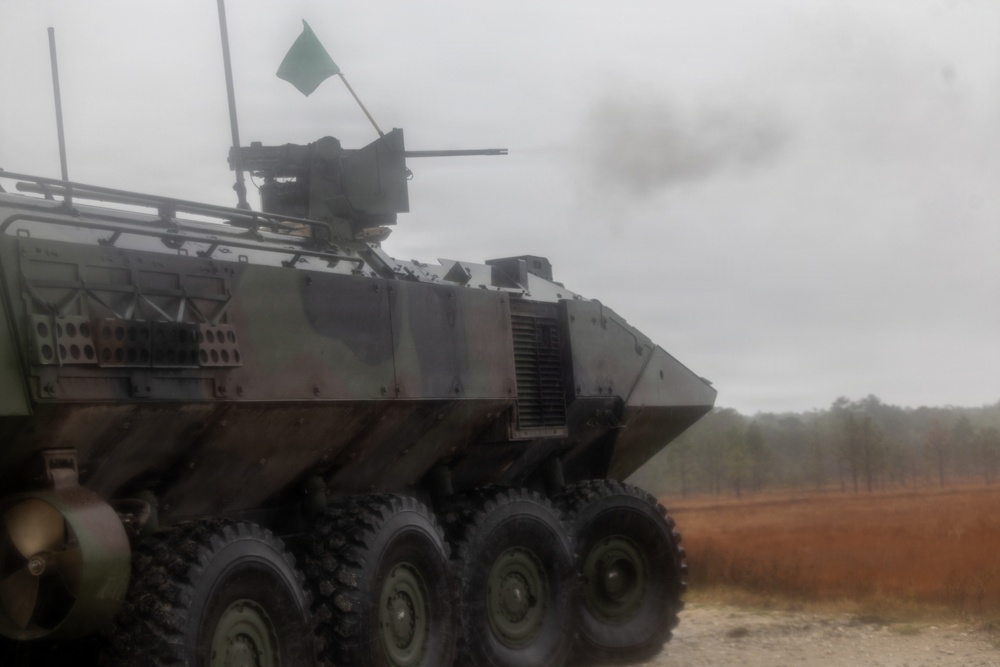
Photo By Cpl. Grace Stover | U.S. Marines with 2nd Assault Amphibian Battalion, 2nd Marine Division fire a M2A1...... read more read more
 Subscribe
MARINE CORPS TRAINING AREA, Hawaii — U.S. Marines and partner nation service members conducted amphibious assault training during Rim of the Pacific (RIMPAC) 2026, strengthening interoperability between partnering nations through realistic operations and combined tactical training.
The amphibious training brought together Marines from the 15th Marine Expeditionary Unit, including 2nd Battalion, 7th Marine Regiment, alongside forces from multiple partner nations to complete ship to land movement, urban operations, live-fire events, and tactical coordination in complex environments. The training is designed to improve ability to operate together in future humanitarian assistance, disaster response and contingency operations.
For Marines participating in the assault training, the greatest value came from learning alongside international partners who often approach the same mission from different perspectives.
"Some of the most significant lessons learned, I would say on both sides, U.S. forces and partner nation-wise, is really understanding each other's techniques, tactics and procedures," said Capt. Samuel Couture, officer in charge of the training. "Whether it's through live-fire training or urban training out here, everybody does things their own way."
Throughout the exercise, Marines exchanged best practices while executing missions that required communication, coordination and trust across language and other barriers. Those interactions help build relationships that extend beyond the training environment.
"Being able to join together and create those connections and relationships really allows us to improve ourselves and for the partner nations to improve themselves as well," Couture said.
Amphibious operations have remained a central component of RIMPAC for decades, evolving from traditional beach landings into integrated operations that combine ground maneuver, aviation, naval capabilities and multinational command and control. These RIMPAC exercises have point a heavy eye on maritime operations and expeditionary capabilities, reflecting the growing importance of coalition forces operating together across the Indo-Pacific.
This year's training continued that progression by integrating partner nations into every phase of planning and execution, allowing participants to gain firsthand experience working through differences in doctrine while achieving common objectives.
"Especially in a time of peace now, if we ever find ourselves in a crisis response later in the future, we're able to use those techniques, tactics and procedures that we learned from each other to benefit us," Couture said.
Exercises such as RIMPAC provide different nations with opportunities to refine tactical proficiency while reinforcing the professional relationships necessary to respond rapidly to future emergency’s and missions. By training together in realistic amphibious scenarios, participating troops work to improve collective readiness and strengthen the partnerships that contribute to stability and security throughout the Indo-Pacific.
RIMPAC, the world's largest international maritime exercise, is held biennially in and around the Hawaiian Islands and has served as a cornerstone of Indo-Pacific security cooperation since 1971. This year's exercise includes approximately 31 nations, more than 30 surface ships, five submarines, more than 200 aircraft, 15 national land forces and roughly 30,000 military personnel working together to improve readiness and reinforce a free and open Indo-Pacific.
| Date Taken: | 07.27.2026 |
| Date Posted: | 07.30.2026 16:04 |
| Story ID: | 571054 |
| Location: | HAWAII, US |
| Web Views: | 20 |
| Downloads: | 0 |

This work, Marines and Partnering Nations Strengthen Amphibious Assualt Techniques During RIMPAC 2026, by SGT David FitzPatrick, identified by DVIDS, must comply with the restrictions shown on https://www.dvidshub.net/about/copyright.

No keywords found.




