
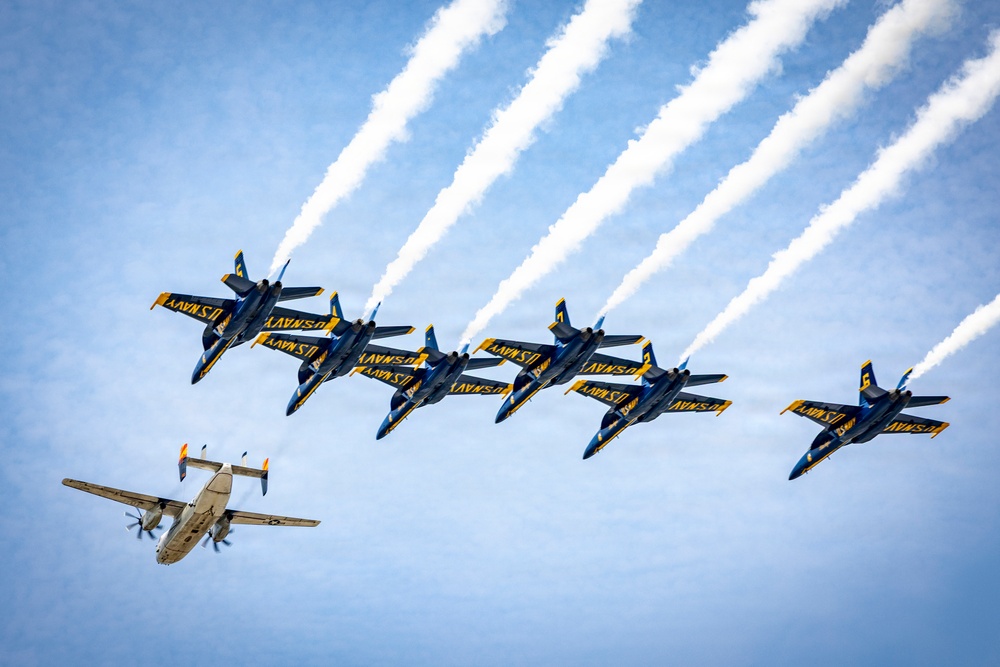
Photo By Chief Petty Officer Ian Cotter | The Navy's final C-2A Greyhound, attached to the "Rawhides" of Fleet Logistics Support...... read more read more
 Subscribe
PENSACOLA, Fla. – A C-2A Greyhound attached to the "Rawhides" of Fleet Logistics Support Squadron (VRC) 40 landed at Naval Air Station (NAS) Pensacola’s Sherman Field July 28, marking the final in-service flight for the platform.
Greeted by nearly 6,000 onlookers at the National Naval Aviation Museum (NNAM), the C-2A participated in a formation flight with the U.S. Navy Blue Angels before touching down on the historic NAS Pensacola airfield.
“Seeing Pensacola overhead, it is the ‘Cradle of Naval Aviation,’ said Cmdr. Paul Ingram, VRC-40's commanding officer, who began his naval aviation career at NAS Pensacola. “It’s very sad to me, but I feel satisfaction that we did it safely – we did it right in coming to a close like this.”
Both Ingram and the C-2A received a ‘wetting down’ during the event, with the air station’s Fire & Emergency Service’s Gulf Coast (F&ESGC) spraying down the aircraft as it taxied and was later towed, while Ingram’s family doused the 27-year Navy commander with buckets of water, signifying the career milestone for the commanding officer.
Ingram briefly addressed the crowd – many of whom were C-2A veterans from all eras – before turning over the aircraft’s logbooks to NNAM Deputy Director Hill Goodspeed.
“When a C-2 appears on the horizon, it brings with it far more than just cargo,” Ingram said. “Every single mission carries a deep, personal meaning for someone aboard the carrier. For a nervous new Sailor, that trap represents the excitement of arriving for their first fleet assignment and for a seasoned master chief, it is the final catapult shot before a hard-earned retirement. It is the joyous flight ferrying a Sailor home to a waiting family, or the delivery of a simple, handwritten letter from a loved one that restores morale during a grueling deployment. In its most urgent capacity, the Greyhound serves as a flying ambulance, executing a life-saving medical evacuation that ensures an injured service member lives to see tomorrow. No other aircraft in the history of Naval Aviation carries so many personal memories for as many people as the C-2.”
The C-2A was transferred to the NNAM – onboard NAS Pensacola – where it will be rehabilitated and eventually serve as an exhibit in 2027. Goodspeed added that along with the airframe’s decommissioning, another aspect of naval aviation will also shift.
“The retirement of the Greyhound also ends an era of enlisted aircrew flying in aircraft equipped with tailhooks,” he said. “The service of these Sailors dates to before World War II when enlisted men began flying as gunners in carrier-based bombing and torpedo aircraft.”
This final flight, originating out of Norfolk, Virginia, marked the end of an era for the carrier onboard delivery (COD) aircraft, which is being replaced in that role by the CMV-22 Osprey. Developed by Grumman Aircraft Engineering Corporation as a derivative of the E-2 Hawkeye airframe and designed for COD missions, the platform’s first flight was in November 1960, achieving initial operational capability in 1966.
The C-2A Greyhound saw more than 250,000 carrier landings during its six-decade service, and transported millions of personnel, ferried more than 100 million pounds of cargo and served as a fleet mainstay for generations of service members.
Founded in 1826, Naval Air Station Pensacola, known as the “Cradle of Naval Aviation,” supports operational and training missions for several tenant commands, Naval Air Technical Training Center, Naval Aviation Schools Command and Center for Technical Training. The installation also hosts Marine Aviation Training Support Group 21 and Marine Aviation Training Support Group 23 and serves as the headquarters for Naval Education and Training Command. In addition to an active airfield, NAS Pensacola maintains a deepwater port supporting operations for the U.S. Coast Guard.
| Date Taken: | 07.28.2026 |
| Date Posted: | 07.29.2026 11:30 |
| Story ID: | 570994 |
| Location: | NAS PENSACOLA, FLORIDA, US |
| Web Views: | 339 |
| Downloads: | 0 |

This work, C-2A Greyhound’s Six Decades of Service Ends with Landing at NAS Pensacola, must comply with the restrictions shown on https://www.dvidshub.net/about/copyright.


No keywords found.




