
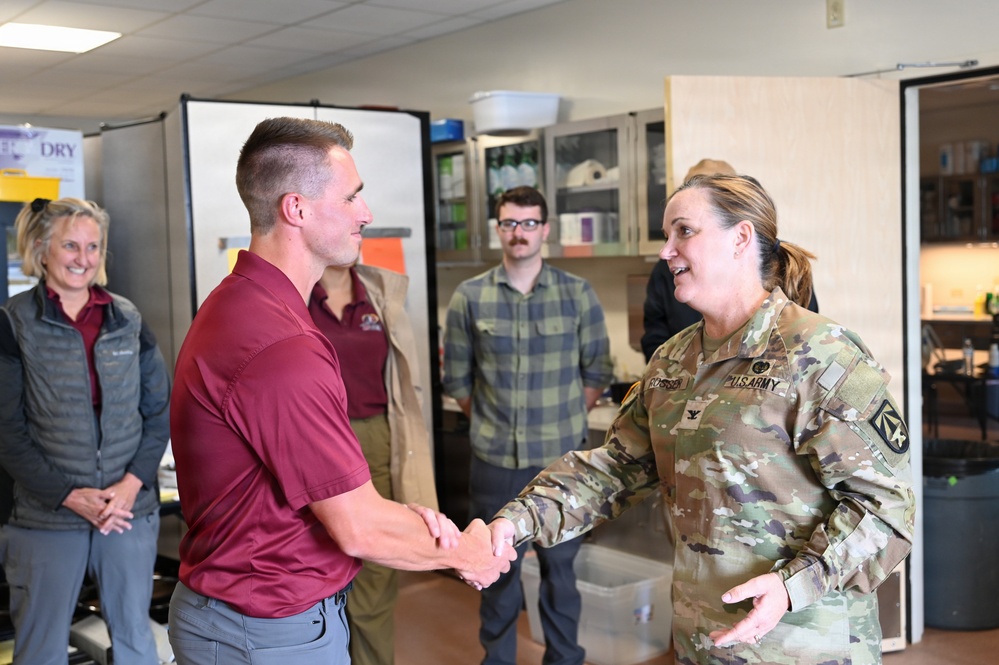
Photo By Carey Phillips | COL Sharon Rosser has served as commander of the U.S. Army Research Institute of...... read more read more
NATICK SOLDIER SYSTEMS CENTER, Mass. – When a commander in the field asks,, “Will my Soldiers be safe conducting operations in this weather?” or “How much longer can they work before a weather-related injury becomes a risk?” the answer used to take weeks. Now it takes hours – an operational shift made possible by the U.S. Army Research Institute of Environmental Medicine’s deliberate efforts to deliver timely, operationally relevant science. As COL Sharon Rosser prepares to depart command of USARIEM, she reflects on that journey and what comes next.
Two years ago, USARIEM faced a straightforward question: how to remain operationally relevant in a changing military landscape. The institute had a long history of rigorous science, but the central challenge was whether that science reached the Soldiers and commanders who needed it most, a challenge Rosser set out to address.
"I am proud of how we have continued to mature research over the past two years, even amidst a transformation. Our work directly informs readiness across the Army and solves some of the toughest problems. When leaders take environmental exposure into perspective – heat, cold, altitude, and subterranean challenges, all of those bring an inherent risk or potential negative impact on Soldier performance. Thus, our ability to provide the information and tools to enable leaders to continue to be responsive in those areas has been so important to the future warfighting environment," says Rosser.
Those decisions weren't easy. According to USARIEM's deputy commander, COL Jeremy Hershfield, Rosser's leadership during this transformation was decisive and strategic.
"Rosser has commanded USARIEM as a strong, strategic leader, making the tough decisions that were required for USARIEM to remain relevant to the Army and the Department of War," says Hershfield. "She reshaped our research priorities to align with Army priorities and reorganized our structure and culture to make us more flexible and agile as we continue to be the Army's premier human performance institute."
To Hershfield's point, the operational environment is ever changing. While leading through change was hard, Rosser knew that asking commanders what they actually need and figuring out how to deliver that knowledge in real time was important to the relevance of USARIEM.
"It wasn't easy, but what to change became very clear as the world started changing around us. Through command of USARIEM I learned what it takes to lead great people through significant transformation, through factors that are out of our control and hone my ability to connect and lead during uncertainty," says Rosser.
One achievement stands out from Rosser's command: USARIEM's research became the foundation for the Army's new height and weight standards. The data-backed findings supported replacing the long-standing height and weight tables and tape test with waist-to-height ratio, a metric that better predicts a Soldier's overall health and operational fitness.
"Our comprehensive ACBC study transformed the Army’s body composition assessments in 2023. The data continues to inform senior leaders on the transition to the waist-to-height ratio, while our modeling capabilities enable rapid, evidence-based analysis to support Army policy and readiness decisions,” says Rosser.
Beyond body composition assessments, USARIEM's innovations extend to predictive health tools. The Heat Injury Prevention Prediction System represents Rosser's vision in action. HIPPS uses real-time environmental data and physiological markers to predict heat injury risk before it occurs, allowing commanders to adjust training intensity, hydration, or rest cycles proactively. The system is currently deployed at Sapper School and with the Marine Corps, with integration into the upcoming Best Medic Competition planned. The long-term goal is embedding HIPPS into wearable technology, smartwatches and body sensors, so that heat injury prevention becomes seamless and automatic.
"As a physician assistant, I don't want to lose Soldiers ever. The ability to apply predictive data and give leaders tools to sustain readiness, prevent injury, or illness is so important. When we talk about USARIEM in the future, that's what I would love to see the institute become—an organization where leaders look to the institute to integrate valuable, specific physiology-based data into whatever our Soldiers are wearing."
Rosser's 10-year vision for USARIEM is clear: to become the Department of War's premier integrator of human performance science. This represents a fundamental shift in how the institute operates and what it delivers to the force.
"I envision integration as connecting physiology, operational data, technology modeling, machine learning, artificial intelligence, and human performance into knowledge that commanders can use in real time."
On the staffing side, Rosser has emphasized one consistent point: USARIEM's greatest asset is its people. The scientists, medical providers, medics, laboratory technicians, and support staff who understand the mission and remain committed to it are irreplaceable.
"People make the Army a great organization and we can't do the exceptional science we do without the people on the USARIEM team and their dedication. I have had the privilege of serving with individuals who come to work every day wanting to improve a Soldier's life, and that ability to lead a group of people who want to make conditions better for the Solider has meant so much to me."
That institutional knowledge, the collective expertise of those who have weathered change, is what will carry USARIEM forward. Rosser's confidence in the organization's future rests largely on the foundation the team has built together.
"Soldiers are our most important asset, and the ability to adapt to environmental conditions is a critical component of protection and readiness,” says Rosser. “Leaders are often called on to make choices, such as what weapon to buy or whether to invest in human performance. USARIEM provides DoW leaders with evidence-based best practices for sustaining performance and returning Soldiers to duty, which is essential to effective warfighting."
As Rosser reflects on her time in command, she emphasizes that leadership is ultimately about stewardship — not personal achievement, but organizational legacy. As she departs USARIEM to take on a broadening assignment with the U.S. Office of Management and Budget serving on the military medical and health portfolio team, that same commitment to institutional strength will guide her next chapter.
"Leaders serve the organization. The Army places its trust in you and assigns you where you are best suited to help ensure the organization remains responsive, relevant, and strategic in an evolving operational environment," says Rosser.
That's the legacy and template Rosser leaves – focus on the mission, listen to the people who will use the work, be willing to evolve, and never lose sight of why the work matters in the first place.
| Date Taken: | 07.22.2026 |
| Date Posted: | 07.28.2026 16:45 |
| Story ID: | 570934 |
| Location: | NATICK, MASSACHUSETTS, US |
| Web Views: | 91 |
| Downloads: | 0 |

This work, As Rosser Departs, Her Vision for Human Performance Science Advances, by Danae Johnson, identified by DVIDS, must comply with the restrictions shown on https://www.dvidshub.net/about/copyright.


No keywords found.





