
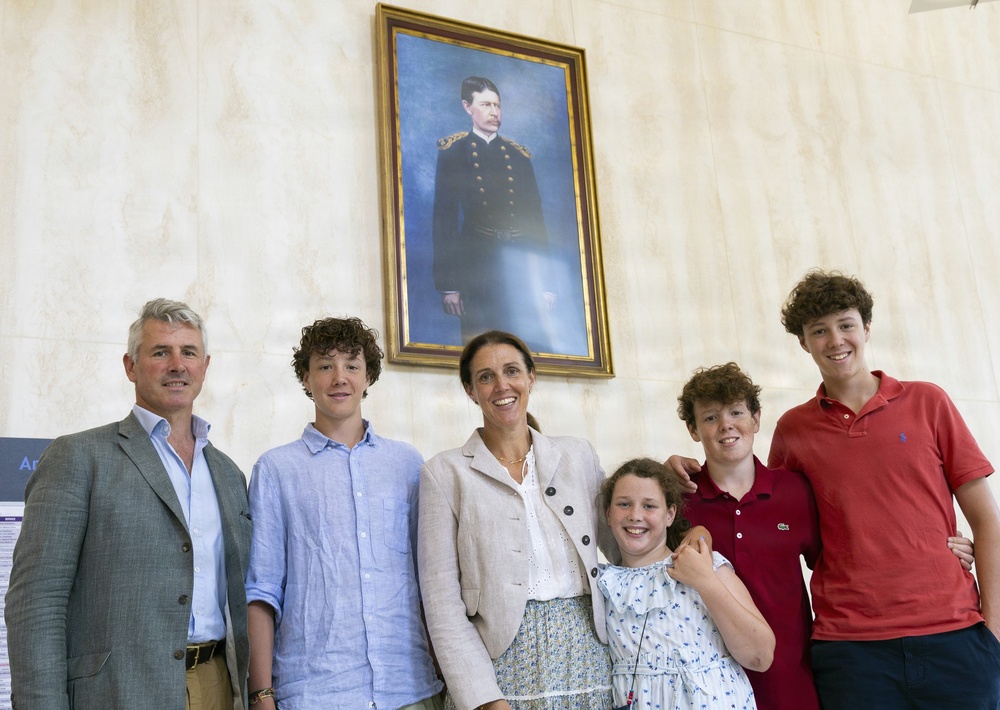
Photo By Ricardo Reyes-Guevara | Rosanne Hayes (third from left) and her family pose for a photograph in front of a...... read more read more
 Subscribe
By Bernard S. Little Walter Reed National Military Medical Center's Hospital Communications
When Rosanne “Rosie” (Munro) Hayes planned her family’s trip from the United Kingdom to the United States this summer, one of the top stops on the bucket list was Walter Reed National Military Medical Center (WRNMMC).
Because the medical center isn’t open to the public due to patient privacy and security, Hayes wasn’t sure a visit would be possible. Given her family’s unique connection to U.S. Army Maj. (Dr.) Walter Reed, she decided to reach out anyway to hospital staff.
“I write from grey and chilly England regarding a trip myself and my family are taking to the East Coast this summer,” Hayes wrote in an email to Walter Reed’s Hospital Communications department. “During this time, we are planning to visit Arlington National Cemetery, as both my great-grandfather (Maj. Gen. Walter Lawrence Reed) and my great-great-grandfather (Maj. Walter Reed), are buried there … If possible, we would like to visit the Walter Reed Medical Centre as I would like my four children to see the famous bust of [Maj. Reed] … and to know a little of their American heritage.”
That visit became reality on July 21, when Hayes, her husband, Charles, and their children, Alexander, William (Lawrence Reed), Patrick and Georgiana, toured Walter Reed before visiting the former Walter Reed Army Medical Center (WRAMC) campus in northwest Washington, D.C.
“Many members of my family had visited beforehand, and I felt like it was important for me in bringing our children to the United States for their first trip here to show them some of their heritage,” said Hayes, who lives in Wiltshire, a county in southwest England.
“Healthcare and the medical profession are very important in our family,” Hayes added. “My father was a surgeon, and my grandfather was a surgeon, so it’s always been instilled in me how important Walter Reed was and what he gave to mankind. I grew up with this knowledge of a legend and it’s wonderful to be here to understand fully today what he means to American people because being from across the pond, it can feel a little bit remote in that information. But I’ve always known it was a huge thing at the time what he did, even though now, yellow fever isn’t such of a concern.”
Krysia Olas, chief for Military Health Diplomacy in Executive and Legislative Affairs at Walter Reed, welcomed the Hayes family to Naval Support Activity Bethesda, home to the famed medical center.
Their first stop was the Tower Museum, where the Hayes children learned more about their great-great-great-grandfather, U.S. Army Maj. (Dr.) Walter Reed, and the impact and legacy of his work.
Born on Sept. 13, 1851, in Gloucester, Virginia, Reed led the team that confirmed the theory that yellow fever is transmitted by mosquitoes rather than direct physical contact in 1900. The discovery transformed public health, advanced the fields of epidemiology and biomedicine, and helped make completion of the Panama Canal (1904-1914) possible. Reed died in 1902 from peritonitis following emergency surgery for a ruptured appendix and is buried at Arlington National Cemetery. In 1909 when the U.S. Army hospital opened in Washington, D.C., it was named in his honor.
The Hayes family then visited the Unspoken Bond statue, a memorial in the lobby of Walter Reed's main inpatient hospital honoring corpsmen and medics, before stopping at the Memorial Garden outside of the hospital’s outpatient facility. There, they stood before the large bronze bust of Maj. Walter Reed, sculpted by Felix de Weldon, best known for creating the iconic Marine Corps War Memorial, also called the Iwo Jima statue, outside of Arlington National Cemetery.
Retired U.S. Army Col. (Dr.) John R. Pierce of the Walter Reed Society then guided the family through the former Walter Reed Army Medical Center campus in D.C., anchored by the original 1909 flagship hospital building recognizable by its prominent cupola, which later housed the historic Pershing Suite, the former Army Medical School - later home to the Walter Reed Army Institute of Research, and the Armed Forces Institute of Pathology - a bomb-proof facility constructed during the Cold War.
In the book “Builders of Trust, Biographic Profiles from the Medical Corps Coin,” published by the Office of the Surgeon General in 2011, Pierce wrote, “Walter Reed remains today, more than 100 years after his death of appendicitis, one of the best known, respected, and revered names in American medicine. The results of [his team’s] work would change the world. Thousands of lives would ultimately be saved. The Yellow Fever Board’s amazingly successful work concluded in late 1901 and has stood as the most precedent-setting and outstanding clinical research ever done by the Army Medical Department, with unsurpassed effects on public health and commerce.”
“Having lived through COVID, I feel like we all need to remember the legacy of people like Maj. Walter Reed,” Hayes concluded.
| Date Taken: | 07.28.2026 |
| Date Posted: | 07.28.2026 15:24 |
| Story ID: | 570910 |
| Location: | US |
| Web Views: | 22 |
| Downloads: | 0 |

This work, Walter Reed’s great-great-granddaughter, family visit medical center named in his honor, by Bernard Little, identified by DVIDS, must comply with the restrictions shown on https://www.dvidshub.net/about/copyright.

No keywords found.




