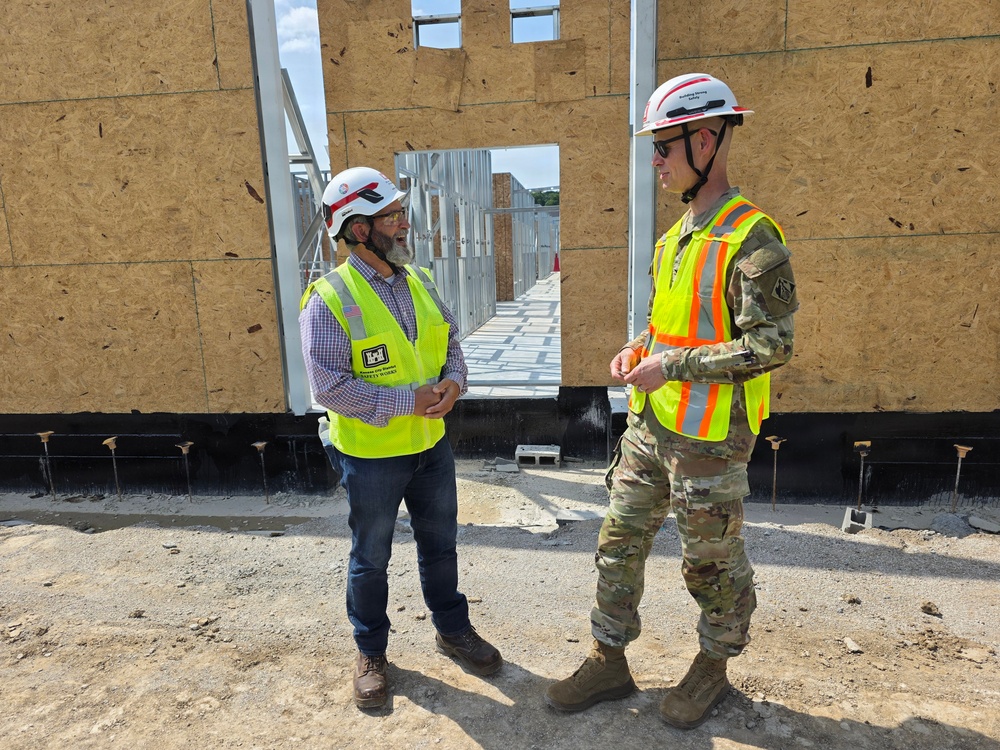
After completing 30 years of military service, Mark Martinez already possessed a solid foundation in maintaining discipline, following orders and adhering to protocols to get the job done right.
However, when he joined [Kansas City District, U.S. Army Corps of Engineers](https://www.nwk.usace.army.mil/) immediately after retirement from the Army as a general engineering officer, he quickly realized there were some aspects of the job the military did not prepare him for.
“I had to learn a lot about the federal civilian workforce … most importantly, filling out a timecard and learning what ’overtime’ meant,” Martinez said jokingly.
Today, Martinez is the office engineer for the district’s Fort Leavenworth Residence Office, recently reaching the 10-year mark in his journey working for the civil service. He credits many of the skills and cultural creeds he developed as a soldier, as guiding his work within the civil service.
“Get up, dress up and show up to work every day … no excuses … do your job,” he said.
When asked about the value veterans bring to positions at USACE, he offered a more detailed perspective.
“Veterans have an in-depth understanding of how the Army works, which is essential to working with military installations on [projects] and dealing with the [required rules and regulations when working] with the active component,” he said.
William “Greg” Huber is a security specialist who joined the district in 1998. Between the active-duty Army and the Army Reserve, Huber served for 37 years — with more than 30 of them completed while working simultaneously for USACE.
Echoing Martinez’s perspective, he said many veterans join the enterprise with a mindset that already aligns with USACE’s varied mission objectives
“Veterans are team focused, mission focused and dedicated to both the people they serve and the mission they support,” Huber said. “They already possess skill sets that enhance the organization.”
So, in theory, veteran’s experiences give valuable insight into how the Army operates customarily, how missions are accomplished and the importance of supporting the people who serve.
Some simple philosophies also reflect some of the many qualities veterans bring to any workplace or job site: respect, reliability, accountability, discipline and strong commitment to the mission and its completion.
Huber further posited that military service also develops leadership and problem-solving skills, while teaching soldiers, sailors, marines, guardians and airmen to care for their battle buddies to ensure they have the tools needed to succeed. Those traits, he said, translate organically into the collaborative environment at the core of USACE’s work culture.
“USACE was not my first job after leaving active duty, but [it’s] a military organization and coming on board felt like a natural transition,” he said.
This is not anecdotal either. According to 2025 statistics provided by the [Pew Research Center](https://www.pewresearch.org/short-reads/2025/04/10/what-we-know-about-veterans-who-work-for-the-federal-government/), it was found that veterans are represented across hundreds of federal occupations, such as administration, information technology, management, maintenance and logistics.
In one of the federal government’s largest job classifications, miscellaneous administration and program work, veterans accounted for 39% of employees.
Digging deeper into the data, approximately 713,000 veterans worked for the federal government at the end of fiscal year 2024, making up about 24% of the federal civilian workforce. Veterans also accounted for nearly half of the civilian workforce for the Department of the Army, which includes USACE.
But while veterans may bring a wealth of experience to a civilian career, the transition also comes with a learning curve, depending on the position they’re hired for.
Martinez’s experience demonstrates that veterans are also capable of learning new systems, cultures and ways of doing business.
“Some tasks don’t come in a five-paragraph operation order … some don’t even come with a verb,” he said. “Decisions are made through a consensus, not direct orders relayed from a higher authority.”
One skill veterans also possess that can’t be gleaned from the data is their adaptability. Over time, Martinez has adapted to the civilian workforce while continuing to apply the lessons he learned during his military career.
Huber said that service members’ ability to adapt is one of the greatest strengths veterans bring to any civil service or private organization.
“Combined with a strong work ethic, proven leadership and an understanding of Department of Defense procedures, veterans are uniquely prepared to contribute from day one while continuing to learn and grow in new roles,” he said.
This means the transition to civilian service involves learning about a new work culture and new processes or systems. But the foundation remains familiar for both— show up, do the job, support the team and accomplish the mission.
As for USACE, hiring veterans means gaining employees who bring discipline, a unique understanding of how the military works and what civilians can do to support them. It also means gaining professionals who know how to adapt when the mission changes.
“Incredible dedicated people and strong professional structured organization – something military veterans are comfortable with and typically thrive in,” Huber said.
Now, heading into his 11th year with our nation’s first engineering firm, Martinez feels he has mastered many of the lessons of civilian employment. He understands timecards. He knows overtime. He has learned the importance of consensus.
As for matching his clothes with his belts or the standard civilian work attire, he displayed a sense of humility.
“That one I’m still working on,” he said.
| Date Taken: |
07.23.2026 |
| Date Posted: |
07.28.2026 15:17 |
| Story ID: |
570909 |
| Location: |
KANSAS CITY, MISSOURI, US |
| Web Views: |
64 |
| Downloads: |
0 |
PUBLIC DOMAIN

This work, “Get up, dress up and show up”: The veterans value to the USACE workforce, by Lawrence Brooks, identified by DVIDS, must comply with the restrictions shown on https://www.dvidshub.net/about/copyright.