
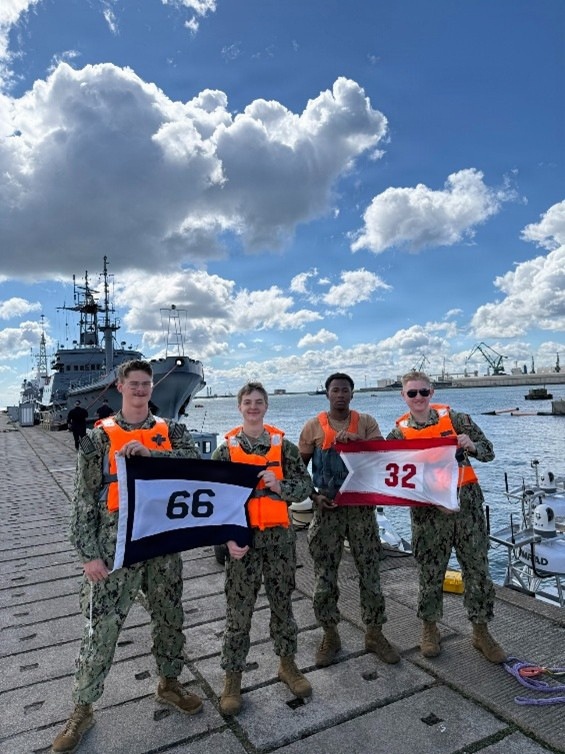
Photo By Ensign Izabella Marchi-Setyan | From left to right, U.S. Navy Midshipmen 1st Class Thomas Nicholas, Midshipmen 2nd...... read more read more
Reflections from the Fleet: Midshipmen experience unmanned operations during BALTOPS 2026 hosted by USVDIV-32.
By: Ensign Collin Quinn, Midshipman 1st Class Nicholas Bartram, and Midshipman 1st Class Thomas Nicholas.
As more than 20 NATO Allied nations converged in the Baltic Sea for BALTOPS 2026 — the premier multinational maritime exercise designed to strengthen regional security and force interoperability — a select group of future naval officers stepped off the traditional deckplates and into the future of naval warfare. For first-class midshipmen, the annual summer cruise is a rite of passage designed to bridge classroom doctrine with real-world fleet operations before commissioning. Hosted by Unmanned Surface Vessel Division (USVDIV) 32 out of Gdynia, Poland, this specific cruise offered us an immersive, front-row seat to the rapid integration of robotic and autonomous systems within the modern Surface Force. Looking back on our time in theater, the following is how we experienced the evolution of surface warfare firsthand.
In the UOC
Our integration began in the unmanned operations center (UOC), where we were able to observe and participate with the command & control (C2) element from start to finish. From observing the C2 side of pre- and post-operation boat checks, to serving as under instruction (U/I) watch standers during several important training evolutions, we gained hands-on experience with unmanned systems. We first observed operations for a few days, watching and asking Sailors questions about the technology, their rates, and the overarching mission for small Unmanned Surface Vessels (sUSV). From this, we gained an appreciation for the complexity of the technology and the role of a junior officer in a USV unit among highly experienced and specialized enlisted personnel.
During our first few days, we observed behind-the-scenes responsibilities of Division 32. From running to find parts to fix a Starlink system, to ensuring that prechecks and testing for Global Autonomous Reconnaissance Crafts (GARCs) in or out of the water, we found that the backbone of the unit was the Sailor who stepped up wherever they were needed; something that we would try to emulate during our cruise. To increase our participation through understanding, we worked with the field support representatives (FSRs) from Anduril to gain experience with the Lattice software through a number of simulations, including the new Lattice update 1.3.
Following this training, we stood watch first as log keepers and then as C2 operators, ultimately controlling the GARC platform for several hours in rough sea conditions and amid complex maneuver schemes with international partners. We continued to observe and be sponges of information, learning constantly from the watch standers next to us and our fellow midshipmen after the day was done. The time we spent in the UOC was one of the most valuable experiences in refining our interest in the USV community. We believe that the lessons and time spent on the watch floor prepared us for commissioning as junior officers.
Maintaining the Boats
Maintenance was busy in Poland, and we were grateful to work alongside the maintenance element Sailors. We received detailed training on every part and subsystem of the GARCs. Checklist by checklist, we became comfortable performing fluid checks, cleaning the bilge and describing processes within the boats- such as how the seawater cooling system, engine, and hydraulic systems work together in unison.
We also were given the opportunity to learn from CTF 66 as they unpacked, did first-time checks, and set up their new Kraken K3 Scout. That was a great chance to learn how USV operators gain understanding from manuals and spread the knowledge through shared experiences. Learning from operators and maintainers of multiple platforms gave us a better understanding of how multi-platform operations can work together to execute a mission.
USVDIV-32 was deliberate in adapting and overcoming challenges, one of which was the small boat launch capabilities of the Polish port in Gdynia. This gave us the opportunity to see how each boat could be safely craned into the water and learn the fine details that are often overlooked in crane lift operations. This tested our newly acquired line-handling skills, as well as working as a team to communicate the lifting, adjustment, placement, and launch of the USVs into the water.
During our time with maintenance, we were also afforded the opportunity to train on the safety remote control (SRC) while underway alongside our counterparts in the British Royal Navy. With hours of SRC time between us, we familiarized and then memorized the controls, as well as the capabilities and limitations of the SRC. While underway with the Royal Navy, we conducted a GARC towing evolution, practicing emergency procedures of our sUSVs from a partner-nation’s vessel.
With USVDIV-32 and CTF 66
We were lucky to be surrounded by a wealth of knowledge and experience, as well as a diverse set of platforms on base. We had technical and strategic conversations with members of USVDIV-32 and CTF 66, not only about the K3 Scout and GARC, but also the Mako and LightFish. These conversations afforded us an understanding of their technical doctrine, capabilities, limitations, and how each contributes to the overall strategic picture.
Additionally, we are grateful for the lessons and experience given to us by the crew of USVDIV 32 in particular. We were able to gain work experience and have deep conversations with the chiefs and division officers about what to expect when we commission and how to carry ourselves to best support our future Sailors.
The command culture of deliberate creativity, experimentation, safety and technical expertise, as well as the evolution in warfare that this unit represents, has motivated us both to seek careers in operating and developing robotic and unmanned systems within the Navy.
On Liberty
Our time in Poland was not just spent on base in Gdynia with USVDIV-32. For most of us, it was our first time in Europe, so we tried to make the most of our off time by exploring the surrounding areas of Gdansk and Gdynia together. Each night after work, we gathered together and found a new restaurant to try or a new activity to do. We went to Old Town Gdansk numerous times, taking in the beautiful historic architecture and abundance of local cuisine, shops, and museums.
During our liberty, we traveled to the small town of Malbork and to the largest castle in the world, the Castle of the Teutonic Order. We also visited the Museum of the Second World War, which outlined the region’s storied past and the following decades. In the immediate vicinity of our hotel in Oliwa, we visited the zoo, churches and the beautiful beach town of Sopot. Our time outside of work brought us closer together with our fellow midshipmen, as much as our time at work brought us closer together with USVDIV-32.
Looking toward the future of the Surface Force
As the Surface Force continues to advance and integrate new unmanned systems in daily operations, the importance of early exposure for future officers is paramount. This cruise gave us an incredibly valuable understanding of the technologies and concepts shaping the fleet of tomorrow. This evolution is not just witnessed on a small scale, but rather globally with our strategic allied partners working hand-in-hand in development and execution. Hands-on experiences allow future leaders to see firsthand how both manned ships and USVs integrate to strengthen one another. Ultimately, this cruise was critical in preparing us to lead Sailors in the most advanced maritime environments of the future, helping to build a smart, capable and adaptable Navy.
| Date Taken: | 07.28.2026 |
| Date Posted: | 07.28.2026 14:53 |
| Story ID: | 570904 |
| Location: | PL |
| Web Views: | 74 |
| Downloads: | 0 |

This work, Midshipmen at BALTOPS 2026, by ENS Izabella Marchi-Setyan, identified by DVIDS, must comply with the restrictions shown on https://www.dvidshub.net/about/copyright.


No keywords found.





