
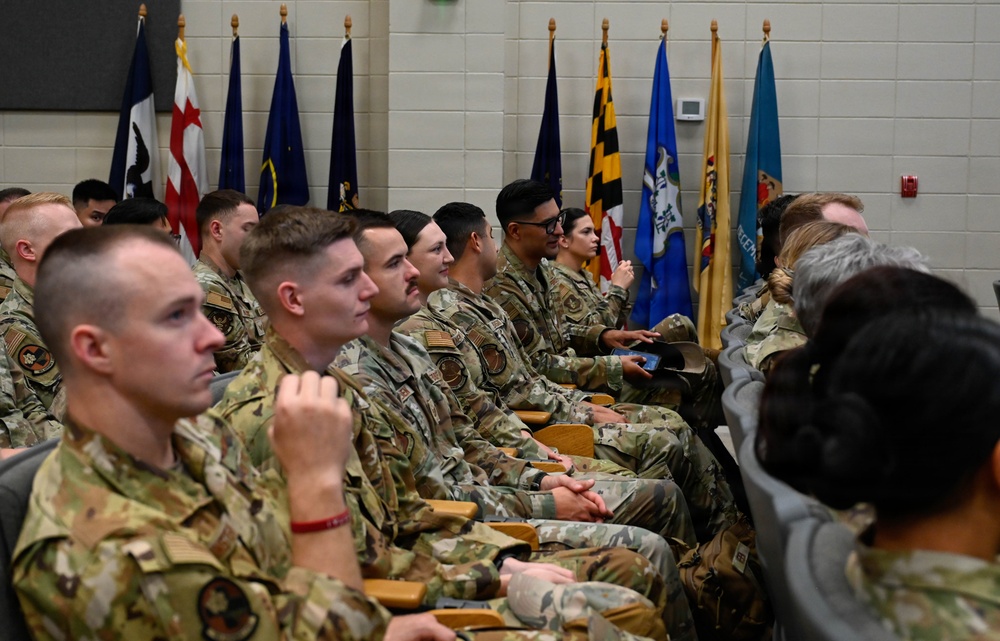
Photo By Maria Gonzalez Garduno | U.S. Airmen from multiple Air National Guard units listen to the Medical Readiness...... read more read more
 Subscribe
GULFPORT, Miss. — As Tropical Storm Bertha swept across the Gulfport Combat Readiness Training Center, students, cadre and support staff participating in Medical Readiness University were forced to adapt swiftly. Logistics, planning, transportation and insertion plans all had to change on the brink of the MRU capstone exercise: Operation Holdem.
During the peak summer heat of July, more than 550 Air National Guard medical professionals representing 79 medical groups gathered for MRU 2026.
The two-week training exercise, hosted annually by the Air National Guard Medical Service, combined classroom instruction with hands-on training in realistic operational circumstances. With an average of 95°F and 70% humidity, Gulfport set the stage to mirror deployed environments.
Unlike traditional classroom instruction, MRU placed participants in realistic scenarios that required critical thinking, teamwork and decision-making under pressure. All 14 courses were designed to prepare Airmen to operate in expeditionary missions.
"We wanted to create more than another training event," said Master Sgt. Chase Edwards, lead planner for Operation Holdem. "We wanted an immersive mission with a shared purpose. Medical personnel attend courses all the time, but deployments don't happen in classrooms.”
From Tactical Combat and Prolonged Casualty Care to Public Health and Biomedical Equipment, students got the opportunity to learn, apply and practice the skills needed in combat environments.
"MRU is a combination of training for pretty much all of the 4-series [medical Air Force Specialty Codes] in the Air National Guard," said Senior Master Sgt. Eric Applen, an exercise planner and developer for the ANG Medical Service. "When you bring them all together in a training like this, it's realistic, it's heavily supported, and it makes it more valuable training than what they can normally get at their home station"
Students progressed from classroom instruction to increasingly complex field scenarios, culminating in Operation Holdem. The 72-hour simulation placed medics under attack as they navigated their patient’s care with few resources.
"It's been a long two weeks for a lot of these students," said Capt. Taylor McWilliams, Tactical Combat Casualty Care course lead. "They've had hard courses."
At every turn, students and cadre faced challenges that reflected MRU’s guiding principle: “Combat Don’t Care”.
“It's a reminder that we've got to do whatever it takes,” said Col. Patricia Hood, strategic management and clinical oversight chief at the ANG Office of the Surgeon General. “If we're learning important skills here that we can take into a deployed environment, whatever problems arise, combat isn't going to stop because of them.”
That philosophy reflects today's operational reality. Every member of a medical group, whether provider or administrator, can be called upon to deploy.
"MRU is important because anyone and everyone is deployable," said Lt. Col. Melanie Hardy, a student in the Prolonged Casualty Care course. "It doesn't matter what slot you're sitting in."
The realism extended beyond patient care.
As Bertha approached the Gulf Coast, logistics planners had to adjust cargo movement, transportation plans and equipment storage in real time, providing an unplanned but authentic training opportunity.
"Logistics always has to have a forward-thinking plan," Applen said. "Building cargo, moving cargo and deciding where we're going to store things all come into play with the weather forecast."
Course owners designed their lectures to evolve alongside today's operational environment.
"We're getting real reports from downrange," said Senior Master Sgt. Ned McElfresh, PCC course owner. "We, in real time, will change the scenarios from what was happening to what is happening."
For Airman Drew Haley, a medic assigned to the 157th Air Refueling Wing, New Hampshire National Guard, the experience transformed his confidence.
"The MRU program is by far the best [temporary deployment] I've ever been on," Haley said. "It definitely prepared me as a medic in every way possible."
Leadership for the exercise and everyone involved recognized the effort each member put into the experience.
“MRU reflects what happens when exceptional people are empowered to lead and train to the standard the mission demands,” said Maj. Julie Blissett, the MRU program manager and special training programs manager at NGB. “I’m incredibly proud of this team and grateful for NGB/SG leadership, our instructors, cadre and mission partners who make it possible. Medical readiness is combat power, and MRU brings that to life.”
Edwards believes the program forges a medical force that is proficient and dominant in the most challenging environments.
"None of those challenges stopped the mission, they made it better," he said. "Everyone adapted, overcame adversity, and kept moving forward. That’s what military medicine is about. Our mission is people. We exist to care for the most important part of our force: our people."
As the last shuttle departed the Gulfport CRTC, MRU's planners hope adapting under pressure will no longer be something students have to think about. It will simply be what they do.
| Date Taken: | 07.28.2026 |
| Date Posted: | 07.29.2026 14:24 |
| Story ID: | 570859 |
| Location: | GULFPORT AIR NATIONAL GUARD BASE, MISSISSIPPI, US |
| Web Views: | 493 |
| Downloads: | 0 |

This work, Medical Readiness University Builds Preparedness Through Realism, by Maria Gonzalez Garduno, identified by DVIDS, must comply with the restrictions shown on https://www.dvidshub.net/about/copyright.


No keywords found.




