
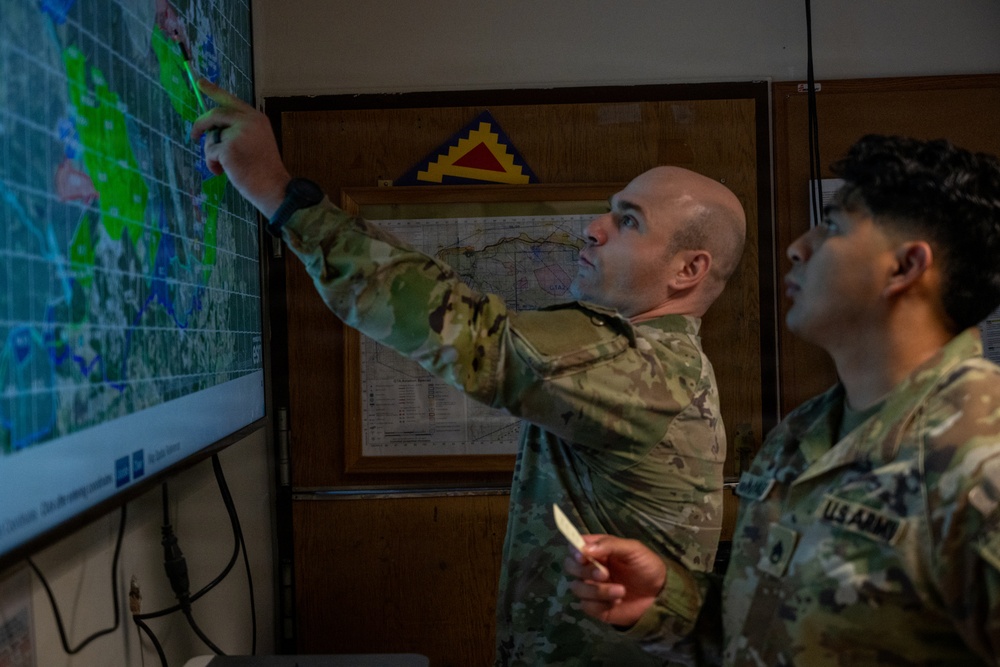
Photo By Sgt. Kammen Taylor | U.S. Army Capt. Justin Boggs, left, the Grafenwoehr Training Area Range Operations...... read more read more
 Subscribe
GRAFENWOEHR, Germany — Behind every live-fire exercise and multinational training event at the Grafenwoehr Training Area is a team working to ensure units can train safely while preserving one of the U.S. Army’s premier training environments for future generations.
Every range clearance, safety review, and training schedule supports a single goal: enabling units to accomplish their training objectives while protecting Soldiers, civilians, and the surrounding communities.
“The mission of Range Operations is to make sure every unit that comes to train here is able to meet its training objectives while preserving the training area so those who come after us can continue to use it to the greatest extent possible,” said Capt. Justin Boggs, Grafenwoehr Training Area Range Operations safety officer.
Grafenwoehr hosts U.S. Army units stationed across Europe and regularly supports multinational training with NATO allies and partner nations.
According to Boggs, working alongside those forces is one of the most rewarding aspects of the mission.
“We’re always supporting our resident units and other U.S. formations, but we also have the opportunity to work with multinational partners,” Boggs said. “Whether it’s the British Army, Danish tank crews or other allied forces, that variety is both the most unique and the most enjoyable part of this job.”
Behind the scenes, Range Operations manages ranges, coordinates schedules, and balances competing training requirements so multiple units can conduct operations safely at the same time.
Using the Range Facility Management Support System, planners schedule ranges and de-conflict competing requirements through regular planning meetings with supported units.
The team also collaborates with unit planners, 7th Army Training Command headquarters, the International Training Branch, and command safety personnel to review training plans, validate surface danger zones, and ensure training events meet established safety standards before execution.
“Our intent is never to create unnecessary roadblocks,” Boggs said. “We want to match a unit’s training event as closely as possible to their commander’s intent and allow them to conduct the most realistic training they can while preserving life, property, and the surrounding communities.”
On any given day, Range Operations balances live-fire exercises, range maintenance, civilian access, emergency responses, and environmental considerations of one of the Army’s largest overseas training areas.
“It’s a big jigsaw puzzle every day,” Boggs said. “We’re constantly fitting the pieces together to make sure units can train, maintenance teams can do their work, and the training area continues to operate safely.”
During periods of increased fire risk, the operations team may temporarily halt training on nearby ranges to coordinate with units responding to downrange fires and provide firefighting crews safe access to affected areas. Boggs said successful training begins long before units occupy a range at Grafenwoehr.
He encouraged leaders to conduct range reconnaissance ahead of their events and hold regular, comprehensive training resource meetings early in the planning process to identify requirements such as ammunition requests, permits, and deviations before they become obstacles.
“Get on the ground and understand the terrain you’re going to train on,” Boggs said. “The more planning you do up front, the better your training will be.”
Boggs said his own Army journey gives him an appreciation for the role Range Operations plays in preparing Soldiers for future missions.
Prior to joining the Army, he earned a degree in law and justice from Central Washington University and worked as a package handler in a warehouse. He enlisted because he wanted to do something that would have a greater impact.
“I knew if I didn’t do it then, I’d regret it,” Boggs said. “I went from being a warehouse worker to basic training, Officer Candidate School and now, over a decade later, helping enable training for Soldiers from across the United States and our allied partners.”
Whether supporting a simple qualification range, a company live-fire exercise or a multinational training event, Boggs said the mission remains the same: helping units train safely and effectively.
“We’re there every step of the way: planning, resourcing, and executing,” he said. “The more repetitions units get, the better they’ll become. Our job is to help make that training happen safely and effectively.”
“We’re here to help,” Boggs said. “We’re all on the same team, trying to move in the same direction. The best way we can help is by understanding your training and working with you to make it happen.”
| Date Taken: | 07.27.2026 |
| Date Posted: | 07.30.2026 09:09 |
| Story ID: | 570855 |
| Location: | GRAFENWOEHR, BAYERN, DE |
| Web Views: | 95 |
| Downloads: | 0 |

This work, GTA Range Operations coordinates training for U.S. and allied forces, by SGT Kammen Taylor, identified by DVIDS, must comply with the restrictions shown on https://www.dvidshub.net/about/copyright.


No keywords found.




