FRCE conducts first on-site HH-60W Jolly Green II repair
Courtesy Photo |
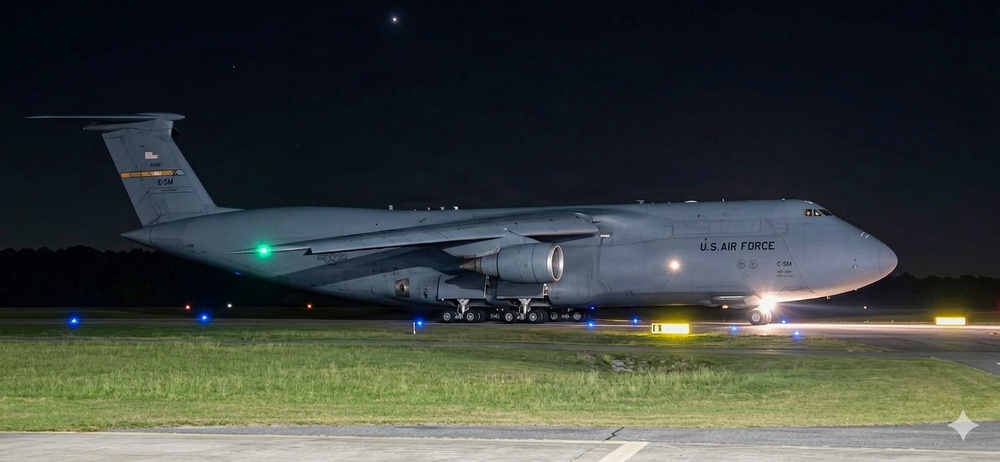
An Air Force C-5M Super Galaxy arrives at Fleet Readiness Center East’s detachment......read moreread more
Courtesy Photo | An Air Force C-5M Super Galaxy arrives at Fleet Readiness Center East’s detachment at the North Carolina Global TransPark in Kinston, North Carolina, to deliver the HH-60W Jolly Green II for in-service repair. The C-5 is a strategic transport aircraft and is the largest aircraft in the Air Force. see less
| View Image Page
FRCE conducts first on-site HH-60W Jolly Green II repair
MARINE CORPS AIR STATION CHERRY POINT, N.C. – An unplanned repair on an Air Force search-and-rescue helicopter is providing Fleet Readiness Center East (FRCE) with the opportunity to refine its HH-60W maintenance skills before the depot begins planned maintenance on the aircraft platform later this year.
While FRCE is slated to begin inducting HH-60W Jolly Green II aircraft for depot-level maintenance overhauls in September at its new facility at the North Carolina Global TransPark in Kinston, this unexpected in-service repair is serving as a strategic training ground for the depot-level maintenance team, providing an invaluable head start on readying its facilities for the workload.
FRCE Commanding Officer Capt. Randy Berti said the event showcases the depot’s dedication to supporting the warfighter and flight line readiness.
“This is an important step in our greater expansion in support of the warfighter and a massive win for our workforce,” Berti said. “This shows that our artisans will stop at nothing to give the fleet the support they need when they need it, even though our dedicated facility is not yet fully operational.”
As the first maintenance event of its kind to be performed at FRCE’s existing H-1 facility at the Global TransPark in Kinston, this in-service repair is giving artisans beneficial experience that will enable the team to easily transition to supporting the new workload later this year, said Rotary Wing Division Director Andrew Rock.
“By taking on this repair now, we are gaining essential knowledge of the platform's systems that can’t be taught in a classroom,” Rock said. “It allows us to establish our workflows and refine processes well before we begin inducting aircraft for scheduled, depot-level maintenance.”
FRCE was selected as the stateside depot source of repair for the HH-60W Jolly Green II in 2023. FRCE will conduct all airframe programmed depot maintenance for Jolly Green II aircraft located within the continental United States, which represents about 70% of the platform’s total expected workload.
Unlike routine, scheduled maintenance, this aircraft arrived at FRCE as anin-service repair – an unscheduled, targeted repair request triggered by a specific fleet issue. These specialized repairs require depot-level expertise because the damagefalls beyond the scope of standard squadron- or intermediate-level maintenance.
This in-service repair is being performed by members of the depot’s current H-1 aircraft line, who will transition to supporting the HH-60W full-time later this year. The team has been training alongside operational Air Force maintenance squadrons since 2024 to become more familiar with the platform’s maintenance activities, according to HH-60W Branch Head Travis Beamon.
“Working side-by-side with active-duty units allowed us to learn a lot,” said Beamon. “It gave us opportunities to perform flight control rigging, landing gear inspections, and main rotor head and transmission inspections – all the things we needed to master by September. That training, combined with this current repair, has given our team the qualifications we need for inductions.”
For this specific event, the helicopter arrived at the Kinston facility via a C-5M Super Galaxy – the largest military transport aircraft in the U.S. Air Force designed to transport oversized cargo.Ahead of its arrival, the FRCE team traveled to Nellis Air Force Base, Nevada, to undergo specialized aircraft loading and unloading training with the squadron.
“Whenever you load an aircraft onto a C-5, it’s called uploading,” said Beamon. “It involves very specific events, such as folding the blades, because they aren’t automated functions like some other aircraft. Artisans had to learn how to manually fold the blades and prepare the aircraft to fit into a C-5, in addition to learning how to put it back together once it’s taken out of a C-5.
“This was an important learning opportunity for our artisans,” Beamon continued. “Many of our HH-60W inductions that are set to take place when our new facility opens up will come in on a C-5 and may even go back to the unit on a C-5, so it’s very important for our artisans to be knowledgeable of the processes and feel comfortable uploading and downloading these aircraft.”
While this is the depot's first HH-60W repair on FRCE property, it is not the team's first experience with the platform.Earlier this year, FRCE artisans traveled toKirtland Air Force Base, New Mexico,to complete their first in-service repair alongside the local rescue squadron.Beamon said the knowledge and experience gained during that initial repair event will allow the team to repair and return aircraft to the fleet faster.
“Even though our current repair is more involved, it builds directly on the training and experience we gained during our first in-service repair at Kirtland Air Force Base,” Beamon said.“Because we are repeating several of the same high-level repairs and inspections we’ve already done before, we’re hoping to expedite this turnaround time so we can get it back to the Air Force quickly.
“These aircraft are used for combat search and rescue, and since they are a newer platform, there are still a lot of HH-60Ws being delivered to the units,” Beamon continued. “In order to maintain readiness of the fleet, it’s very important that we get this aircraft back as soon as possible.”
In addition to building technical skills, the event allows the depot to identify and source any additional support equipment and specialized tooling required to support the platform. Beamon said this opportunity will enable a more seamless adoption of the workload.
“Being able to go out and work with the maintenance squadrons, in addition to bringing an aircraft here to use our tools for the repair, we’re able to easily identify the support equipment commonly used on this aircraft,” Beamon said. “It allowed us to see their specialized and locally manufactured tooling to help us understand what types of equipment we need at our facility. That way we have everything we need for inductions in September.”
FRCE is North Carolina's largest maintenance, repair,overhauland technical services provider, withmore than3,600civilian,militaryand contract workers. Its annual revenue exceeds $886 million. The depot provides service to the fleet while functioning as an integral part of the greater U.S. Navy; Naval Air Systems Command; and Commander, Fleet Readiness Centers.