
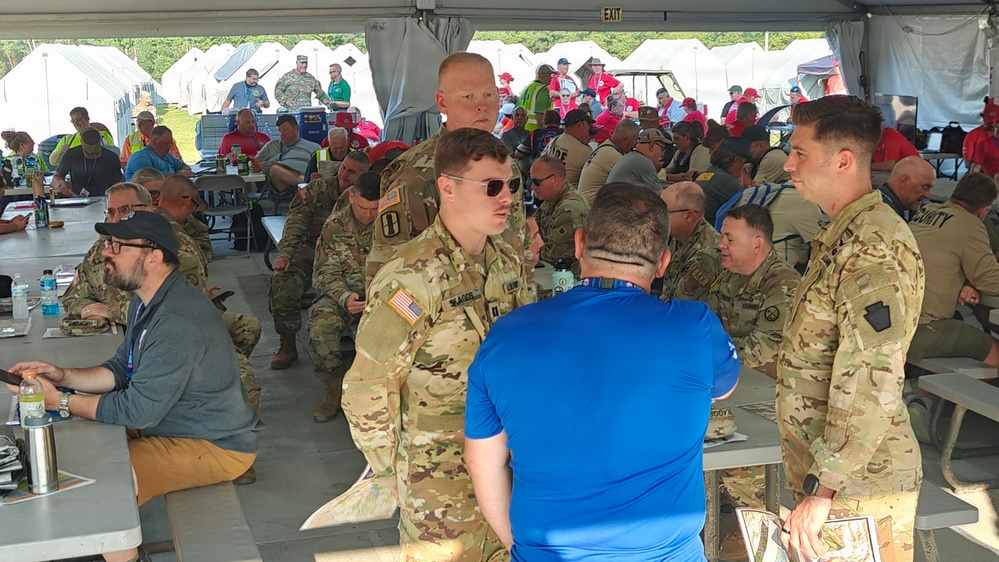
Photo By Staff Sgt. Zoe Morris | Military and civilian organizations are working together to support Scouting...... read more read more
 Subscribe
GLEN JEAN, W.Va. — Before the first Scout pitches a tent or begins an adventure across the Summit Bechtel Reserve, another team has already been at work for months. Soldiers, Airmen, Civil Air Patrol, emergency managers, law enforcement officers, firefighters, emergency medical personnel and Scout leadership come together with a common objective: ensuring the National Scout Jamboree is safe, secure and prepared for anything.
For the West Virginia National Guard, the National Scout Jamboree is more than a support mission. It is a demonstration of interoperability—multiple organizations with different responsibilities, authorities and expertise operating as a unified team in support of one of the nation's largest youth events.
This year, approximately 15,000 Scouts, leaders, volunteers and staff from across the United States gather at the Summit Bechtel Reserve in Fayette County, West Virginia. Supporting an event of that size requires a level of coordination that cannot be accomplished by any single organization alone.
Instead, success depends on partnerships built long before opening day.
Months before participants arrive, representatives from military organizations, state agencies, local governments and Scout leadership begin meeting to develop operational plans, establish communication procedures and identify how resources will be shared if an emergency occurs. These planning sessions create a common understanding of responsibilities and ensure every organization knows how it fits into the larger mission.
This year marks the 13th year that the West Virginia National Guard contributes personnel, planning expertise and specialized capabilities while working alongside partners such as the West Virginia Division of Homeland Security and Emergency Management, Civil Air Patrol, West Virginia State Police, county emergency management agencies, local fire departments, emergency medical services, public health officials and Summit Bechtel Reserve staff.
Although each organization maintains its own mission, all participants operate within a unified framework that emphasizes communication, coordination and shared situational awareness.
Whether responding to severe weather, supporting medical operations or managing transportation and logistics, decisions are made collaboratively, allowing agencies to leverage one another's strengths while maintaining a common operating picture.
Interoperability extends far beyond radios and technology.
It begins with relationships.
Planning conferences, tabletop exercises and coordination meetings allow leaders to establish trust before challenges arise. When decisions must be made quickly, those existing relationships help reduce uncertainty, accelerate information sharing and improve operational effectiveness.
"The partnerships built before an incident are often the reason a response succeeds," said Col. Robert Kincaid, dual status commander of Joint Task Force-National Scout Jamboree. "When everyone understands one another's capabilities and responsibilities, coordination becomes much more effective."
For Guardsmen supporting the event, the Jamboree also provides valuable experience working in a multi-agency environment that closely mirrors the complex coordination required during natural disasters and domestic emergencies.
“The Jamboree is a unique training opportunity for the soldiers and airmen of the West Virginia National Guard,” said Col. Ryan Harrah, commander of Task Force Events. “Because it provides a local training venue that exposes our younger Airmen and Soldiers to the meaning of interoperability and the role that they play in it.”
Unlike military operations where command structures are clearly defined, large public events require organizations from different jurisdictions to synchronize efforts while respecting each agency's legal authorities and operational responsibilities.
That environment reinforces skills that are essential during floods, winter storms, search and rescue operations and other emergency responses throughout West Virginia.
Communication remains one of the most important elements of the operation.
Throughout the event, representatives from partner organizations continuously share information regarding weather, medical activity, transportation, security and logistics. This steady exchange allows leaders to anticipate potential challenges before they become emergencies and rapidly coordinate resources when assistance is needed.
Behind the scenes, dozens of professionals work inside operations centers where information from across the reservation is collected, analyzed and distributed to decision-makers. While visitors may never see this coordination firsthand, it enables the seamless support that allows Scouts to focus on their once-in-a-lifetime experience.
According to Col. Robert Sloan, the Unified Command Chief of Staff, it would be impossible to pull an event of this magnitude off, without the expertise that the national, state and local agencies provide.
“Their ability to synchronize with one another and our staff, despite different backgrounds and regulations, reflects their flexibility and dedication to completing the mission flawlessly,” Sloan said.
For the West Virginia National Guard, supporting the National Scout Jamboree reflects the Guard's dual mission of serving both the nation and the state. While Guardsmen remain ready to respond to overseas contingencies, they also stand prepared to assist civil authorities during emergencies at home.
Each planning meeting, exercise and coordinated response builds familiarity among organizations that may one day work together under far more demanding circumstances. Those relationships create a stronger emergency management network capable of protecting communities across West Virginia.
| Date Taken: | 07.27.2026 |
| Date Posted: | 07.27.2026 07:37 |
| Story ID: | 570765 |
| Location: | GLEN JEAN, WEST VIRGINIA, US |
| Web Views: | 284 |
| Downloads: | 0 |

This work, One Mission, Many Partners: How Interoperability Powers the National Scout Jamboree, by 1st Lt. De-Juan Haley, identified by DVIDS, must comply with the restrictions shown on https://www.dvidshub.net/about/copyright.


No keywords found.




