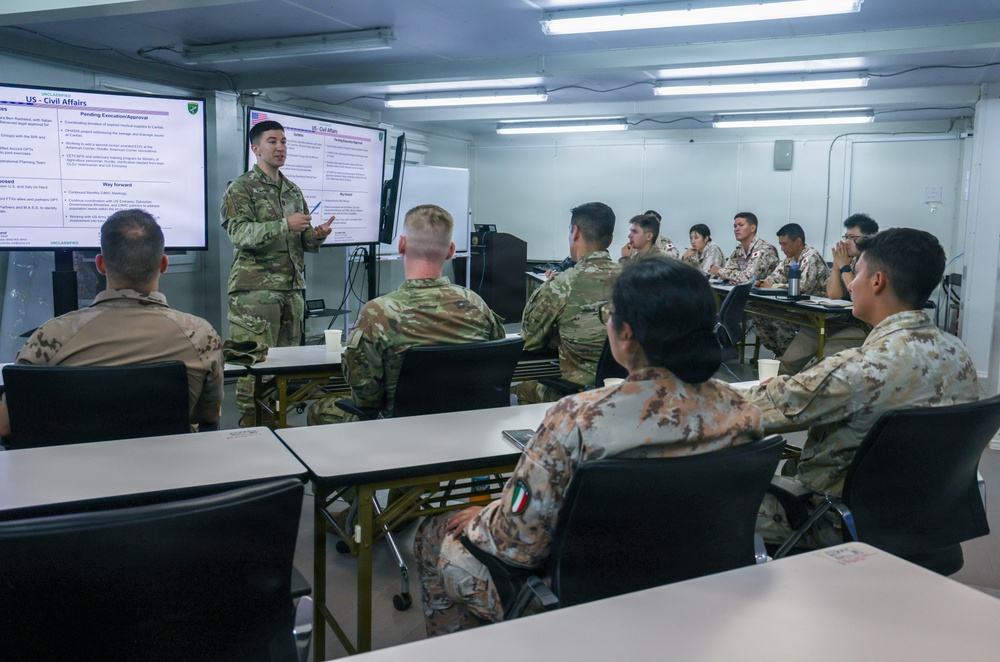
Photo By Pfc. Luis Gautier-Martinez | U.S. Soldiers assigned to Civil Affairs Battalion, U.S. Army Southern European Task Force, Africa (SETAF-AF) meet with partner forces to coordinate civil-military cooperation at the Japan Self-Defense Forces Base, Djibouti, July 2, 2026. The meeting gathered partner forces from the United States, Japan, Spain and Italy to enhance interoperability in the region by improving coordination efforts that foster peace and prosperity for local communities. (U.S. Army photo by Pfc. Luis Gautier-Martinez) see less
| View Image Page
SETAF-AF’s civil affairs battalion conducts relief in place in Africa, Italy
VICENZA, Italy – New personnel recently took charge of the mission for Civil Affairs Battalion, U.S. Army Southern European Task Force, Africa (SETAF-AF) in Africa and Italy.
The battalion’s relief in place was an incremental process that began in late June and concluded July 6 at Caserma Del Din in Italy, Camp Lemmonier in Djibouti, and various locations throughout Africa.
The Soldiers who now comprise the two CA companies are Army reservists of the 412th Civil Affairs Battalion, based in Columbus, Ohio, and the 422nd Civil Affairs Battalion, headquartered in McLeansville, North Carolina.
According to U.S. Army Maj. Bryan Bridges, the CA battalion’s tactical officer in charge who serves in Italy, the battalion provides command and control for two civil affairs companies and a security force assistance brigade team in U.S. Africa Command’s area of responsibility.
“The CA teams support AFRICOM in building partner capacity, advancing U.S. access and influence, integrating civil knowledge and supporting crisis response,” Bridges said.
As the new civil affairs crew began their nine-month deployment, they learned the normal duties and expectations from their predecessors through the Army’s traditional “left seat/right seat” familiarization. Bridges emphasized that this phase is especially important because the lessons learned by new personnel provide continuity for the mission, while avoiding gaps in command and control to help maintain that mission.
Bridges said his team in Italy will ensure that units in Africa have all the information they need to complete mission requirements, while also providing SETAF-AF necessary information from CA units in the field.
U.S. Army Lt. Col. Kevin Jusza, outgoing battalion commander, explained that the CA mission is important to building baseline organizational trust with host nations, fostering and understanding local network access, and supporting partner forces’ training by incorporating the CA skill sets into their organizations. While the nature of civil affairs work is nonlethal, by making these connections and advancing relationships, CA operations contribute “through several lenses” to the Army’s overall, big-picture lethality and mission success.
“We work to ease and mitigate any tensions between U.S. forces and the local populace while developing mutual understanding and trust,” Jusza said.“We also develop the civil common operating picture, creating a layout of the civilian area for U.S. commanders to better understand the environment.”
U.S. Army Sgt. 1st Class Corey Damron, the incoming noncommissioned officer in charge of the operations (S3) section, said that his unit’s initial priorities will concentrate on ensuring that all staff functions and processes run efficiently, with a focus on mission analysis to expand capabilities and mission opportunities.
“Our [future] goals are to complete missions aligned with U.S. Africa Command and SETAF-AF lines of effort to increase American sentiment within Africa while maintaining operations,” Damron said.
During their deployment, the outgoing CA Soldiers achieved significant accomplishments, such as conducting a subject matter expert exchange in Libya and supporting contingency operations in Nigeria. Jusza noted that both were first-time engagements in those locations for an Army Reserve civil affairs organization.
As he prepared to head home, Jusza counseled flexibility and patience for CA Soldiers taking charge of the mission in Africa.
“The mission is always changing and evolving,” Jusza said. “Don’t get stuck on any preconceived notions you developed during mobilization.”

 Subscribe






