
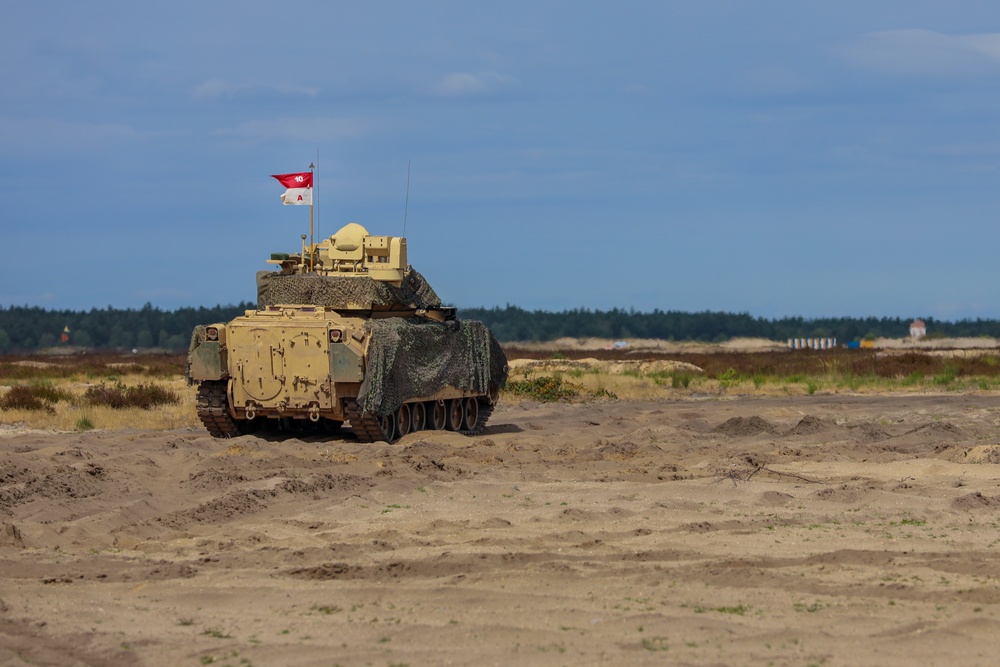
Photo By Sgt. Tara Fajardo Arteaga | A U.S. Army M2A3 Bradley Fighting Vehicle assigned to Apache Troop, 4th Squadron, 10th...... read more read more
 Subscribe
FORT IRWIN, Calif. — Soldiers assigned to the 4th Squadron, 10th Cavalry Regiment, 3rd Armored Brigade Combat Team, 4th Infantry Division, honored the squadron’s 160-year legacy during Project Convergence-Capstone 6 (PC-C6) at Fort Irwin, California.
The celebration also marked a historic milestone as the squadron conducted its final formation before deactivation, bringing more than a century of distinguished service to a close while honoring the Buffalo Soldiers’ enduring legacy.
The squadron traces its lineage to the aftermath of the Civil War, when Congress authorized six all-Black Army regiments in 1866. More than 180,000 African American soldiers served in the Union Army during the Civil War, and as the nation expanded westward, these newly established regiments were tasked with protecting frontier settlers, escorting wagon trains and securing transportation routes across the frontier.
The 10th Cavalry Regiment, along with the 9th Cavalry Regiment and the 24th and 25th Infantry Regiments, became known collectively as the Buffalo Soldiers. The nickname was given by Native American tribes, although its exact origin remains uncertain. Historians believe it referred either to the soldiers' dark, curly hair, which resembled a buffalo's coat, or to the courage and determination they displayed in combat. The name became a symbol of honor and respect and was later became part of the 10th Cavalry Regiment's distinctive insignia and crest.
For more than two decades, Buffalo Soldiers supported westward expansion by protecting communities, escorting mail routes, building roads and safeguarding critical infrastructure. They also served as the nation's first park rangers, protecting public lands from poaching, illegal logging and livestock grazing in areas that would later become national parks. During the Indian Wars, 18 Buffalo Soldiers received the Medal of Honor for their valor.
While the ceremony honored the squadron’s distinguished legacy, it also marked an important step in the Army’s ongoing transformation efforts. The deactivation of 4-10 Cav reflects the Army’s broader transformation of its force structure to meet the demands of future large-scale combat operations. As the Army modernizations its force structure through initiatives such as Transformation in Contact (TiC), units have evaluated emerging capabilities including unmanned systems, electronic warfare tools, advanced sensors, and Next-Generation Command and Control (NGC2) to enhance battlefield effectiveness. Throughout fiscal year 2026, 4-10 Cav contributed to those efforts by testing and integrating new capabilities.
Lessons learned from those efforts have informed the Army’s evolving force design, placing greater emphasis on agile, digitally connected formations capable of operating across multiple domains. Within this modernization framework, Stryker Brigades are increasingly serving as the Army’s primary reconnaissance and security force, providing commanders with enhanced mobility, survivability and the ability to rapidly integrate emerging technologies.
More than 150 years later, Soldiers assigned to the 4th Squadron, 10th Cavalry Regiment continue to honor that legacy through modernization, multinational partnerships and large-scale combat training.
One of the squadron's enduring traditions is the Order of the Spur, a cavalry rite of passage recognizing excellence and service. Soldiers earn Silver Spurs by successfully completing a Spur Ride and Gold Spurs through service in combat with a cavalry unit. Upon completion, Soldiers participate in a ceremony recognizing their achievement and commitment to the cavalry profession.
Since its activation with the 3rd Armored Brigade Combat Team, 4th Infantry Division at Fort Carson, Colorado, in 2007, 4-10 Cav has provided reconnaissance and security capabilities in support of brigade operations while preparing for large-scale combat operations.
During fiscal year 2026, the squadron advanced Army modernization efforts and experimented future warfighter capability through Black Hornet training, the Ivy Sting series and PC-C6. Throughout Ivy Sting and PC-C6, Soldiers evaluated and integrated NGC2 designed to enhance commanders’ battlefield decision-making, data sharing and command-and-control capabilities for future large-scale combat operations.
“PC-C6 is the largest experiment in the history of the program, delivering a critical opportunity to continue validation of the NGC2 architecture at operational scale,” said Lt. Gen. Michael McCurry, commanding general of the Army Futures and Concepts Command. “By leveraging an Army division, we are not only testing over 100 emerging technologies in a realistic environment, we are actively enhancing the future capabilities of our operational forces.”
During Ivy Sting 4, 4-10 Cav tested several emerging technologies that support NGC2 initiatives. The squadron tested wearable sensors that enabled real-time casualty tracking, integrated Lattice-enabled unmanned aircraft systems for intelligence, surveillance and reconnaissance missions and employed Beast+ electromagnetic warfare system to feed spectrum data across the network. The technologies provided commanders with greater situational awareness while demonstrating the value of integrated system in a complex operational environment.
As reconnaissance and security capabilities continue to evolve, the Army is restructuring its formations to better align with future operation requirements. While the deactivation marks the end of a proud chapter in the regiment’s history, it also represents the Army’s continued commitment to adapting its organizations, technologies and warfighting capabilities for the challenges of tomorrow, ensuring the legacy of 4-10 Cav endures as it helps shape the force of the future.
“Today we honor 160 years of service, sacrifice, and excellence that began with the very first Buffalo Soldiers and continued through every Trooper that followed in their footsteps,” said Lt. Col. Shawn Scott, commander of 4th Squadron, 10th Cavalry Regiment. “Always in the vanguard, the 10th U.S. Cavalry Regiment is a legendary unit that was vital to the pioneering efforts of the United States in the 19th century. Today, the Buffalo Soldiers of 4-10 Cav continued that legacy by helping the 4th Infantry Division pioneer the future of the U.S. Army as they prototype the Next Generation Command and Control that will reshape the future of warfighting forever. As the squadron colors are cased today on the 160th birthday of the regiment, we remember the courage, professionalism and selfless service of all those BLACK JACK Troopers who came before us. While this chapter comes to a close, the values and traditions of the Buffalo Soldiers will continue to live on in every Trooper who served in this extraordinary unit. READY AND FORWARD!”
Though the 4-10 Cav’s mission has come to an end, the legacy of the Buffalo Soldiers lives on through the Soldiers who earned their spurs and carried the regiment’s traditions forward. While they may be retired, the values of courage, resilience and selfless service that defined generations of Buffalo Soldiers will continue to shape the Army for years to come.
| Date Taken: | 07.26.2026 |
| Date Posted: | 07.28.2026 11:11 |
| Story ID: | 570735 |
| Location: | FORT IRWIN, CALIFORNIA, US |
| Web Views: | 50 |
| Downloads: | 0 |

This work, The Final Formation: Honoring 160 Years of the 4-10 Cav Legacy, by SPC Kristen Cruz, identified by DVIDS, must comply with the restrictions shown on https://www.dvidshub.net/about/copyright.


No keywords found.




