
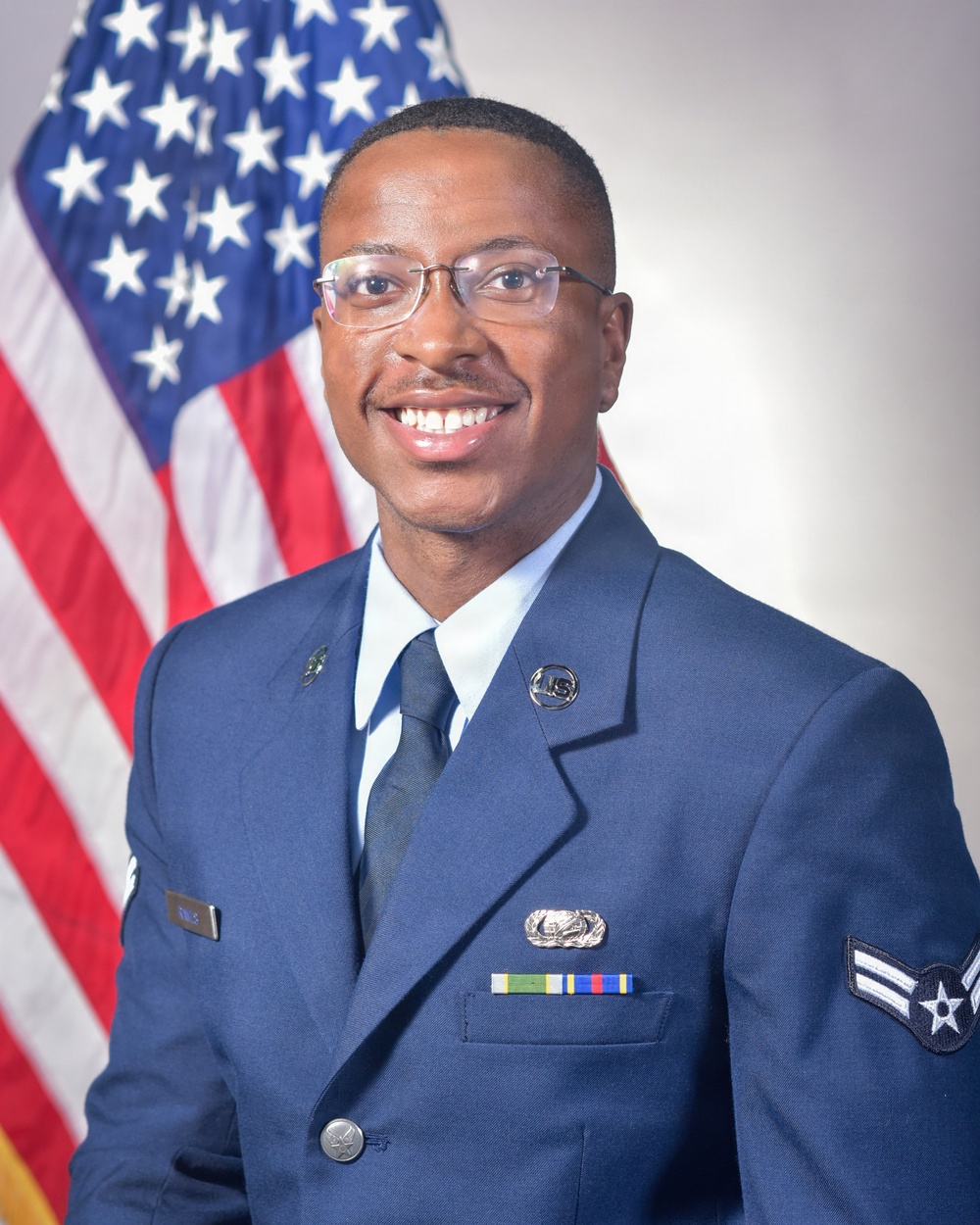
Photo By Capt. Michelle Chang | U.S. Air Force Airman 1st Class Jalen Rawls, a command support staff technician...... read more read more
 Subscribe
LOS ANGELES AIR FORCE BASE, Calif. — Airman 1st Class Jalen Rawls earned an early promotion to senior airman after being selected through the Air Force's below-the-zone program, a competitive process recognizing Airmen who demonstrate exceptional performance and leadership potential ahead of their peers.
Rawls is among the first Airmen selected through Space Base Delta 3's return to an in-person below-the-zone board, marking a shift back to face-to-face evaluations after years of virtual reviews. This transition aligns with the priorities to restore the warrior ethos and to strengthen warrior culture across the installation. The change allows senior enlisted leaders to assess candidates not only through their records, but also through their confidence, military bearing and ability to perform under pressure.
The below-the-zone program promotes outstanding airmen 1st class to senior airmen six months early, giving them an opportunity to reach future career milestones sooner while recognizing sustained excellence early in their careers.
“This is a six-month advance on that position and potentially could alter your career,” said Master Sgt. Taylor Moore, 61st Force Support Squadron development advisor and acting first sergeant for Space Base Delta 3. “That's the opportunity that you're affording these people.”
The selection process began with eight eligible Airmen from across Space Base Delta 3 and supporting Space Systems Command organizations. Before anyone appeared before the board, supervisors determined whether each Airman had earned the opportunity to compete.
“If I had the stripe in my hand right now, would I give it to them?” Moore said. “If the answer is no, then they're simply not ready yet. Some people develop faster than others.”
Only four Airmen advanced to the formal board.
Candidates entered a room lined with five senior enlisted leaders, all dressed in service dress uniforms to mirror the professionalism expected of those competing. A chief master sergeant presided over the board alongside four senior noncommissioned officers who had no supervisory relationship with any of the competitors, ensuring every evaluation remained impartial.
The interview tested far more than memorized knowledge. Board members evaluated military bearing, confidence, communication, leadership potential and composure while asking questions about Air Force heritage, enlisted force structure, job proficiency and leadership scenarios. This rigorous, face-to-face standard reflects the high, uncompromising and clear expectations for its warfighters, ensuring that early promotions are strictly merit-based and centered on capability.
Each competitor also submitted a package documenting accomplishments from basic military training through their current assignment, including awards, education, volunteer service and performance. Together, the package and interview provided a comprehensive picture of each Airman's readiness for early promotion, embodying SSC’s commitment to developing a world-class workforce.
“The package tells us what they've done,” Moore said. “The board tells us who they are.”
Rawls serves as the director's executive and command support staff for the 61st Force Support Squadron, where he manages personnel accountability and reviews administrative correspondence before it reaches senior leadership. His work helps ensure leadership receives accurate information while supporting the readiness of Space Base Delta 3.
Outside his primary duties, Moore said Rawls built a reputation for consistently seeking opportunities to improve. Whether asking senior enlisted leaders for mentorship, volunteering for additional responsibilities, or pursuing professional development, he approached every challenge with the same mindset.
“He doesn't know how to drop the ball,” Moore said. “I've had to tell him more than once to slow down because I don't want him to burn himself out.”
Rawls' commitment to growth also stood out to his supervisor, Staff Sgt. Brandon Kelso, 61st Force Support Squadron base training manager. Kelso said Rawls quickly embraced responsibilities beyond those typically expected of an Airman, balancing career development, college coursework, and additional duties while serving as his alternate on key programs. A former below-the-zone selectee himself, Kelso mentored Rawls, demonstrating that developing the workforce is a shared responsibility that never settles for "good enough."
“We're not expecting you to have every single answer,” Kelso said. “We want to know that you have the integrity and accountability to say, ‘I'm not sure, but I'll verify it and get back to you.’” Kelso said Rawls has consistently sought opportunities to challenge himself and grow. “From the moment I met him, he wanted to be challenged,” Kelso said. “He wants to understand the bigger picture, and he's always looking for the next opportunity to improve.”
Moore said Rawls' commitment extends beyond the workplace. He consistently excels during dormitory inspections, prioritizes physical fitness and maintains the discipline expected of an Airman preparing for greater responsibility.
“From the time he arrived at this installation, people were saying, ‘That's a below-the-zone Airman,’” Moore said. "He sought out opportunities. He sought out knowledge. He sought out mentorship. He was always asking how he could improve."
Despite Rawls' accomplishments, Moore described this year's competition as one of the closest he has seen. “When I looked at the four names, I couldn't tell you who was going to win,” Moore said. “They were that close.”
The competition became so narrow that board members scrutinized the smallest details of each candidate's presentation, illustrating the caliber of every Airman who reached the final stage.
Rawls said earning below-the-zone promotion is both an honor and a responsibility.
“Getting BTZ for me means more responsibility and an opportunity to produce more within your unit and help bear the weight for your leadership,” Rawls said.
Preparing for the board required discipline as much as confidence.
“I studied everything discipline-related, studied the enlisted force structure and went in confident,” Rawls said.
The return to an in-person board has also strengthened the development process for Airmen who are not selected. Rather than simply receiving a score, competitors leave with meaningful feedback that helps supervisors guide their continued growth.
“We're not just choosing someone to wear another stripe,” Moore said. “We're helping develop the next generation of leaders.”
As Rawls prepares to sew on senior airman six months ahead of schedule, his selection reflects more than individual achievement. It highlights a commitment to continuous improvement and readiness, qualities the below-the-zone program is designed to recognize in the Air Force's future enlisted leaders.
| Date Taken: | 07.23.2026 |
| Date Posted: | 07.28.2026 10:51 |
| Story ID: | 570695 |
| Location: | LOS ANGELES AIR FORCE BASE, CALIFORNIA, US |
| Web Views: | 8 |
| Downloads: | 0 |

This work, Space Base Delta 3 Airman Selected for Early Promotion Following the Return of the In-Person Below-The-Zone Board, by Capt. Michelle Chang, identified by DVIDS, must comply with the restrictions shown on https://www.dvidshub.net/about/copyright.

No keywords found.




