
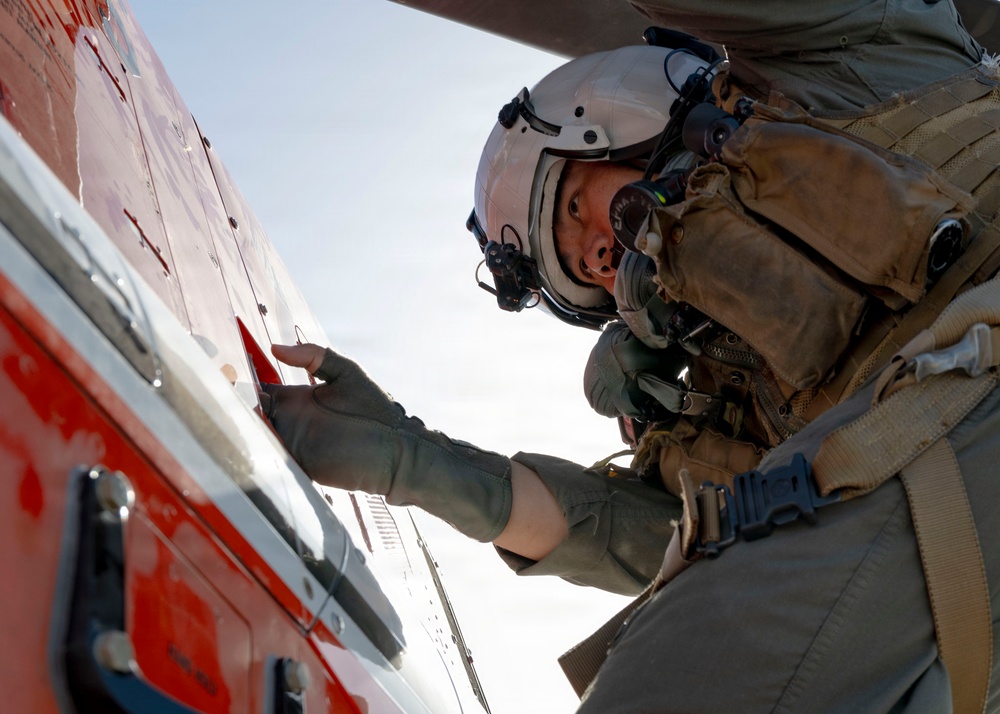
Photo By Lt.j.g. Melvin Fatimehin | Lt. j.g. Darwin Reyes, of Pampanga, Philippines, a student naval aviator assigned to...... read more read more
 Subscribe
A feature from Rear Admiral Max McCoy
Our Forge: The Foundation of Naval Aviation
The Chief of Naval Air Training (CNATRA)’s solemn charge is forging the next generation of Naval Aviators, and this mission begins on the ground at Naval Air Station (NAS) Pensacola. Under the Naval Education and Training Command (NETC), we have purposefully engineered the Naval Introductory Flight Evaluation (NIFE) as the first crucible for every prospective aviator. We consolidated our legacy indoctrination and screening programs formerly known as Aviation Preflight Indoctrination (API) and Introductory Flight Screening (IFS) into a single, eight-and-a-half-week curriculum. Candidates are immersed in the fundamentals of aviation, procedural-based standards and are screened for aeronautical adaptability. This front-end investment is critical; it sharpens our students for Primary Flight Training and reduces attrition where it matters most.
The men and women who report to NIFE are newly commissioned Ensigns and Second Lieutenants from the U.S. Naval Academy, Officer Candidate School, and Naval Reserve Officer Training Corps units nationwide. These students represent the Navy, Marine Corps and Coast Guard, alongside a vital cohort of international officers from our Ally and partner nations. Though their backgrounds are diverse, they share one common goal: to earn their Wings of Gold.
To meet the demands of a dynamic global environment, we have aggressively implemented the “Street to Fleet” initiative. We methodically streamlined our training pipeline to produce combat-ready aviators more rapidly, without compromising standards or safety. We are accelerating delivery of our highly motivated warfighters to the Fleet where their skills are urgently needed by optimizing every phase of training and leveraging the most advanced instructional resources. This is not a matter of convenience; it is a strategic imperative.
The initial phase at Pensacola is the bedrock for their entire career. We forge discipline, professionalism, integrity, and attention to detail that defines a Naval Aviator. NIFE builds the essential foundation for the demanding profession of Naval Aviation.
Mastering the T-6B Texan II: Gateway to the Fleet
Upon completing NIFE, our student naval aviators advance to Primary Flight Training at one of two Air Wings: Training Air Wing Four (TW-4) at NAS Corpus Christi in Corpus Christi, Texas, or Training Air Wing Five (TW-5) at NAS Whiting Field in Milton, Florida. It is here that we begin teaching them the core skills of our profession: contact flying (familiarization), precision aerobatics, formation discipline, and instrument navigation.
The T-6B Texan II is the heart of the Primary Training syllabus, and we chose it for a reason. While it is their first aircraft, it is anything but a simple trainer. We equipped the T-6B with upgraded avionics providing a state-of-the-art "glass cockpit" with multifunction displays, and a Head-Up Display (HUD) that deliberately mirrors the complex systems in our most advanced Fleet aircraft.
This sophisticated cockpit is by design. We are not just teaching stick-and-rudder skills; we are training our aviators in the complex art of managing advanced flight systems under pressure, a non-negotiable skill for operating modern naval aircraft. The Texan II is a demanding machine that requires precision and discipline. By mastering it, our students prove to us, and to themselves, that they possess the aptitude and skill to fly more powerful and complex aircraft. They prove they are worthy of the next step in their journey toward earning the coveted Wings of Gold.
Training Pipelines Student Naval Aviators (SNAs) flow into several Advanced Training pipelines after Primary Training. Based on demonstrated performance and operational needs of the Navy and Marine Corps, we select them for one of six training pipelines: Strike, Rotary, Maritime, Tilt-Rotor, E-2, and E-6.
Advanced Flight Training CNATRA’s Advanced Training syllabi employs all available resources to ensure training occurs at the right time and at the right cost for a seamless transition into Fleet Replacement Squadrons (FRS).
Strike The Strike Pipeline is the path to jets. SNAs report to either Training Air Wing One (TW-1) at NAS Meridian, or Training Air Wing Two (TW-2) at NAS Kingsville, to fly the T-45C Goshawk.
Strike SNAs are immersed in "tailhook" culture, learning air-to-air, air-to-surface and carrier landing fundamentals required to fly 4th and 5th generation Strike Fighters and Electronic Attack aircraft.
Rotary and Intermediate Tilt-Rotor Advanced Rotary and Intermediate Tilt-Rotor training is conducted at TW-5 at NAS Whiting Field. Students master flying in the highly dynamic TH-73A Thrasher, which has replaced the venerable TH-57 Sea Ranger. The Thrasher’s all-digital "glass cockpit" is a technological leap forward to enable a smoother transition into complex Fleet rotary aircraft.
Maritime Multi-Engine and Advanced Tilt-Rotor SNAs selected for Multi-Engine and Advanced Tilt-Rotor training go to TW-4 at NAS Corpus Christi where they learn to fly the twin-engine T-44C Pegasus or T-54A Marlin II. The T-54 teaches students to manage an advanced all-digital “glass cockpit” similar to fleet Poseidon, Hercules and Osprey aircraft.
This multi-engine syllabus prepares SNAs for long-range missions and crew resource management required to hunt submarines, conduct surveillance over vast stretches of ocean, deliver logistical support and employ Marine Air-Ground Task Force (MAGTF) operations.
E-2 Hawkeye SNAs selected for the E-2 Hawkeye pipeline report to TW-4 for multiengine training in the T-44C Pegasus or T-54A Marlin II. Upon completion, students report to TW-1 or TW-2 to complete a syllabus that culminates in a T-45C Carrier Qualification.
E-6 Mercury SNAs selected for the E-6 Mercury pipeline report to TW-4 for multiengine training in the T-44C Pegasus or T-54A Marlin II.
CNATRA’s advanced training pipelines teach pilots to master precision and decision-making while operating high-performance aircraft safely. These skills are foundational to fly from aircraft carriers, cruisers, destroyers, amphibious ships and expeditionary airfields in demanding and dangerous combat environments.
The Naval Flight Officer (NFO) Pipeline Student Naval Flight Officer (SNFO) training is conducted at Training Air Wing Six (TW-6) at NAS Pensacola. SNFO training develops tactical expertise, situational awareness and teamwork required to operate advanced weapon and sensor systems.
The SNFO journey begins at Training Squadron 10 (VT-10), the “Wildcats,” learning aviation fundamentals in the T-6A Texan II and mastering navigation and communication before they branch into their own specialized pipelines.
The NFO Strike pipeline trains future Weapon Systems Officers (WSOs) or Electronic Warfare Officers (EWOs) for the F/A-18F Super Hornet or EA-18G Growler. These students complete intermediate flight training at VT-10. Advanced training takes place at Training Squadron 86 (VT-86), the "Sabrehawks," where students fly the T-45 in air-to-air and air-to-ground missions. The T-45’s Virtual Mission Training System (VMTS) allows SNFOs to train on a synthetic radar that mirrors F/A-18F or EA-18G capabilities.
For those heading into the Airborne Early Warning (AEW), Maritime Patrol and Reconnaissance (MPR), and Take Charge and Move Out (TACAMO) communities, intermediate and advanced NFO training takes place at Training Squadron 4 (VT-4), the "Warbucks."
The NFO AEW pipeline trains SNFOs to manage radar surveillance, communications and networks in complex battlespace in the E-2D Hawkeye.
The NFO MPR pipeline trains SNFOs to operate advanced systems critical for Anti-Submarine Warfare (ASW), Anti-Surface Warfare (ASuW) and Intelligence Surveillance and Reconnaissance (ISR) missions aboard the P-8A Poseidon.
The NFO TACAMO pipeline prepares SNFOs to provide critical communications links aboard the E-6B Mercury. AEW, MPR and TACAMO SNFOs train in the Multi-Crew Simulator (MCS). This high-fidelity trainer is a gamechanger. Crews learn how to manage complex sensors, data links, and communications. In the MCS, SNFOs operate in realistic mission scenarios. Honing skills and crew coordination are essential to operate Fleet multi-crew platforms.
SNFO training develops specialists who manage complex aircraft systems, coordinate tactics, and guide the aircraft to mission success. SNFOs are all learning how to integrate radar, sensors, weapons, communications and navigation, turning advanced technology and information into decisive action in combat.
Naval Air Vehicle Pilot Training System Naval Aviation is undergoing a fundamental transformation in pilot training. Driven by technological advancements, the future of Naval Aviation includes the development of advanced unmanned aerial vehicles. NAVPTS consists of the initial stages of traditional Naval Aviator training with unique training necessary to operate the MQ-25 Stingray. Post NIFE, Student Air Vehicle Pilots (SAVP) report to TW-6 for a three-month primary training course with VT-10. Students train in the T-6 simulators, learn the basic skills of aviation, visual and instrument navigation and communications. Upon completion of primary, students move to advanced training at VT-86 where they utilize a variety of training media including the Vigilant Spirit (VS) simulator which is also utilized by the Air Force in unmanned aerial system (UAS) training.
The Modernization of Naval Air Training We are fundamentally transforming how we train the next generation of SNAs. By integrating mixed-reality technology and aggressively addressing pipeline bottlenecks, we are producing more capable, highly adaptable Naval Aviators and Air Vehicle Pilots (AVP) at an accelerated pace.
New Approaches to Training We continue to integrate Mixed Reality (MR) and Virtual Reality (VR) trainers into syllabi. This digital immersion enables students to practice complex procedures, build muscle memory and allow collaborative training events that focus on proficiency long before they climb into the aircraft. Advances in technology will simultaneously increase the quality and competency of the aviators delivered to the Fleet. These devices are more compact and modular, reducing space constraints and required maintenance.
CNATRA is also developing systems using advanced technologies that include artificial intelligence and data visualizations to synchronize long range syllabus training plans with data driven maintenance tools. This effort will align training resources and dramatically reduce production time to train.
Meeting the Demand The modernization of our training syllabi is matched by an aggressive approach to overcoming personnel and aircraft readiness challenges. Recognizing operational risk caused by extended time to train, CNATRA executed a comprehensive review to employ data driven measures to more rapidly deplete pools between or during training phases. Today, those once-stagnant wait times have been decisively cut, ensuring a fluid pipeline of SNAs and SNFOs moving to the Fleet.
To sustain this momentum against the backdrop of Instructor Pilot (IP) shortages, CNATRA has implemented creative, force-multiplying solutions. We are leveraging highly experienced Contract Instructor Pilots to complement active duty and Naval Reserve instructors. Additionally, the Contractor Operated Primary Training-Rotary (COPT-R) program has been effective in allowing SNAs who desire a path in the Rotary community to immediately flow into helicopter training by bypassing fixed-wing Primary Training. Utilizing commercial helicopter training facilities to provide initial phases of rotary flight instruction, COPT-R has dramatically accelerated the production of rotary-wing pilots and eased the burden on T-6B Texan II readiness without compromising training standards.
The Future of Naval Aviation Training Our training platforms must reflect modern avionics and capabilities to prepare our aviators for advanced Fleet aircraft. The Naval Air Training Command is currently undergoing a massive recapitalization of its aging fleet.
The Next Generation of Trainers The legacy T-44C Pegasus is actively being replaced by the T-54A Marlin II. We completed the transition from the venerable TH-57 Sea Ranger to the advanced TH-73A Thrasher in fall 2025. We are laying the groundwork for the Undergraduate Jet Training System (UJTS) program, which will eventually replace the T-45C Goshawk. These new platforms are not just upgrades in airframes; they represent a fundamental leap in training capability. These next-generation trainers are equipped with modern glass cockpits, advanced sensor suites and digital flight management systems, bridging the technological gap and ensuring our SNAs are fully prepared to operate advanced Fleet aircraft from day one.
Training for Tomorrow’s Conflicts Naval Aviation training is constantly evolving through innovation using technological advancements to elevate performance and standards while reducing time to train throughout the training pipeline. CNATRA is forging the most lethal, capable, and ready Naval Aviators and Air Vehicle Pilots. The sky is not our limit. It is our arena.
| Date Taken: | 07.23.2026 |
| Date Posted: | 07.23.2026 16:21 |
| Story ID: | 570621 |
| Location: | CORPUS CHRISTI, TEXAS, US |
| Web Views: | 1,774 |
| Downloads: | 0 |

This work, Naval Air Training Command: Forging Naval Aviators, must comply with the restrictions shown on https://www.dvidshub.net/about/copyright.


No keywords found.




