
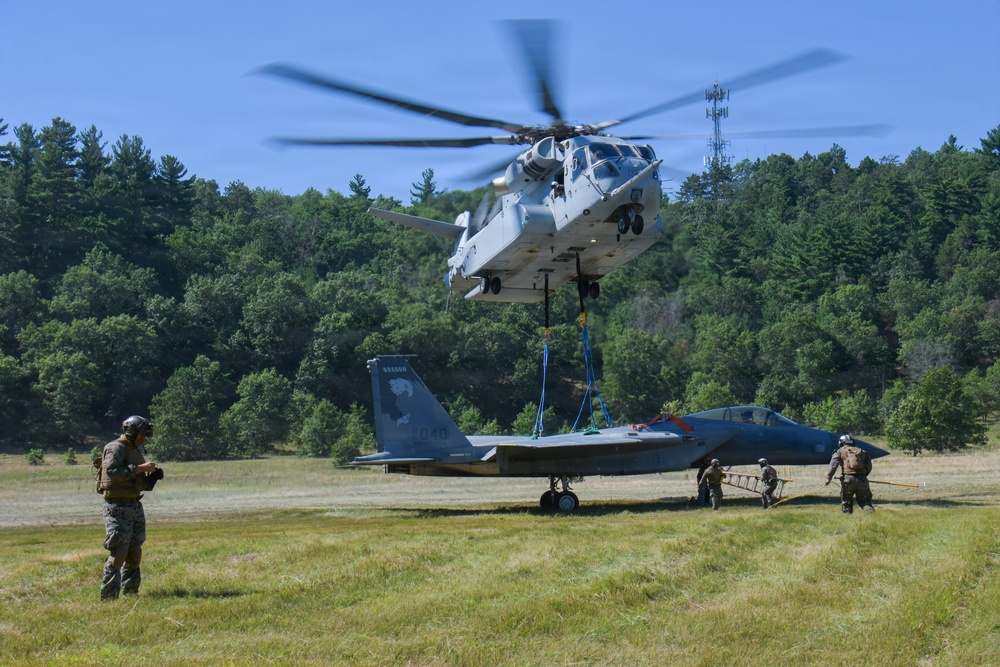
Photo By Paul Gorman | U.S. Marines assigned to Marine Operational Test & Evaluation Squadron 1 use a...... read more read more
CAMP DOUGLAS, Wis. - More than 85 military and civilian defense partners took part in the Advanced Crash Damaged and Disabled Aircraft Recovery Course at Volk Field Combat Readiness Training Center July 10-17.
The course, administered by the Joint Program Office, provided attendees with practical, hands-on training recovering a wide variety of airframes with the equipment and techniques necessary to do so safely and efficiently.
Senior Master Sgt. Jordan Jensen serves as CDDAR deputy program manager for the National Guard Bureau Maintenance Division, as well as Volk Field’s CDDAR program site manager.
“The scenarios that we introduce to our students offer a tremendous amount of operational interchangeability,” Jensen explained. “We strive to ensure our students are familiarized with current recovery practices and equipment, while regularly adapting our training sites to replicate real-world incidents that they could potentially encounter.”
In addition to military participants from multiple U.S. active and reserve service components, this year’s course included 41 foreign national student participants from Singapore, Norway, Canada, Poland, Germany, the United Kingdom, and the European Air Transport Command. Also in attendance were representatives from several civilian organizations and defense partners, to include Lockheed Martin, Delta Airlines, the Naval Air Warfare Center Aircraft Division and the Joint Program Office Lightning Support Team.
During the course, participants were randomly divided into six different groups, challenging them to overcome the barriers that can result from differing career fields, experience levels and regional practices.
Master Sgt. Christian Steffen, a maintenance specialist with the German Air Force, recognized the importance of working with partner nations as his unit will be transitioning to F-35 Lightning II aircraft next year.
“We want to get more and more of our people here to work together with other nations,” Steffen relayed. “The language can be a barrier, but in a team, when you have a plan, everybody knows what to do.”
The teams were tasked to safely recover aircraft from sites at both Volk Field and Hardwood Air-to-Ground Weapons Range using methods such as airbag lifts, PlaneSkates and the Transporter multi-aircraft movement system.
To contribute to the realism of the scenarios, students also addressed concerns such as on-site communications, personal protective equipment, fire management, unexploded ordnance and securing classified items.
To achieve course objectives, the students were assisted by the assets and expertise of multiple joint partners.
Company D of the Wisconsin Army National Guard’s 173rd Brigade Engineer Battalion operated tactical unmanned aircraft systems to provide participants with precision drone mapping of the crash sites. U.S. Marines assigned to Marine Operational Test and Evaluation Squadron 1 (VMX-1) provided CH-53K King Stallion helicopters to transport heavy equipment between training sites, and performed sling lift operations of F-15 Eagle, F-16 Fighting Falcon and F-18 Hornet aircraft with a 100% success rate. Additionally, CH-47 Chinook helicopters assigned to the Iowa Army National Guard’s 1st Battalion, 171st Aviation Regiment provided transportation to each of the training locations.
Representatives from the Naval Air Warfare Center Aircraft Division Cargo Lab traveled to Volk Field to help facilitate VMX-1 sling load operations by minimizing undue risk to personnel and equipment.
“The CDDAR team had a very good handle on this,” relayed Michele Hoefer, NAWCAD Cargo Lab engineer. “We just added some more specific experience with the supporting aircraft, and were happy to contribute to operations that promote collaboration across the DoW and allied forces.”
Preparations for this year’s training iteration began as soon as the 2025 course ended. Students were tasked to provide feedback on which aspects of the course they found most valuable and what might be incorporated to improve the training for future participants.
In total, hundreds of man-hours were spent establishing agendas, coordinating logistics and preparing training sites, allowing 18 instructors from 13 bases and four different countries to facilitate the week-long course.
Chief Master Sgt. Ronald Jemmott, CDDAR program manager for NGB’s maintenance division, voiced his appreciation to Jensen and Volk Field Commander Col. Timothy Guy for the quality of training the course provides.
“When I first came out here, I was really taken aback,” Jemmott said. “The facilities here are outstanding, and what Jordan’s team and Col. Guy have done, with very limited resources to make sure their students are ready to handle any tasks that are out there, is truly phenomenal.”
While CDDAR training has taken place at Volk Field for more than a decade, the involvement of the Joint Program Office has significantly expanded the scope of the training provided by Jensen and his staff.
Since 2019 alone, they have trained nearly 1000 military members, hosting 11 team chief courses and 21 annual training events. In 2025, they also administered CDDAR courses in Italy, Germany, and Japan, and have begun providing annual support to U.S. Marine Corps courses at Marine Corps Air Stations Miramar in California and Cherry Point in North Carolina.
“Helping to facilitate training opportunities for CDDAR teams in multiple nations has been the highlight of my military career,” said Jensen. “As I approach the end of my time in uniform, I look forward to seeing Volk Field continue its role in shaping the future of crash recovery operations worldwide.”
For additional imagery and video of the 2026 JPO CDDAR course visit: https://www.dvidshub.net/feature/VFCDDAR
| Date Taken: | 07.22.2026 |
| Date Posted: | 07.22.2026 17:16 |
| Story ID: | 570535 |
| Location: | CAMP DOUGLAS, WISCONSIN, US |
| Web Views: | 504 |
| Downloads: | 0 |

This work, Volk Field hosts multinational aircraft crash recovery training, by Paul Gorman, identified by DVIDS, must comply with the restrictions shown on https://www.dvidshub.net/about/copyright.


No keywords found.





