
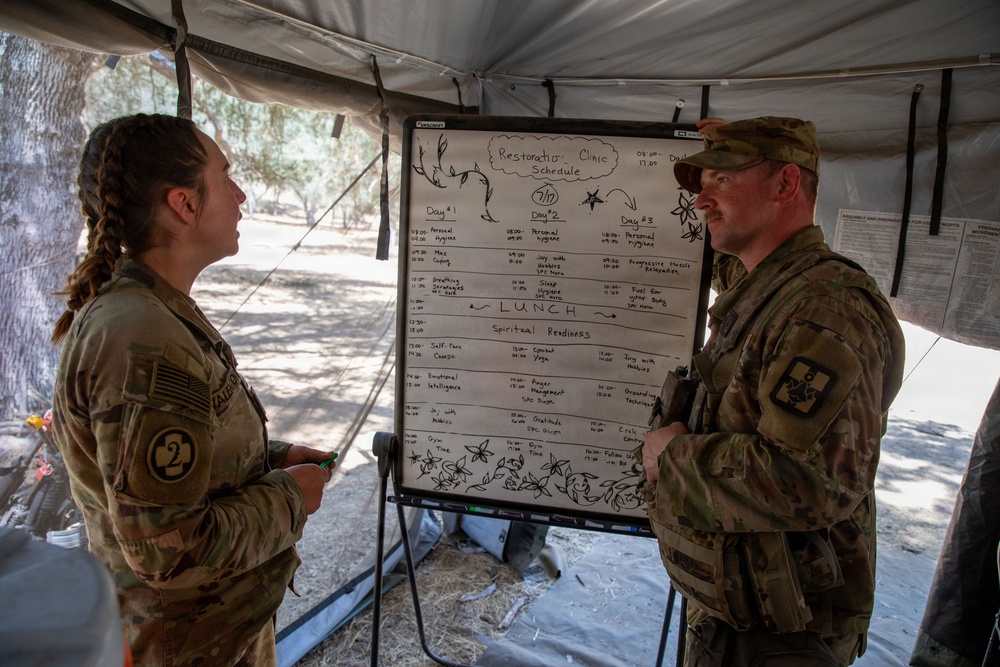
Photo By Staff Sgt. Mikayla Fritz | From left, U.S. Army Sgt. Athena Valentovis, a behavioral health specialist, and Sgt....... read more read more
 Subscribe
FORT HUNTER LIGGETT, Calif. — While field hospitals treat traumatic injuries and ambulance crews move casualties across the battlefield, behavioral health teams were preparing for another critical mission during Exercise Global Medic, as part of Operation Bold Eagle 26: keeping Soldiers mentally resilient and mission ready.
Soldiers assigned to the 1835th Medical Detachment (Combat and Operational Stress Control) trained alongside Army Reserve medical units during the exercise, operating expeditionary behavioral health clinics and responding to simulated patients in a realistic, austere environment designed to prepare forces for large-scale combat operations.
Unlike traditional behavioral health settings, COSC teams deploy alongside supported units, providing care close to the fight.
"The thing about a Combat and Operational Stress Control Unit is we specialize in going out with the units," said Sgt. 1st Class William Guerre, an occupational therapy specialist assigned to the 55th COSC, who augmented the 1835th COSC during the exercise. "We're not in the rear. We get put right into the fight. So, where the Soldiers are, we are."
Global Medic challenged units to rapidly establish and relocate field medical facilities while training in their military occupational specialties. For the 1835th COSC, that meant proving they could establish behavioral health services anywhere the mission required.
"We have to pop up clinics quickly, take them down quickly," Guerre said. "This gives us a really great opportunity to test our capabilities and see where we're deficient or where we're meeting those metrics that we have to hit."
Behavioral health support in a deployed environment differs significantly from treatment in garrison or civilian practice.
"Stateside, garrison, civilian side, behavioral health is typically done in a very controlled environment," Guerre said. "What we do in COSC units, that is not the case."
Instead of weeks or months of scheduled therapy sessions, COSC teams often have only one opportunity to help a Soldier before returning them to their unit.
"The whole job for us is to return Soldiers back to the fight," Guerre said. "We want to keep people where they are. We're a force multiplier."
That means providing practical coping skills Soldiers can immediately apply, knowing they may never return for another appointment.
"We've got to give them tools that they can take back with them because we may only see these Soldiers one time," Guerre said.
As an occupational therapy specialist, Guerre helps bridge the gap between clinical recommendations and practical application by teaching Soldiers how to incorporate stress management techniques into their daily routines while deployed.
The detachment also operates restoration programs designed to help Soldiers recover without removing them from their units whenever possible.
"Not every Soldier needs to be taken out to another echelon of care," Guerre said. "We actually put up what we call restoration, and that allows these Soldiers three days of getting good sleep."
The program focuses on the fundamentals of recovery, including sleep, nutrition, hygiene and practical stress-management techniques before returning Soldiers to duty.
The detachment also works alongside embedded chaplains, giving Soldiers another confidential resource when they need someone to talk to.
Guerre stated, "If it's something they don't want to talk to us about, oftentimes they're more than happy to talk to the chaplain because that is confidential. That's a huge tool for us."
During Global Medic, role players presented behavioral health teams with a wide range of simulated scenarios.
"Not everybody that comes into behavioral health has psychosis or PTSD," Guerre said. "Some of them are just simple home-front issues. It's hard to be away from home for nine, 10 or 11 months."
The training also gave junior Soldiers and officers an opportunity to experience operational behavioral health in a realistic environment for the first time.
"This is the first time a lot of people are really getting to put their skills to the test," Guerre said. "This is an awesome opportunity for them to get stressed. They're throwing some hard stuff at us here, but we have some really young people and they're doing awesome."
For Guerre, watching younger Soldiers gain confidence has become one of the most rewarding aspects of the exercise.
"I love to see people succeed where they don't think they would have," he said. "You start seeing skills in people that they don't even know they have. When they succeed and realize, 'Holy cow, I can do this,' that's incredibly rewarding."
For Sgt. Grae Dewey, a behavioral health specialist assigned to the 1835th COSC, supporting Soldiers means helping them succeed both during the mission and long after the exercise ends.
"Personally, the most rewarding part of my job is knowing that we're planting seeds of hope and help," Dewey said. "We're helping service members in the moment. We're helping them return to duty with the mental health and mental clarity that they need.”
After more than two decades of service, Guerre witnessed a cultural shift in how behavioral health is viewed across the Army. That evolution, he said, has strengthened the role of behavioral health teams and made training exercises like Global Medic increasingly valuable for preparing Soldiers to support units in operational environments.
"My first deployment, there was a huge stigma around behavioral health," Guerre said. "Now commanders understand the importance. They understand we're a force multiplier."
About Operation Bold Eagle 26 Operation Bold Eagle 26 is a premier multi-echelon training exercise providing mission command for 74 units and more than 3,300 Soldiers. It combines a Combat Support Training Exercise (CSTX) and Global Medic (GM), an international joint military medical training exercise, to prepare Army Reserve forces for large-scale combat operations (LSCO) in a demanding multi-domain operational (MDO) environment from July 14-23, 2026.
| Date Taken: | 07.19.2026 |
| Date Posted: | 07.21.2026 19:20 |
| Story ID: | 570447 |
| Location: | FORT HUNTER LIGGETT, CALIFORNIA, US |
| Web Views: | 36 |
| Downloads: | 0 |

This work, Behavioral health services stays in the fight, next to troops at Bold Eagle 26, by SSG Mikayla Fritz, identified by DVIDS, must comply with the restrictions shown on https://www.dvidshub.net/about/copyright.


No keywords found.




