
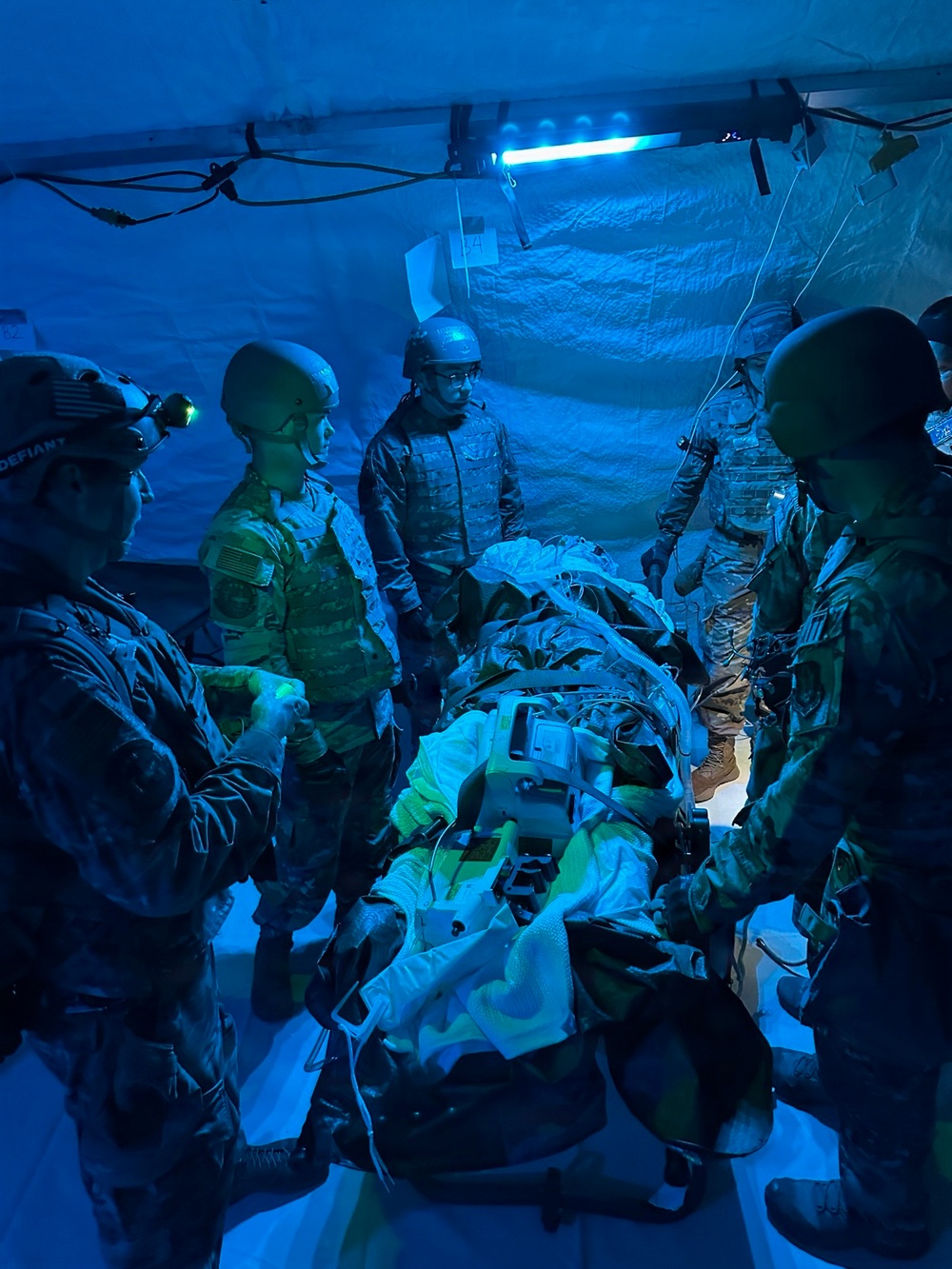
Courtesy Photo | Reserve members stand up an operational medical staging facility from the ground up at...... read more read more
 Subscribe
When lives are on the line in a contested environment, the window between point-of-injury care and strategic airlift is critical. For Airmen of the 403rd Aeromedical Staging Squadron, mastering that window was the primary mission during Patriot Medic 2026.
Held across the Gulfport Combat Readiness Training Center and Camp Shelby, Mississippi, Patriot Medic 2026 challenged medical personnel to operate in austere conditions simulating Large-Scale Combat Operations. The exercise evaluated joint-service readiness, focusing on trauma care, enroute stabilization, and rapid patient evacuation under high-pressure scenarios.
Patriot Medic is the U.S. Air Force Reserve’s premier annual medical readiness exercise, designed to train and certify Reserve medical personnel in combat and deployment environments. For the 403rd ASTS, it was a rigorous test of their core capability: establishing the vital link between front-line combat medics and aeromedical evacuation aircrews.
"Patriot Medic validates Reserve medical readiness, strengthens resilience and adaptability, and prepares forces for future conflicts," said Master Sgt. Jammie Evans, 403rd ASTS unit deployment manager, who served as an Observer Coach/Trainer and Subject Matter Expert during the exercise. "It also builds long-term medical capability development."
The training kicked off with the rapid deployment of mobile field hospitals. Airmen were tasked with standing up fully operational medical staging facilities from the ground up at Camp Shelby's austere training sites. Operating frequently under chemical, biological, radiological, and nuclear threats wearing Mission Oriented Protective Posture gear, the medical teams processed continuous waves of simulated casualties.
"The event naturally includes realistic field training, simulated emergencies, and cross-service coordination to test and improve capabilities," said Evans. "There was alarm black, there was CBRN threats and MOPP gear, and naturally there was the Mississippi weather at play, so that brings extra stressors as well."
To accurately simulate this friction of war, evaluators introduced complex inject scenarios that tested every facet of the squadron's capabilities. Teams managed severe trauma and navigated the complex logistics of patient regulation while handling mass casualty surges, contaminated ground procedures, morgue operations, shift fatigue management, and unexpected spikes in the number of patients needing evacuation.
Integrating directly into these high-stress scenarios was Maj. Brett Price, a 403rd ASTS Critical Care Air Transport Team registered nurse. CCATTs are three-person teams, which consists of a critical care physician, nurse, and respiratory therapist, who augment the aeromedical evacuation system to provide intensive care during transport.
"My role included participating in critical-care scenarios, helping integrate CCATT operations with Aeromedical Evacuation, Expeditionary Medical Support, En Route Patient Staging System, and Ground Surgical Team personnel," said Price. "One of the greatest benefits was the opportunity to share experience across specialties and help participating organizations better understand how CCATT connects surgical and ground-based care with aeromedical evacuation."
Some examples of these connections include an exercise event consisting of an aircraft launch and recovery, which provided the CCATT, aeromedical evacuation, and ERPSS teams an opportunity to coordinate with each other on configuring C-130 station setup, practice safe litter movement, standardized movement commands, and communication between the aircraft and ground teams.
“The teams worked together on jointly configuring the C-130 and develop an efficient aircraft patient-load plan,” said Price. “However, an inject created a challenge introducing an increase in the number of patients requiring evacuation, forcing rapid reassessment and reconfiguration of the load plan and aircraft. Furthermore, an additional inject shortened the ground time before take-off.”
Price said that these injects represented real-world challenges creating an opportunity for the CCATT, ERPSS, and AE teams to perform effective teamwork, professionalism, cross-team communication, safe litter movement, and showcase operational flexibility under pressure that resulted in a successful on-time simulated launch despite obstacles.
Another major focus of the exercise was practicing Tactical Combat Casualty Care principles, specifically the critical transition from Care Under Fire to Tactical Field Care.
"The exercise helped reinforce that TCCC is not simply a list of medical procedures, it is a phased approach in which treatment priorities change according to the tactical situation," said Price. "Members demonstrated a good appreciation for the need to perform the right intervention at the right time rather than attempting to provide definitive care before the tactical situation permits it."
Applying these clinical principles often required Airmen to adapt to severe resource constraints, making interoperability and flexibility central themes throughout the 2026 iteration. At one point, teams had to conduct simulated CCATT operations without a complete equipment allowance standard, forcing them to improvise training aids to represent monitors, ventilators, and suction systems.
"It was a strong demonstration of the adaptability expected in an austere environment: identify what is essential to the mission, use the resources available, and continue training safely while preserving the clinical objectives," Price said. "When technology or equipment is limited, every team member must understand the patient’s condition, treatment priorities, evacuation plan, and contingency options."
Despite the long hours, resource constraints, and simulated combat stress, the En Route Patient Staging Systems successfully moved patients safely without accidents, relying heavily on cross-functional teamwork. "I really feel like everyone stepped up, and the newly trained members in their jobs were right there taking on roles and responsibilities, taking their job seriously," said Evans. "Because every inject that was started was completed in a timely manner, that says a lot. Our members are being trained and will be an asset downrange."
Price echoed this sentiment, noting how quickly the diverse teams unified.
"Many of the participants had not previously worked together and many have never deployed, yet they quickly formed functional teams, established clear responsibilities, and integrated effectively," said Price. "Patriot Medic provided a valuable opportunity to validate those relationships, identify areas for continued growth, and strengthen readiness for future joint and contested-environment operations."
By continually testing their ability to operate in degraded environments, the 403rd ASTS ensures they remain a premier aeromedical staging capability, ready to bring wounded warriors home safely when the call comes.
| Date Taken: | 07.20.2026 |
| Date Posted: | 07.21.2026 16:09 |
| Story ID: | 570420 |
| Location: | CAMP SHELBY, MISSISSIPPI, US |
| Web Views: | 281 |
| Downloads: | 0 |

This work, 403rd ASTS bridges the gap between battlefield and airlift during Patriot Medic 2026, by Jessica Kendziorek, identified by DVIDS, must comply with the restrictions shown on https://www.dvidshub.net/about/copyright.


No keywords found.




