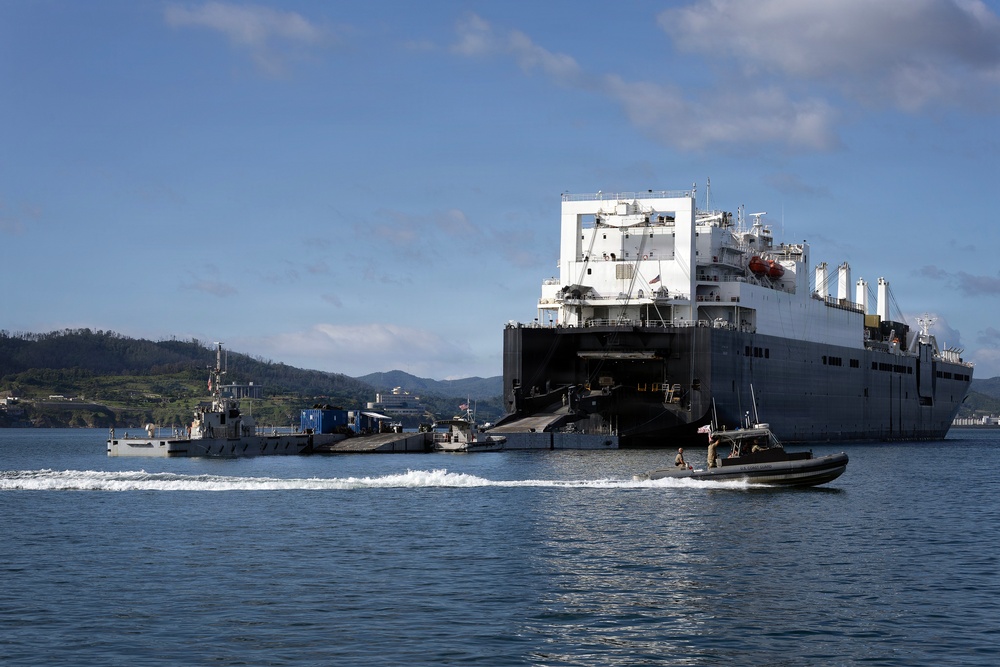
Before the first vehicle rolled ashore at Dogu Beach during Combined Joint Logistics Over-the-Shore 26 in Pohang, South Korea, U.S. Marine Corps Sgt. Mariah Aparicio was already below deck aboard USNS Sisler, moving through steel ladder wells with a folded load plan in her hand.
Inside the ship's cargo holds, the July heat lingered until ventilation systems could be started for vehicle movement. Wearing a red reflective vest marked "Blount Island Command," Aparicio verified every item remained exactly where it belonged ahead of the next phase of the operation.
"The goal at this point is to squeeze and compact," Aparicio said, finalizing the offload with Marines from 3rd Maintenance Battalion, Combat Logistics Regiment 35, 3rd Marine Logistics Group. Two days ahead of schedule, they had repositioned the final cargo near the stern for offload.
"Now we need to fit everything in so we're not wasting any space," she said of the remaining equipment.
Aparicio arrived July 4 from Blount Island, Florida, ready to support CJLOTS 26, a combined exercise held July 10–20 that integrated U.S. and Republic of Korea lighterage and ship-to-shore connector capabilities. The equipment would also support Korean Marine Exchange Program 26.2, a follow-on exercise that further strengthens interoperability within the alliance.
Some 21 service members, civilians and contractors deployed from Marine Corps Support Facility Blount Island, where they generate, sustain, modernize and position service-managed equipment that supports Marine Corps operations worldwide.
As one of two embarkation specialists assigned to Blount Island Command's technical assistance and advisory team, Aparicio worked alongside Marines from 3rd Marine Logistics Group to verify equipment placement and preserve the vessel’s loading sequence.
"This is one of the easier decks," she said, moving between tactical trucks and generator carts. "There's less stuff up here. Some of the others are a real puzzle."
Every vehicle had to leave the ship in a precise sequence. If equipment was misplaced, Marines could spend hours repositioning vehicles to reach mission-essential cargo.
"If you move something to another deck, it may not fit, and you could cause damage getting it there."
A roll-on, roll-off discharge facility connected to USNS Sisler’s stern ramp allowed Marines to drive vehicles directly onto Improved Navy Lighterage System causeway ferries. Sailors assembled and operated the ship-to-shore system, building on experience gained during recent regional exercises. When the ferries dug into Dogu Beach, the vehicles rolled ashore through salt spray. U.S. Army watercraft also transported selected cargo to the Trident Pier, a modular floating pier extending from the beach.
Hundreds of pieces of equipment were offloaded, including nearly 300 vehicles. The offload was only one phase of the mission.
The accelerated timeline allowed Marines to shift sooner to joint limited technical inspections with maintenance contractors from Blount Island.
Blowing sand swept through rows of equipment at a staging area, where Marines assigned to 3rd Landing Support Battalion and Combat Logistics Regiment 35 conducted arrival and assembly operations.
Cpl. Seth Waite, a Blount Island Command supply quality assurance specialist, led the disassociation of roughly 200 pieces of equipment that had been temporarily removed during the offload to preserve the ship's discharge sequence. He ensured every item in the maritime positioning set remained fully accountable while staged ashore.
Nearby, Sgt. Abigail Raines, Blount Island Command data systems administrator specializing in the Marine Corps Platform Integration Center, guided Marines through the digital asset tracking process as vehicles departed the staging area for training. Each scan updated the equipment's location.
From sweltering cargo holds to salt-soaked causeway ferries and windswept staging areas, every vehicle had to leave the ship in the correct sequence, arrive at the right location and remain fully accountable for follow-on maneuvers.
Long after the last vehicle left the beach, Blount Island Command's technical assistance and advisory team continued preparing the maritime positioning set for its next mission.
"CJLOTS reinforces that interoperability extends beyond ships and connectors," said Col. Robert Fairley, commanding officer of Combat Logistics Regiment 35, 3rd Marine Logistics Group. "It includes the technical expertise, sustainment systems and responsive logistics that allow combined forces to operate together."
At Dogu Beach, Fairley watched Marines and Sailors demonstrate ship-to-shore sustainment capabilities.
"Every piece of equipment that arrives where it needs to be, when it needs to be there, strengthens our ability to rapidly respond to crisis or contingency alongside our Republic of Korea allies," he said.
| Date Taken: |
07.21.2026 |
| Date Posted: |
07.21.2026 14:26 |
| Story ID: |
570418 |
| Location: |
POHANG, GYEONGSANGBUGDO [KYONGSANGBUK-DO], KR |
| Hometown: |
JACKSONVILLE, FLORIDA, US |
| Web Views: |
220 |
| Downloads: |
0 |
PUBLIC DOMAIN

This work, Blount Island Team Keeps Maritime Readiness Moving in South Korea, by Dustin Senger, identified by DVIDS, must comply with the restrictions shown on https://www.dvidshub.net/about/copyright.