
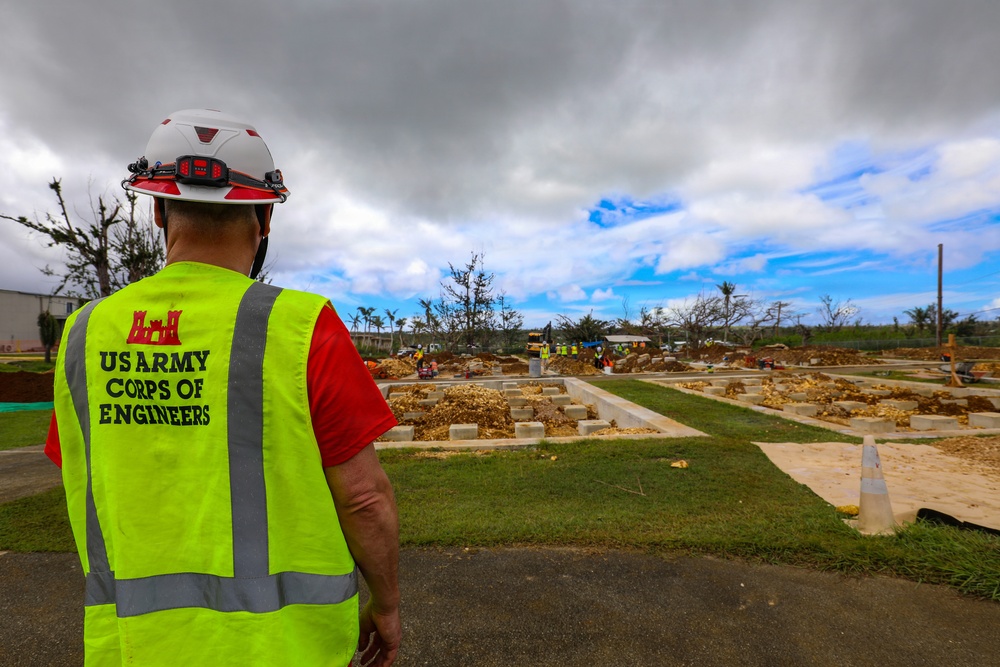
Photo By Monique Freemon | Post-super typhoons Sinlaku and Bavi, educational facilities across Saipan, from...... read more read more
SAIPAN, Northern Mariana Islands— In the aftermath of Super Typhoons Sinlaku and Bavi, residents of the Commonwealth of the Northern Mariana Islands are continuing their road to recovery. The U.S. Army Corps of Engineers has partnered with the Federal Emergency Management Agency, the American Red Cross, and other local and federal agencies to restore life-essential functions across the CNMI.
Educational facilities across Saipan, from elementary schools to colleges, were forced to postpone their academic years or close completely due to extensive storm damage. Northern Marianas College, the islands’ premier higher-education institution, suffered significant structural damage from Typhoon Sinlaku.
The college cut its spring semester short and postponed the May graduation ceremony following the storm's devastation. According to NMC's website, summer semester classes resumed July 13.
To support the institution's recovery and ensure educational continuity, USACE is constructing 18 modular classrooms and two restrooms for NMC.
“It has been a wonderful project to work on for the people of CNMI," said Capt. Wesley Beck, a critical infrastructure mission commander deployed from the USACE San Francisco District. "It is critical for the future of CNMI since it is the highest level of education on the island.”
Based on engineering lessons learned from temporary structures USACE erected in 2018 after Typhoon Yutu caused similar devastation, the new buildings’ design has been heavily modified to withstand the region's harsh tropical climate. Each building can accommodate up to 30 students.
The climate-controlled design ensures the classrooms remain between 70 and 75 degrees Fahrenheit and maintain 50% humidity, creating a comfortable and dry learning environment. With outside temperatures averaging between 70 and 90 degrees Fahrenheit alongside 80% humidity, the new classrooms provide vital resilience against the tropical weather.
Because NMC is the primary higher-education institution on the island, completing the classrooms on a significantly accelerated timeline is a top priority for USACE.
“The people we have been working with have been fantastic and have a strong willingness to work with us,” Beck said.
The upgraded classrooms will also feature new lighting and removable sunshades to protect students from the intense sun.
Because the CNMI is surrounded by saltwater, design criteria require the classrooms’ framework to be constructed from galvanized tubular steel treated with a protective anti-corrosion coating. This specialized engineering prevents rust and significantly extends the lifespan of the structures.
Super typhoons Sinlaku and Bavi brought sustained winds of 130 mph and 180 mph, respectively. To prepare for future severe weather events, USACE designed the new modular structures to withstand 185 mph winds, ensuring they can resist the strength of another super typhoon.
“Our work will have a lasting effect on the genuinely wonderful people on the island,” Beck said.
A ribbon-cutting ceremony for the new facilities is projected for late fall.
“I'm proud to have played a small part helping CMNI students get back to school and back to normal,” said Louie Munoz, a USACE critical infrastructure mission manager.
For more information on USACE post-typhoon recovery and relief operations, visitthe Sinlaku Response webpage.
| Date Taken: | 07.21.2026 |
| Date Posted: | 07.21.2026 18:05 |
| Story ID: | 570378 |
| Location: | SAIPAN, MP |
| Web Views: | 29 |
| Downloads: | 0 |

This work, USACE Aids Northern Mariana Islands Recovery with Climate-Resilient Classrooms Following Super Typhoons, by Monique Freemon, identified by DVIDS, must comply with the restrictions shown on https://www.dvidshub.net/about/copyright.


No keywords found.





