NSWCPD Helo Hangar Door Team Earns NAVSEA Readiness Generation Award
Photo By Jay Butterbaugh |
Naval Surface Warfare Center, Philadelphia Division’s (NSWCPD) Helo Hangar Door Team......read moreread more
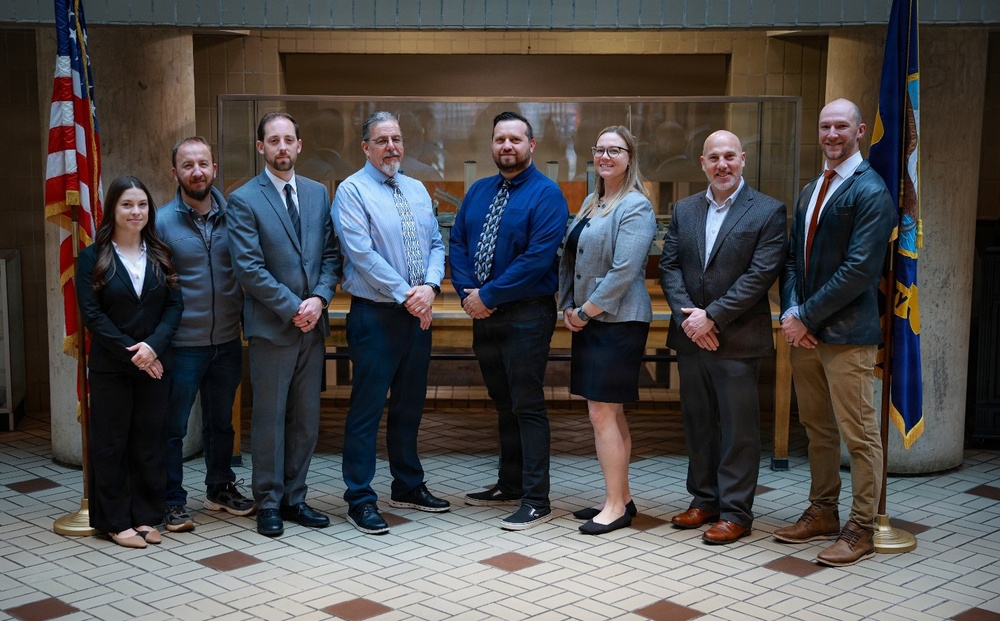
Photo By Jay Butterbaugh | Naval Surface Warfare Center, Philadelphia Division’s (NSWCPD) Helo Hangar Door Team has been named a recipient of the NAVSEA Readiness Generation Award. (L-R) Mariah Schmelzle, Daniel Turek, James Case, Kenneth Poole, Salvatore DeSantis, Kristen Bradshaw, Patrick Violante, and Philip T. Greiner. Team members not present: Randall Kern, Allison Hice, and Tyler Sutton. (U.S. Navy photo by Jay Butterbaugh, CTR) see less
| View Image Page
NSWCPD Helo Hangar Door Team Earns NAVSEA Readiness Generation Award
Naval Surface Warfare Center, Philadelphia Division’s (NSWCPD) Helo Hangar Door Team recently earned the Naval Sea Systems Command (NAVSEA) Readiness Generation Award for rapidly developing and delivering an additive manufacturing solution that helped restore shipboard capability, reduce lead times, and support Navy readiness.
The team, led by Helo Hangar Door In-Service Engineering Agent Randall Kern, partnered with the Advanced Data Acquisition Prototyping Technology and Virtual Effects Lab Team, known as ADAPT.VE, to address Helicopter Hangar Door component failures affecting guided-missile destroyers. The team engineered a critical Helicopter Hangar Door component using additive manufacturing, reducing lead time and enhancing mission effectiveness.
The award will be formally presented during a ceremony on June 11 in the Washington Navy Yard, where winners will be recognized both in person and virtually. NSWCPD will also hold a Command-level ceremony later in June to celebrate the team’s achievement.
The Helo Hangar Door Team is credited with resolving a critical Helicopter Hangar Door proximity switch bracket failure aboard USS Halsey (DDG 97) and USS Spruance (DDG 111). In late 2023, the bracket failure threatened mission readiness. The team designed, tested, and delivered a replacement component in 19 days, installed the bracket aboard USS Halsey four days ahead of operational need, and reduced a traditional six- to 12-month lead time to 18 days.
For Kern, the effort showed what can happen when engineering urgency, technical expertise, and cross-team collaboration come together around a fleet need.
“This was never just about making a part faster,” Kern said. “It was about getting a ship the capability it needed, when it needed it, and proving that additive manufacturing can give the Navy more options when traditional supply timelines are too long. The team understood the operational impact from the start, and everyone stayed focused on delivering a safe, effective solution for the Sailors who needed it.”
The effort was later replicated aboard USS Spruance, helping ensure the ship remained mission capable for a summer 2024 deployment. The bracket is now fully provisioned in the Navy’s logistics system, expanding the solution beyond a single shipboard repair.
“The Helo Hangar Door Team earned this recognition through creativity, technical discipline and a clear focus on readiness,” NSWCPD Hull, Deck and Machinery Systems Division Head Chedric “Ced” Waters said. “Their work reflects the best of NSWCPD, people who identify a fleet challenge, bring the right expertise together and deliver results that matter to the Navy and the Sailors who rely on these systems.”
During fiscal year 2025, the team also supported repairs to USS Pinckney’s (DDG 91) port Helicopter Hangar Door, enabling the ship to obtain full Aviation Certification for deployment using additive manufacturing valve subplates. Through collaboration with the ADAPT.VE Lab Team, the Helo Hangar Door Team developed a solution intended to eliminate failures and restore normal operating capabilities for additional Helicopter Hangar Door components on guided-missile destroyers.
NSWCPD Propulsion, Power & Auxiliary Machinery Systems Department Head Karen Dunlevy Miller said the team’s work demonstrated the direct connection between engineering innovation and operational readiness.
“The Helo Hangar Door Team took a readiness challenge and turned it into a repeatable solution for the Navy,” Dunlevy Miller said. “Their work shows how NSWCPD engineers solve real problems under real constraints, while keeping the needs of the Sailor and the mission at the center of every decision. This award recognizes more than a technical achievement. It recognizes a team that helped move additive manufacturing from promise to practical readiness.”
The cost impact was significant.The effort reduced the per-valve expense from approximately $100,000 to $10,000 (6 valves per ship) and the per-ship expense from $600,000 to $60,000. The work also contributed to broader Flight IIA DDG modernization, with subplates installed aboard USSShoup (DDG 86), USS Pinckney (DDG 91), and USS Truxtun (DDG 103).Ship change documents were submitted through the Machinery Alterations program to support class-wide adoption, with 196 subplates planned for installation across fiscal years2027and2028.
The team’s contribution also accounted for 45% of all additive manufacturing installations, with additional advancements underway for components supporting the port Helicopter Hangar Door pneumatic console. The award recognized how the team’s work reduced Sailor workload, eased engineering burdens, and demonstrated that additive manufacturing is an essential capability for sustaining naval readiness.
Joining Kern on the Helo Hangar Door Team were Kenneth Poole and Tyler Sutton. The ADAPT.VE Lab Design Team included Kristen Bradshaw, Patrick Violante, Salvatore DeSantis, Philip Greiner, Daniel Turek, James Case, Allison Hice, and Mariah Schmelzle. In addition to his work with the ADAPT.VE Lab, Violante supported the Parts Installation Team of the Maritime Industrial Base.
The NAVSEA Readiness Generation Award recognizes the Helo Hangar Door Team for exceptional collaboration, technical execution, and innovation in support of the Navy, the Nation, and the Sailors who rely on mission-ready ships.
NSWCPD employs about 2,700 civilian engineers, scientists, technicians, and support staff. The team focuses on research and development, testing and evaluation, acquisition support, and in-service and logistics engineering for non-nuclear machinery, ship machinery systems, and related equipment and materials for Navy surface ships and submarines. NSWCPD also serves as the main organization responsible for providing cybersecurity for all ship systems.

 Subscribe






